
The process at a glance
Publishing a journal article is a sequence of decisions shared between you, the editor, the reviewers and the publisher. The details differ between journals and disciplines, but the stages are broadly the same. For doctoral researchers the process is also part of learning to write for a scholarly audience beyond the thesis (Kamler, 2008).
- 1Choose a journal
- 2Prepare the manuscript
- 3Submit
- 4Editorial screening
- 5Peer review
- 6Decision
- 7Revise and resubmit
- 8Acceptance
- 9Production and proofs
- 10Publication
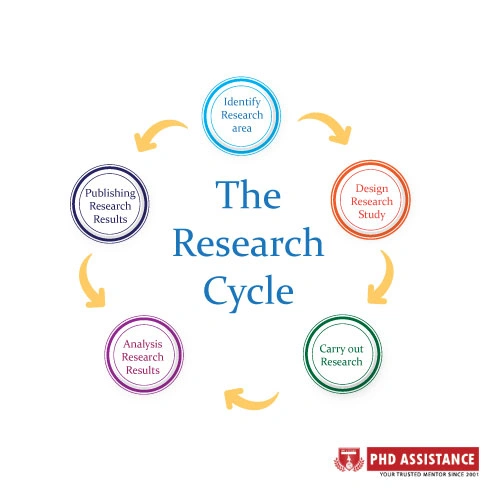
Stage 1: choose the journal before you finish writing
Choosing the journal early lets you shape the paper to its scope, audience, article types and word limits. Read the aims and scope and several recent articles, and check how the journal handles open access, licences and any publication charges. Check legitimacy too: predatory journals mimic real ones but do not provide genuine peer review or editorial service (Grudniewicz et al., 2019). The Think. Check. Submit. checklist offers a structured way to judge a journal before you commit (Think. Check. Submit., n.d.). For more on this stage, see how to select a journal for publication.
Stage 2: prepare the manuscript
Follow the journal's instructions for authors exactly: structure, reference style, figure formats, data availability statements and declarations. Use the reporting guideline for your design where one exists, for example CONSORT 2025 for randomised trials, which replaced CONSORT 2010 (Hopewell et al., 2025), or PRISMA 2020 for systematic reviews (Page et al., 2021).
- Authorship. Agree who qualifies as an author and the order before submission. Many journals require contributor statements using roles such as conceptualisation, analysis and writing (Brand et al., 2015), and medical journals apply the ICMJE authorship criteria (International Committee of Medical Journal Editors, 2024).
- AI tools. Generative AI cannot be listed as an author, and its use must be disclosed according to the journal's policy (Committee on Publication Ethics, 2023). Publisher policies vary considerably, so read the one that applies (Ganjavi et al., 2024).
- Prior publication. If parts of the paper come from your thesis, a preprint or an earlier article, check the journal's policy and declare any reuse of text (Committee on Publication Ethics, 2024).
- Cover letter. State briefly what the paper contributes, why it fits the journal, and that it is not under consideration elsewhere.
For a full pre-submission checklist, see preparing a manuscript to meet journal requirements.
Stages 3 and 4: submission and editorial screening
Most journals use an online submission system that asks for the manuscript, figures, supplementary files, declarations of interest and funding, ethics approvals and suggested or excluded reviewers. Submit to one journal at a time; duplicate submission breaches publication ethics (International Committee of Medical Journal Editors, 2024).
An editorial office then checks completeness and compliance, and an editor reads the paper to decide whether it is within scope and of sufficient interest and quality to send for review. A desk rejection at this point is common and usually quick. It often reflects poor fit rather than poor research, which is why journal choice matters.
Stage 5: peer review
The editor invites usually two or more independent experts to review the manuscript. Review may be single anonymous, double anonymous or open, depending on the journal. Reviewers assess the importance of the question, the soundness of the methods, the support for the conclusions and the clarity of reporting, and advise the editor; the editor makes the decision (Glonti et al., 2019). Review times vary widely between fields and journals, so check the journal's own published information rather than relying on general estimates.
Stage 6: the decision
| Decision | What it means | What to do |
|---|---|---|
| Desk rejection | Declined without external review | Consider fit, revise and choose another journal |
| Reject after review | Reviewed but not suitable for this journal | Use the comments to improve the paper before submitting elsewhere |
| Reject and resubmit | Not acceptable now, but a substantially revised version may be considered as a new submission | Decide whether the changes are feasible |
| Major revision | Potentially acceptable after substantial changes | Revise and respond to every comment |
| Minor revision | Acceptable after small changes | Revise promptly and carefully |
| Accept | Accepted for publication | Complete licence and production forms |
Rejection is not the end of a paper. A study of rejected biomedical manuscripts found that many were later published in other journals (Faggion & Menne, 2024).
Stage 7: revise and respond
Respond to each comment in a point-by-point letter: quote the comment, explain what you changed and where, and where you disagree, say why politely and with evidence. Make the editor's job easy by showing changes clearly (Noble, 2017). A revised manuscript may go back to the same reviewers. For a step-by-step method, see how to respond to peer reviewers.
Stages 8 to 10: acceptance, production and publication
After acceptance you sign a copyright transfer or a licence agreement; open access articles are usually published under a Creative Commons licence. The publisher copyedits and typesets the article and sends proofs. Check proofs carefully for errors in names, affiliations, numbers, tables and references, and answer every query, but do not use proofs to add new material. Many journals publish the accepted version online before the final issue, and the version of record then receives its final citation details.
After publication, share the article within the terms of the licence, deposit it in your institutional repository where allowed, and correct any errors through the journal's correction process. If you posted a preprint, link it to the published version; preprints are now widely used, and many go on to be published in journals (Abdill & Blekhman, 2019).
What to prepare at each stage
Much of the delay in publication comes from authors rather than journals: missing files, unclear declarations, slow revisions or unanswered proof queries. Preparing the right material at each stage keeps the paper moving.
| Stage | What you need | Typical problems |
|---|---|---|
| Choosing a journal | Shortlist of two or three journals, with scope, article type, open access terms and legitimacy checked | Choosing by reputation alone; overlooking charges or licence terms |
| Preparing | Manuscript in the journal's format, reporting checklist, figures, data statement, contributor statement | Wrong reference style; checklist items missing from the text |
| Submitting | Cover letter, declarations of interest and funding, ethics approval details, AI-use statement | Inconsistent author details; undisclosed overlap with earlier work |
| Peer review | Patience, and a plan for the next journal in case of rejection | Contacting reviewers; withdrawing without telling the editor |
| Revision | Revised manuscript with changes marked, point-by-point response letter | Partial responses; new analyses not explained |
| Production | Signed licence, answered proof queries, checked names and affiliations | Late proof corrections; new content added at proof stage |
Waiting, enquiries and appeals
While the paper is under review, it is reasonable to check the status in the submission system and, if the journal's stated review time has passed, to send a short, polite enquiry to the editorial office. Do not contact reviewers, and do not submit the paper elsewhere unless you have formally withdrawn it. If you believe a rejection rests on a clear factual error by a reviewer, most journals allow an appeal to the editor; explain the error briefly and with evidence. Appeals are rarely successful when the disagreement is about judgement or fit, so in most cases it is better to revise and submit to another journal.
Planning publication from a thesis
If your thesis is in a monograph format, plan which chapters can become articles before you finish writing. Each article must stand alone, with its own argument, literature and methods, rather than being a chapter cut to length (Kamler, 2008). Agree authorship with your supervisors early, check whether your university allows thesis material to be published before examination, and keep a record of which text appears where so that any overlap can be declared (Committee on Publication Ethics, 2024). For a step-by-step approach, see how to convert a PhD thesis into a journal manuscript, and to learn the process from the reviewer's side, see how to peer review a manuscript.
Worked example and common mistakes
Illustrative example: a doctoral researcher submits a mixed-methods study to a journal chosen for its prestige. It is desk rejected as outside scope. She reads the aims and scope of three alternatives, picks one that has recently published similar designs, reformats the paper to its instructions, and adds a contributor statement and an AI-use declaration. After review she receives a major revision decision, revises with a point-by-point letter, and the paper is accepted after a second round.
- Choosing a journal by impact metric alone, without checking scope and article types.
- Ignoring reporting guidelines and the journal's formatting instructions.
- Leaving authorship and author order undecided until submission.
- Submitting to more than one journal at the same time.
- Answering reviewers defensively or leaving comments unanswered.
- Treating proofs as a chance to rewrite.
Key takeaways
- Choose the journal early and check its legitimacy as well as its scope (Grudniewicz et al., 2019; Think. Check. Submit., n.d.).
- Follow reporting guidelines such as CONSORT 2025 and PRISMA 2020 where they apply (Hopewell et al., 2025; Page et al., 2021).
- Agree authorship before submission and disclose any use of AI tools (International Committee of Medical Journal Editors, 2024; Committee on Publication Ethics, 2023).
- Reviewers advise and editors decide; a clear point-by-point response speeds revision (Glonti et al., 2019; Noble, 2017).
- A rejection often leads to publication elsewhere after revision (Faggion & Menne, 2024).