
Why journal choice matters
Choosing a journal is one of the first decisions in turning a thesis chapter into a paper, and it shapes everything after it: the length and structure of the manuscript, the readers who will find it and the weight others give it. A poor choice wastes months in desk rejection, and a dishonest outlet can attach your name to a journal that colleagues and assessors do not trust. Digital publishing and open access have multiplied the options, which makes careful selection more important, not less (Suiter & Sarli, 2019).
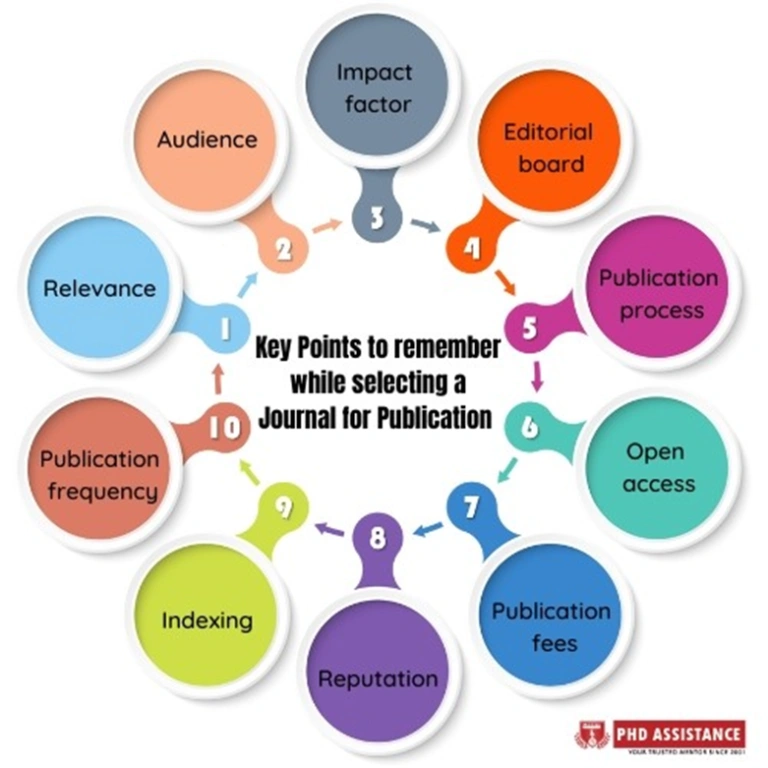
This guide works through the decision in five steps. Start from the paper, then judge rigour, then check legitimacy, and only then look at metrics and practical terms. The order matters: a well-indexed journal with a high impact factor is still the wrong choice if its readers will not care about your question.
Step 1: Start from your paper and its readers
Write down, in two sentences, what your paper contributes and who needs to know it. Then list the journals that the papers you cite most were published in, the journals your supervisor and colleagues read, and those where recent debates on your topic have taken place. This list is usually a better starting point than any search engine.
For each candidate, read the aims and scope page and the author guidelines, then look at the last year of issues. Check whether the journal publishes your article type (original research, review, short communication), your methods and your setting. Publisher tools that match an abstract to journals can widen the list, but they only suggest titles; the decision, and the checks below, remain yours (Elsevier, n.d.-a).
Note the practical limits as you go: word and figure limits, structured abstract requirements and reference style. A thesis chapter often needs heavy cutting to fit, and knowing the limits early tells you how much of your chapter one paper can carry.
Step 2: Judge scientific rigour and editorial quality
The quality of what a journal has already published is the best evidence of what it will do with your paper. Suiter and Sarli (2019) put scientific rigour and editorial quality first among their criteria. Read several recent articles in your area and ask:
- Are the purpose, design, methods, analysis and conclusions clear and consistent?
- Are tables and figures well labelled, and do the numbers in them agree with the text?
- Are reference lists complete and current?
- Does the journal ask authors to follow reporting guidelines for their study design?
- Is the peer review process described: who reviews, how many reviewers, typical timelines?
- Are policies on ethics approval, conflicts of interest, authorship and data stated and followed?
Look at the editorial board as well. Members should be identifiable researchers in the field, with institutional affiliations you can confirm independently (Suiter & Sarli, 2019).
Step 3: Check legitimacy and verify indexing
Predatory journals and publishers have been described, in an international consensus definition, as entities that prioritise self-interest at the expense of scholarship, marked by false or misleading information, deviation from best editorial and publication practice, a lack of transparency and aggressive, indiscriminate solicitation (Grudniewicz et al., 2019). They exploit the author-pays model (Beall, 2012), so the problem is not open access as such but outlets that charge fees without providing real peer review.
Early-career researchers are exposed to this. In a survey of 160 medical trainees at two academic medical centres in Abu Dhabi, 95% were unaware of resources to help them select a journal, and 15.2% of those who had received unsolicited publisher emails had submitted to an unfamiliar journal (Ibrahim et al., 2022). Simple checks prevent most mistakes:
- Work through the Think. Check. Submit. checklist: do you or your colleagues know the journal, can you contact the publisher, is the peer review process clear, are fees stated up front? (Think. Check. Submit., n.d.)
- Verify indexing claims in the database itself, searching by title and ISSN. Scopus, for example, requires a public description of peer review, an ISSN and a publication ethics statement, re-evaluates titles when concerns arise and marks discontinued titles in its source list (Elsevier, n.d.-b).
- Treat a claim of indexing only in Google Scholar as a warning sign (Suiter & Sarli, 2019).
- Be wary of flattering invitations, promises of very fast publication and generic emails from unfamiliar publishers (Suiter & Sarli, 2019).
Remember that database coverage is uneven. Web of Science and Scopus both over-represent the natural sciences, engineering and English-language journals, so a sound journal in the social sciences, the humanities or a regional language may be missing from one or both (Mongeon & Paul-Hus, 2016). Absence from a database is a reason to look harder, not proof of poor quality.
Step 4: Read impact metrics with care
The journal impact factor grew out of Garfield's proposal to use citation analysis to evaluate journals (Garfield, 1972). It reports the average number of recent citations to a journal's recent items. It says nothing reliable about any single article, varies widely between fields, and can be distorted by a few highly cited papers or by editorial practices. Suiter and Sarli (2019) advise choosing target journals for relevance and scientific rigour rather than impact factor.
The Leiden Manifesto offers sound rules for using any research metric: quantitative indicators should support, not replace, expert qualitative judgement, and differences between fields in publication and citation practice must be taken into account (Hicks et al., 2015). In practice, use metrics only to compare journals within your own field, check which database a metric comes from, and be suspicious of any journal that advertises a metric you cannot find in the source database.
Step 5: Weigh open access, fees, rights and timing
Once a journal passes the first four steps, practical terms decide between the remaining candidates. Check whether your funder or university requires open access and, if so, which routes it accepts and whether it pays article processing charges. Read the copyright or licence agreement: you should know whether you can post your accepted manuscript in a repository and reuse figures in your thesis (Suiter & Sarli, 2019). Note typical times to first decision and to publication, and how often the journal publishes, especially if you need the paper before a viva or job application.
Check the basic operations too. A trustworthy journal assigns DOIs to its articles, carries a valid ISSN, arranges long-term archiving of its content, publishes on a regular schedule and gives a working editorial contact (Suiter & Sarli, 2019). These details are easy to confirm and their absence is telling.
Finally, rank the journals that remain rather than picking one. Decide on a first choice, a second and a third, and note what you would change in the manuscript for each, such as word limit, structure, reference style or emphasis. A rejection then costs you weeks rather than months, because the next submission is already planned. Discuss the ranking with your co-authors and supervisor before you submit: every author must agree to the submission, and their knowledge of a journal's editors and reviewers is often the most useful evidence you have.
The ten criteria in one table
| Criterion | What to check | Where to check | Warning sign |
|---|---|---|---|
| Relevance | Aims and scope match your question, methods and article type | Aims and scope page; recent issues | No papers like yours in the last two years |
| Audience | The readers who need your finding read this journal | Your reference list; colleagues | Nobody in your field reads or cites it |
| Editorial board | Named, identifiable experts with confirmable affiliations | Board page; institutional pages | Unverifiable names, or experts unaware they are listed |
| Publication process | Peer review described; clear guidelines and timelines | Author guidelines; peer review policy | Acceptance promised within days |
| Reputation and longevity | Established publisher or society; consistent publication history | Publisher site; archive | New title with a name copied from a known journal |
| Indexing | Listed in the databases it claims, searched by title and ISSN | Scopus, Web of Science, discipline databases | Claim cannot be confirmed in the database |
| Open access | Model fits your funder's and university's policy | Journal OA page; funder policy | Licence terms unclear |
| Publication fees | All charges stated before submission | Fees page | Fees revealed only after acceptance |
| Impact metrics | Field-relative position from a named source | Source database | Metric not found in the database it names |
| Publication frequency | Regular issues and stable timelines | Archive; article dates | Irregular issues, or huge issues at once |
Worked example: narrowing a shortlist (illustrative)
A doctoral researcher in public health has a mixed methods paper on how community health workers use a mobile reporting tool. Her reference list points to five journals. One publishes almost no qualitative work and is dropped at Step 1. One has an attractive impact factor, but its recent issues contain papers with unlabelled tables and no ethics statements, and its claimed Scopus indexing cannot be found by ISSN; it is dropped at Steps 2 and 3. Of the three left, one has a twelve-month median time to publication, too slow for her timeline. She submits to the journal whose recent articles are closest to her design and readership, and keeps the third as a fallback if the first rejects her paper. The example is hypothetical, but each step mirrors the checks above.
Common mistakes
- Choosing the journal with the highest impact factor without checking fit.
- Trusting indexing badges on a journal website without searching the database.
- Responding to an unsolicited invitation from an unfamiliar journal.
- Ignoring fees, licence terms or funder open access rules until after acceptance.
- Submitting to several journals at once; simultaneous submission breaches journal policies.
- Writing the paper first and choosing a journal afterwards, so the format and length do not fit.
Key takeaways
- Choose for fit and rigour first; a journal's readers matter more than its metrics (Suiter & Sarli, 2019).
- Predatory outlets are defined by deception and lack of transparency, not by open access (Grudniewicz et al., 2019; Beall, 2012).
- Verify indexing claims in the database itself, and remember coverage is uneven across fields (Elsevier, n.d.-b; Mongeon & Paul-Hus, 2016).
- Use metrics only to support expert judgement and only within your field (Hicks et al., 2015).
- Check fees, licences and funder rules before you submit (Think. Check. Submit., n.d.).