

Quantum-Secure Computing and Next-Generation Cybersecurity Architectures
July 6, 2026
How to Write a Literature Review in Qatar Economics: Evaluating FinTech Adoption and Digital Banking Frameworks
July 7, 2026Struggling with SPSS, R, or Python? The Data Analysis Problem Facing UK PhD Researchers
- July 07, 2026
- PhD Data Analysis
Introduction
Artificial Intelligence (AI), big data, and advanced analytics are transforming different industries around the globe. It helps make more informed and data-driven decisions in health care, finance, engineering, and many other business environments. Based on the findings of the Future of Jobs Report 2025 by the World Economic Forum, analytical thinking continues to rank as the most significant skill set among the core skills, while AI, big data, and technology literacy are among the skills that are gaining ground at a very rapid rate.
Data analysis still poses a challenge to many UK-based PhD researchers. Deciding among SPSS, R, and Python, identifying suitable statistical methods, and correctly analysing data sets are tasks that require an expert hand at data analysis. In this paper, we discuss the data analysis problems faced by most UK-based PhD researchers, the advantages of SPSS, R, and Python, and provide tips on how to generate good research results.
Global industries and universities are focusing on data-driven analytics with sophisticated tools, as provided under structured PhD Data Analysis Support in UK from PhD Assistance Research Lab.
What you will learn from this blog?
- Understand why data analysis has become a critical competency in modern doctoral research.
- Explore the common challenges UK PhD researchers face when using SPSS, R, and Python.
- Discover practical strategies to select the right analytical tools and improve research quality.
- Gain best practices for producing accurate, reliable, and publication-ready research outcomes.
Why PhD Data Analysis Services in UK Become Critical for UK PhD Researchers
PhD studies have undergone substantial change in the last ten years as universities focus more on evidence-based findings, methodologically rigorous and can be repeated. In various fields such as healthcare, business, engineering, and social sciences, PhD students are now required to perform analysis of increasingly complex sets of data and interpret the statistical findings into meaningful contributions. It has become such an inevitable part of the PhD research process.
Satisfying such expectations involves much more than mere statistical literacy. It requires that researchers choose proper analysis methods, conduct correct interpretation of results, and be able to use software packages like SPSS, R, and Python. With such requirements becoming increasingly more difficult to meet, many academics turn to PhD Data Analysis Services in UK to improve their analysis method.
Common Data Analysis Challenges Faced by UK PhD Researchers
1. Choosing the Right Statistical Software
As artificial intelligence, analytics, and computing techniques become more prominent in academic research, software selection has taken on greater significance for doctoral students conducting their research. Since various academic disciplines demand diverse sets of analytical tools, software choice should not be considered a technical matter alone.
What research shows:
According to a study conducted by Noble (2009), published in Nature Biotechnology, there is an increasing need to identify suitable computational tools that ensure research reproducibility and analysis accuracy. Noble stated that the choice of a particular software tool is supposed to be influenced by the research objective, level of data complexity, and type of data analysis process. The selection of such tools can be seen in various industries;
SPSS is commonly used in conducting clinical and epidemiological analyses. R and Python programming languages have become increasingly popular for predictive modelling and machine learning applications.
Tips
- Select software based on your research objectives and methodology.
- Consider the complexity of your dataset before choosing SPSS, R, or Python.
- Evaluate the statistical techniques required for your study.
- Learn the strengths and limitations of each analytical tool before starting analysis.
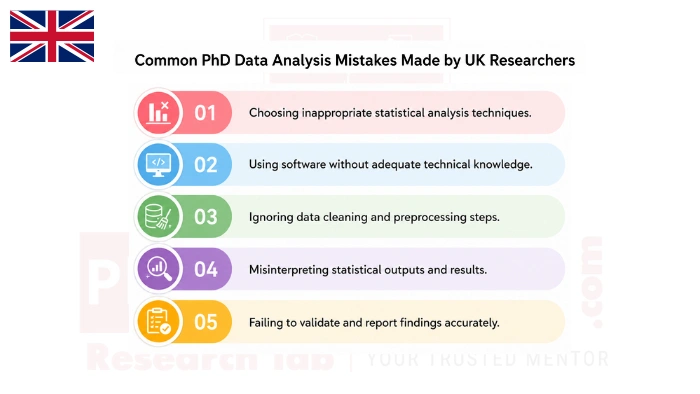
2. Selecting Appropriate Statistical Techniques with PhD AI Data Analysis Help in UK
As data sets for research have grown increasingly bigger and more complicated, choosing suitable statistical methods has been vital to getting correct results in research work. Nowadays, much of the research conducted at the PhD level includes multivariate analyses, longitudinal research and forecasting models. Students often refer to PhD AI Data Analysis Help in UK to improve their statistical skills.
What research shows:
According to Joseph F. Hair Jr. et al. (2022) in Multivariate Data Analysis, not taking into consideration the nature of the data, scales of measurement, and objectives of research when selecting the appropriate statistical technique can undermine the validity of research results. The authors emphasise the importance of selecting the right methodology, such as regression, structural equation modelling, and multivariate analysis, not from the software perspective but from the conceptual point of view.
The use of proper statistical techniques in relation to the research questions and verification of the assumptions of the analytical technique will help UK PhD students make their methodology more rigorous.
Tips:
- Match statistical tests to your research questions and hypotheses.
- Verify assumptions such as normality and independence before analysis.
- Choose analytical methods based on your study design and data type.
- Consult a statistician when applying advanced statistical models.
3. Preparing and Cleaning Research Data
The advent of digital technologies, electronic health records, surveys on the Internet, and other Internet of Things (IoT) devices has increased the amount of information that can be used to conduct research during doctoral programs. The availability of such data has led to the importance of data preparation.
What research shows:
Dasu and Johnson (2003) noted the importance of data cleansing before any statistical analysis to obtain high-quality results. It was stated that biases can be produced if such problems as missing values, duplicates, inconsistencies, or outliers are not identified and addressed. In the same way, data validation is an integral part of predictive modelling and decision-making in health care and finance.
UK PhD students will find it useful to spend some time on data cleansing and documentation to increase accuracy and make their research reproducible.
Tips:
- Match statistical tests to your research questions and hypotheses.
- Verify assumptions such as normality and independence before analysis.
- Choose analytical methods based on your study design and data type.
- Consult a statistician when applying advanced statistical models.
4. Interpreting Statistical Results Accurately
Given that current research favours the use of evidence-based decision-making in medicine, business, and engineering, proper interpretation of results is just as crucial as the actual data analysis itself. In contemporary research, there is a need for doctoral students to go beyond p-values and to consider issues like effect sizes and confidence intervals.
What research shows:
An important contribution from Douglas G. Altman and Martin J. Bland (1995) appeared in the British Medical Journal (BMJ). They highlighted the fact that statistical significance should never be considered in isolation. The two authors provided an explanation of how misinterpretation of p-values and confidence intervals may result in erroneous conclusions and poor research recommendations.
Altman and Bland have significantly improved the reporting standards of statistics in the field of medicine and social sciences. UK PhD students would greatly benefit from comprehending the statistical outputs other than the automated ones from software.
Tips:
- Match statistical tests to your research questions and hypotheses.
- Verify assumptions such as normality and independence before analysis.
- Choose analytical methods based on your study design and data type.
- Consult a statistician when applying advanced statistical models.
Get the pricing details for the PhD data analysis service at PhD Assistance Research Lab, designed to assist researchers in handling rigorous statistical tools.
5. Developing Programming Skills for Advanced Analytics
The fast development of AI, machine learning, and Big Data has changed the type of analysis researchers need to know. Researchers must know programming languages such as R and Python that allow analysing large data sets, automation, and making predictions.
What research shows:
Davenport and Harris (2007) in Competing on Analytics showed that companies using analytics always have a competitive advantage over other organisations in terms of decision-making based on data analysis. The research has proven that analytical programming skills help practitioners gain deeper insights into various issues, make accurate forecasts, and deal with more complicated problems.
Basic programming skills will allow UK PhD students to be able to carry out flexible analysis, ensure research replicability, and use new analytical tools.
Tips:
- Match statistical tests to your research questions and hypotheses.
- Verify assumptions such as normality and independence before analysis.
- Choose analytical methods based on your study design and data type.
- Consult a statistician when applying advanced statistical models.
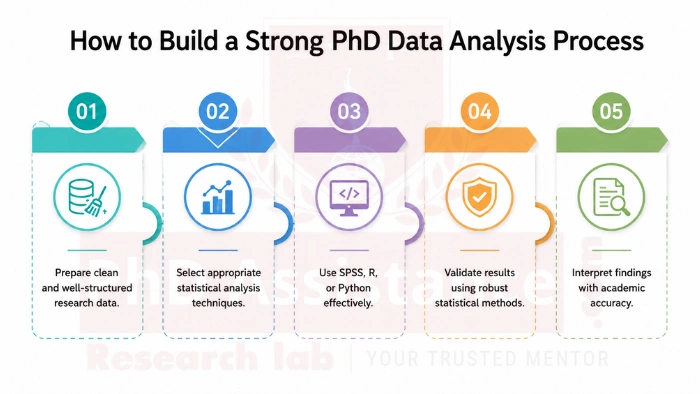
How UAE PhD Researchers Can Improve Journal Acceptance
- Data analysis approach should be planned before data collection.
- The selection of SPSS, R, or Python is dependent upon the aims and methodology of the study
- Dataset cleaning and validation involves tackling the issue of missing data, outlier, and inconsistency.
- Appropriate statistical methods should be used after checking certain assumptions.
- Results should be interpreted by considering the effect size and confidence intervals.
Conclusion
Given that artificial intelligence, big data, and evidence-based decisions are changing the landscape of global research, data analysis has become an indispensable skill for PhD students. Being proficient in SPSS, R, and Python software helps researchers generate high-quality and publishable results that meet the expectations of UK universities and journals.
Although there are many problems related to choosing the appropriate statistical techniques, their application, and analysis of data among UK PhD students, they can be overcome by good planning and skills development.
PhD Assistance Research Lab provides robust PhD ML Statistical Analysis Support in UK that aligns with the university expectations and meets global industry standards.
Book a Free Expert Consultation to get guidance on statistical tools for your PhD research.
References
- World Economic Forum. (2025). The Future of Jobs Report 2025. World Economic Forum. https://www.weforum.org/reports/the-future-of-jobs-report-2025/ .
- Altman, D. G., & Bland, J. M. (1995). Absence of evidence is not evidence of absence. BMJ, 311(7003), 485. https://doi.org/10.1136/bmj.311.7003.485
- Dasu, T., & Johnson, T. (2003). Exploratory Data Mining and Data Cleaning. John Wiley & Sons.
- Davenport, T. H., & Harris, J. G. (2007). Competing on Analytics: The New Science of Winning. Harvard Business School Press.
- Hair, J. F., Black, W. C., Babin, B. J., & Anderson, R. E. (2022). Multivariate Data Analysis (9th ed.). Cengage Learning.
- Noble, W. S. (2009). A Quick Guide to Organizing Computational Biology Projects. Nature Biotechnology, 27(11), 973–974. https://doi.org/10.1038/nbt1109-973
