
Critical Review: Artificial intelligence in preclinical research: enhancing digital twins and organ-on-chip to reduce animal testing
Artificial intelligence in preclinical research: enhancing digital twins and organ-on-chip to reduce animal testing
Introduction
Artificial intelligence (AI) advancements enable new computational methods which conduct drug discovery and preclinical testing in biomedical and pharmaceutical research. The requirements of traditional preclinical research methods which depend on animal testing lead to ethical problems and higher costs and difficulties in conducting research with human subjects. Digital twin technology and organ-on-chip systems provide new solutions to existing problems, but their success relies on their combination with sophisticated computational systems.
The reviewed article by Gangwal and Lavecchia (2025) explores how artificial intelligence enhances digital twins and organ-on-chip platforms to reduce reliance on animal testing in preclinical drug development. The authors present a conceptual and methodological synthesis of AI applications in simulation-based research environments. This critical review evaluates the article’s conceptual relevance, methodological approach, analytical depth and contribution to preclinical research and biomedical innovation.
Summary of the Article
The article examines how artificial intelligence (AI) has begun to play an increasing role as a force that drives change in preclinical drug research through its ability to enhance digital twin and organ-on-chip technologies, which serve as substitutes for traditional animal testing. The article demonstrates that AI techniques, which include machine learning and deep learning, provide researchers with tools to create precise biological system simulations, which enable them to determine drug safety and effectiveness through more efficient methods.
The combination of AI with advanced computational models enables preclinical studies to achieve better accuracy and lower expenses while delivering quicker drug development results, which follow ethical research standards through the 3Rs principle that includes replacing and reducing and refining animal testing methods. The review presents current technological progress together with major obstacles that need to be overcome before AI-powered systems can become dependable and scalable methods for contemporary drug discovery and preclinical research assessment.
Critique
Significance and Contribution to the Field
The research article explores the increasing need for non-animal testing methods which results in two significant effects on preclinical research and drug development. The research studies emerging computational techniques in biomedical research by combining AI-based digital twin systems with organ-on-chip technology.
The research study successfully combines existing artificial intelligence advancements to show their potential for changing drug discovery methods. The study increases its relevance to regulatory bodies and research organisations through its examination of ethical issues, together with its compliance with the 3Rs principle.
The article serves as a descriptive review, which fails to provide any theoretical analysis. The study presents technological advancements, but it lacks comprehensive coverage of the theoretical concepts that underpin computational modelling, translational medicine and innovation adoption. The research would gain academic value through a detailed framework that establishes connections between AI implementation and biomedical research theoretical foundations.
Methodology and Research Design
The article follows a narrative review design that combines existing research about AI-driven preclinical models. The article presents a detailed summary of contemporary technologies that researchers utilise for drug discovery in their work.
The research presents its main advantage through interdisciplinary research, which combines artificial intelligence knowledge with pharmaceutical sciences and biomedical engineering. The review demonstrates how machine learning and deep learning technologies boost predictive capabilities for digital twin and organ-on-chip system modelling through their introduction of improved modelling techniques.
The methodology shows two major strengths, yet it fails to explain how researchers selected literature and what evaluation standards they used. The article does not specify database sources, inclusion criteria or systematic review procedures. The research approach establishes limitations for replication, which leads to decreased research accuracy when compared to standard systematic review methods.
The review does not provide any numerical data synthesis or study comparison between different research works. The research would become more reliable through systematic evaluation methods, which would also increase its academic standing.
Argumentation and Use of Evidence
The article presents a logically structured argument linking AI technologies to improved preclinical research outcomes The discussion of machine learning deep learning and generative adversarial networks shows how AI improves both predictive accuracy and simulation capabilities The authors support their arguments by referencing technological applications such as digital twins and organ-on-chip models that enable precise biological simulations The real-world examples help to make the discussion more relevant to practical situations.
The analysis describes the subject matter, but it does not compare different technologies or research methods. The article requires an evaluation of empirical evidence that proves the effectiveness of AI-driven preclinical models. The text provides a detailed discussion about AI integration advantages, while it describes the possible negative effects and limitations to a lesser extent.
Ethical Considerations and Omissions
The article shows strong ethical awareness because it focuses on decreasing animal testing and following the 3Rs principle. The research shows that AI-enabled technologies can solve ethical problems while they enhance research productivity.
The ethical conversation remains extensive because it does not focus on the specific dangers that AI-based research presents through data bias problems, algorithm transparency issues, and regulatory challenges. The study would benefit from more extensive ethical evaluation because it would improve the critical assessment of its findings.
The review also provides limited discussion on accessibility and implementation challenges in low-resource research settings. The study would achieve better inclusivity and practical importance through better access to modern technology, which is developing worldwide.
Writing Style and Structure
The article demonstrates a clear and well-structured writing style that meets academic review standards. The authors present their concepts through a logical sequence that starts with AI fundamentals and ends with advanced applications used in preclinical research. The article understandably presents its technical terms, which enable readers from different fields to comprehend the content.
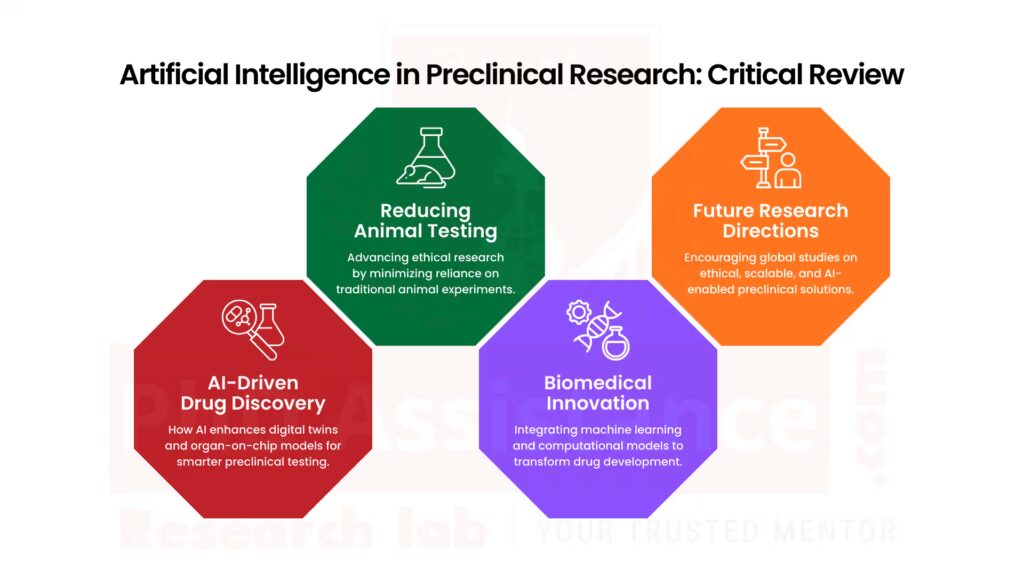
The combination of visual elements and structured sections enables readers to better understand advanced technical concepts. The sections use descriptive explanations as their main content, but they lack essential critical analysis. The text would benefit from improved synthesis between its technological content and its theoretical framework, which would result in better coherence and deeper analysis.
Conclusion
In their 2025 study, Gangwal and Lavecchia provided a comprehensive overview of how AI is used in preclinical drug discovery – illustrating through existing research that AI will enhance predictive outcomes, reduce costs and eliminate ethical concerns surrounding animal testing by integrating digitally-created agents (“digital twins”) and organ-on-chip models into the overall process of drug discovery.
The study demonstrates its value for biomedical research and pharmaceutical development through its combination of different fields of study and its practical applications. The analysis suffers from two major limitations because the authors used a narrative review approach, which combines their theoretical knowledge with their research work. Future research should incorporate systematic evaluation methods, empirical validation of AI-driven models and stronger theoretical frameworks to advance understanding of AI integration in preclinical research.
Reference:
Gangwal, A., & Lavecchia, A. (2025). Artificial intelligence in preclinical research: enhancing digital twins and organ-on-chip to reduce animal testing. Drug Discovery Today, 30(5), 104360.. https://www.sciencedirect.com/science/article/pii/S135964462500073X
Methodology and Research Design