
Introduction
Likert-scale questionnaires are widely used in management research to examine employee engagement, leadership perceptions, job satisfaction, organisational commitment and workplace climate. They allow researchers to convert employees’ opinions into structured responses that can be analysed statistically. Yet a questionnaire that appears simple may conceal important measurement problems, particularly when respondents work in different languages and cultural settings.
The UAE and Qatar provide a valuable context for this issue. Their organisations often include Arabic-speaking employees and expatriates who use English or another language at work. Respondents may understand management concepts differently because of language familiarity, educational background, professional experience or expectations about workplace hierarchy. A scale that performs well in one group may not function in the same way in another.
Validating Likert scale constructs therefore involves more than collecting completed forms or reporting a reliability coefficient (Flake & Fried, 2021). Researchers need evidence that questions are clear, items represent the intended concepts and scores can be interpreted appropriately across language groups. This article outlines a practical approach to Likert scale validity and reliability in multilingual management research.
Understanding Likert-Scale Constructs in Management Research
A Likert-type response scale asks participants to select an ordered category, commonly ranging from strongly disagree to strongly agree. Five-point and seven-point formats are frequently used, although the number of categories should reflect the respondents’ needs and the complexity of the topic. The response scale itself should be labelled clearly and consistently.
Management constructs such as trust, motivation, leadership support and organisational commitment cannot usually be observed directly. Researchers therefore use multiple questionnaire items to represent each concept. Combining item responses into a score is appropriate only when the items form a coherent measure and the theoretical definition is clear. Reliability concerns the consistency of scores; validity concerns whether the instrument measures the intended construct. A dependable scale can still measure the wrong concept, making both forms of evidence necessary.
2. Multilingual Challenges in UAE and Qatar
Language and culture can influence how employees interpret a statement, recall an experience and choose a response category. For example, “My supervisor encourages independent decision-making” may be understood differently in organisations where managerial authority is strongly hierarchical. Similarly, an employee may interpret “commitment” as loyalty to a team, a manager or the organisation as a whole.
Response styles also deserve attention. Some respondents may avoid extreme categories, prefer neutral answers or hesitate to express disagreement about supervisors. These tendencies should not be attributed automatically to nationality; language proficiency, survey design and organisational conditions may also explain them. Researchers should avoid treating local and expatriate employees as homogeneous groups and should document relevant language and respondent characteristics.
3. Survey Translation and Cross-Cultural Adaptation
An Arabic-English questionnaire should preserve conceptual meaning rather than translate words mechanically. A survey translation back-translation process is one useful safeguard: a translator prepares the target-language version, an independent translator converts it back into the source language, and the research team compares the versions (Cruchinho et al., 2024). Differences are discussed and resolved rather than corrected through literal wording alone.
Bilingual management personnel as well as representatives from the targeted labor force should assess whether the items are clear, relevant and culturally appropriate. Cognitive interviewing will allow you to ask your respondents what each item means to them and why they made the choice that they made. A pilot study with participants from relevant language groups can identify confusing expressions, missing response options and practical issues such as survey length. These steps improve the instrument before the main data collection.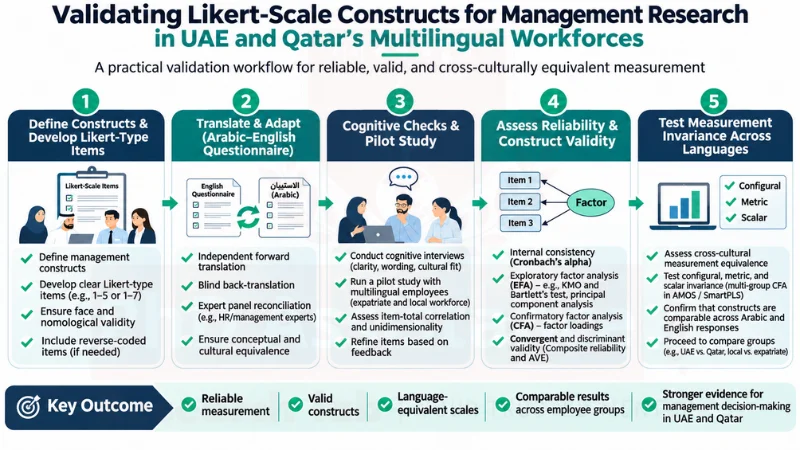
4. Construct Validity and Reliability Assessment
Construct validity Likert scale assessment begins with a clear theoretical definition and expert review. A content validity index (CVI) can summarise experts’ ratings of item relevance, while face validity considers whether the questionnaire appears understandable and appropriate to its respondents. Nomological validity is supported when relationships with other variables follow theoretical expectations. These forms of evidence complement, rather than replace, statistical analysis.
Cronbach’s alpha reliability is commonly used to assess the internal consistency of items intended to measure one construct. A value around 0.70 is often used as an initial guideline, but it is not a universal pass mark. Alpha does not prove validity and can be inflated by repetitive items. Researchers should examine item-total correlation, review reverse-coded items carefully and consider composite reliability when item loadings differ. Reliability should be evaluated separately for Arabic and English versions where group comparisons are planned.
Table 1. Key validation methods for Likert-scale constructs
Validation method | Purpose | Application in multilingual research |
Content validity | Establish item relevance | Review items with bilingual management experts |
Cronbach’s alpha reliability | Assess internal consistency | Examine consistency within each language group |
Exploratory factor analysis (EFA) | Identify underlying factor structures | Explore whether items group similarly across respondents |
Confirmatory factor analysis (CFA) | Test the proposed measurement model | Verify the expected construct structure |
Convergent and discriminant validity | Examine relationships between constructs | Establish whether related items converge and distinct constructs remain separate |
Measurement invariance | Assess cross-group equivalence | Compare Arabic and English questionnaire responses |
Composite reliability and AVE | Evaluate construct reliability and convergence | Assess measurement quality using latent-variable models |
Item-total correlation | Identify poorly performing items | Detect items that may not fit the intended construct |
5. Exploratory and Confirmatory Factor Analysis
Exploratory factor analysis (EFA) is useful when researchers need to examine how items group together. Before EFA, KMO and Bartlett’s test are commonly checked. The Kaiser-Meyer-Olkin statistic provides an indication of sampling adequacy, while a significant Bartlett test suggests that the correlation matrix contains relationships suitable for factor analysis. Neither result, on its own, establishes construct validity.
Principal component analysis (PCA) is primarily a data-reduction procedure and should not be presented as interchangeable with common-factor EFA. After the factor structure is explored and theoretically reviewed, confirmatory factor analysis (CFA) tests whether the proposed model fits the data. Researchers need to validate factor loadings, measure of fit, and intercorrelations among constructs.Should the scale be designed for a single dimension, then unidimensionality will become critical.
6. Convergent, Discriminant and Cross-Group Validity
Convergent validity looks at whether the items measuring a construct have enough shared variance. It is common practice to examine factor loadings, composite reliability, and average variance extracted (AVE), where an AVE of 0.50 and above is one criterion. Discriminant validity asks whether related concepts remain distinct. For example, job satisfaction and organisational commitment may correlate but should not be assumed to be identical. The Fornell-Larcker criterion and heterotrait-monotrait ratio (HTMT) can provide supporting evidence.
Measurement invariance multilingual survey analysis evaluates whether a construct is measured comparably across groups. Multi-group CFA commonly considers configural invariance (the same factor pattern), metric invariance (equivalent factor loadings) and scalar invariance (equivalent intercepts). With ordinal indicators, item thresholds require attention. Metric invariance generally supports comparisons of relationships; scalar-level equivalence is typically needed for latent mean comparisons (Leitgöb et al., 2023).
Complete invariance cannot always be attained in all studies. Partial invariance can sometimes support specific comparisons when enough parameters remain equivalent and the decision is theoretically justified. Researchers should identify non-invariant items, explain any model modifications and avoid making group comparisons that the evidence does not support.
7. Analysing Ordinal Likert Data and Software
Individual Likert-type items are ordinal: their categories have an order, but equal distances between categories cannot be assumed. For categorical indicators, an estimator such as weighted least squares mean and variance adjusted (WLSMV) may be appropriate for CFA. Treating multi-item scores as approximately continuous may be defensible in some circumstances, but researchers should justify the decision and consider response distributions.
Common method bias can arise when predictors and outcomes are collected from the same respondents, using the same instrument and at the same time. Anonymity, neutral wording and separation of questionnaire sections can reduce some risks; no single statistical test establishes that bias is absent. SPSS is useful for descriptive statistics, reliability and EFA; AMOS supports CFA and multi-group models; SmartPLS supports composite-based modelling. Software should be selected according to the research question and measurement assumptions.
Table 2. Statistical procedures and their interpretation
Statistical procedure | Common analytical indicator | Research interpretation |
Cronbach’s alpha | ≥ 0.70 | Initial evidence of internal consistency |
KMO | ≥ 0.60 | Preliminary sampling adequacy |
Bartlett’s test | p < 0.05 | Correlation matrix is suitable for factor analysis |
Factor loadings | Often ≥ 0.50 | Items demonstrate meaningful factor relationships |
Composite reliability | ≥ 0.70 | Acceptable internal consistency |
AVE | ≥ 0.50 | Evidence of convergent validity |
HTMT | Often below 0.85 or 0.90 | Evidence supporting discriminant validity |
8. Practical Validation Process for UAE and Qatar Studies
Proper scale development starts with a definition of constructs and item selection through a theory or reliable measures (Boateng et al., 2018). Translations are adapted, expert reviews are sought, cognitive interviews are conducted and the survey is piloted. The primary survey must cover representative employee and language groups, both local and expatriates if necessary.
The size and adequacy of sampling must be determined on the basis of model complexity and statistical power rather than a respondent-to-item ratio. After data collection, researchers assess reliability and factor structure, test convergent and discriminant validity, and evaluate measurement invariance before comparing groups or examining structural relationships. Reporting decisions, exclusions and limitations transparently makes the findings easier to evaluate and reproduce.
Conclusion
Validating Likert-scale constructs in UAE and Qatar’s multilingual workforces requires both linguistic adaptation and statistical evidence. Translation review, pilot testing, reliability analysis, EFA or CFA, and measurement invariance together help establish whether a scale is suitable and comparable across groups. Careful validation enables management researchers to interpret employee responses responsibly and produce stronger evidence for leadership, engagement and human-resource decisions across the GCC.
Need support validating your Likert-scale questionnaire for management research?
PhD Assistance provides research and statistical support to help strengthen construct validity, reliability and measurement analysis.
Contact PhD Assistance to move your research forward with confidence.
Frequently Asked Question
Why is Likert-scale validation important in management research?
It ensures that questionnaire items measure the intended constructs consistently and accurately.
Which statistical methods are used to validate Likert-scale constructs?
Researchers commonly use Cronbach’s alpha, EFA, CFA, composite reliability, AVE and measurement invariance testing.
Why is measurement invariance important for UAE and Qatar studies?
It helps establish whether a questionnaire measures constructs comparably across Arabic- and English-speaking employee groups.
Reference
- Boateng, G. O., Neilands, T. B., Frongillo, E. A., Melgar-Quiñonez, H. R., & Young, S. L. (2018). Best practices for developing and validating scales for health, social, and behavioral research: A primer. Frontiers in Public Health, 6, Article 149. https://doi.org/10.3389/fpubh.2018.00149
- Cruchinho, P., López-Franco, M. D., Capelas, M. L., Almeida, S., Bennett, P. M., Miranda da Silva, M., Teixeira, G., Nunes, E., Lucas, P., & Gaspar, F. (2024). Translation, cross-cultural adaptation, and validation of measurement instruments: A practical guideline for novice researchers. Journal of Multidisciplinary Healthcare, 17, 2701–2728. https://doi.org/10.2147/JMDH.S419714
- Leitgöb, H., Seddig, D., Asparouhov, T., Behr, D., Davidov, E., De Roover, K., Jak, S., Meitinger, K., Menold, N., Muthén, B., Rudnev, M., Schmidt, P., & van de Schoot, R. (2023). Measurement invariance in the social sciences: Historical development, methodological challenges, state of the art, and future perspectives. Social Science Research, 110, Article 102805. https://doi.org/10.1016/j.ssresearch.2022.102805
Flake, J. K., & Fried, E. I. (2021). Measurement schmeasurement: Questionable measurement practices and how to avoid them. Advances in Methods and Practices in Psychological Science, 4(4). https://doi.org/10.1177/25152459211052906