
How to Overcome PhD Data Analysis Challenges in Cambridge Quantum Materials Research: Fixing Errors in Superconductivity Modelling
Sustainable Practices in Environmental Science
- Identify Data Analysis Challenges in Cambridge Quantum Materials Research
- Conduct Critical Data Evaluation and Research Gap Analysis
- Apply Theories and Conceptual Frameworks
- Evaluate Data Analysis Methods and Validation Techniques
- Evaluate Results and Develop Research Contributions
- Evaluate Results and Develop Research Contributions
- Conclusion

Recent Post
Introduction
Quantum materials research will be shaping the future of superconductors, quantum computers, and sophisticated electronic devices. The University of Cambridge has established itself as a prominent research centre where superconducting materials are being studied using state-of-the-art experimental methods, computer modelling, and artificial intelligence. One of the most difficult tasks that PhD students face is dealing with complex experimental and computer simulation data that can be influenced by mistakes in its preparation, validation, and modelling.
PhD Data Analysis process is necessary for detecting useful patterns, testing theory models, and generating reproducible scientific results. For scientists carrying out work in Cambridge Quantum Research, there is a need to conduct careful analysis of experimental results, computational simulations, and machine learning models so that one can increase the accuracy of superconductivity methods. Quantum Data Analysis process ensures that researchers make minimal mistakes in their analysis.
This article describes the process that enables researchers to create an analytically strong data analysis procedure through the identification of analytical problems, review of scientific evidence, application of modelling methods, and verification of computational results. A structured PhD Data Analysis Support can help scholars overcome these challenges.
What you will learn?
Step 1: Identify Data Analysis Challenges in Cambridge Quantum Materials Research
The initial phase in conducting effective data analysis involves the identification of where analysis fails at different stages of the research process. Datasets for quantum materials investigation can be generated via cryogenic experimentation, spectroscopy methods, electronic structure modelling, and computer simulation. Errors during data pre-processing, calibration, missing data, and differences in the parameters can adversely influence the performance and the outcome of the model.
Data quality needs to be verified before performing complicated analysis. Arranging data, identifying outliers, checking the calibration of the instruments used, and having standard procedures for preprocessing help increase the accuracy of Superconductivity Methods.
What Research shows:
The SuperBand database was developed by Pogue et al. (2023) for superconductors, showing that machine learning models require well-curated, validated, and standardised databases to be accurate. Their research points out that low-quality data will impair prediction accuracy and the need for systematic preparation of data before computational modelling.
Tips
Step 2: Conduct Critical Data Evaluation and Research Gap Analysis
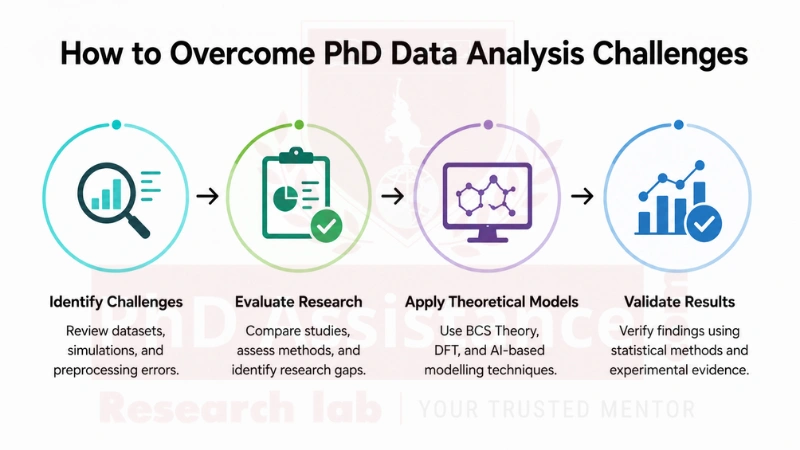
Data analysis should involve a critical review of previous work rather than merely citing results from existing research by other researchers. Through the comparison of methodologies, data sets, computations, and validation processes, researchers can find contradictions and areas for further study.
The research gap analysis becomes especially relevant for Cambridge Quantum Materials Research as researchers keep exploring high-temperature superconductors, machine learning for materials discovery and electronic structure prediction. By grouping literature based on models used, computer simulations performed and experiments conducted, researchers can determine open scientific questions and support their research proposals.
What Research shows:
Adiga & Waghmare (2026) have found that numerous machine learning models created to predict superconductivity have been built on incomplete or inconsistent data sets. With the proper data cleaning and engineering processes carried out, significant improvement of their accuracy was achieved, which highlights the significance of proper data analysis before model creation.
Tips
Step 3: Apply Theories and Conceptual Frameworks
An effective analysis framework needs to be supplemented by an appropriate theory that would describe the physics of the phenomenon of superconductivity in the concerned materials. Theoretical models need to be chosen according to the goals, materials used, and experimental setup. Some of the popular theories are BCS Theory, Ginzburg-Landau Theory, Density Functional Theory (DFT), and Electronic Band Structure Theory.
Combining theory with computation allows scientists to make sense of experimental findings, verify results obtained from simulation, and correlate material properties with superconducting behaviour. The comparison of competing theories will add scientific weight to the research as well.
What Research shows:
Stanev et al. (2018) showed that by using machine learning along with traditional theories of superconductors, the critical temperature (Tc) can be predicted more accurately. They concluded that when physics and data are combined, it leads to better predictions than statistics alone.
Example theory:
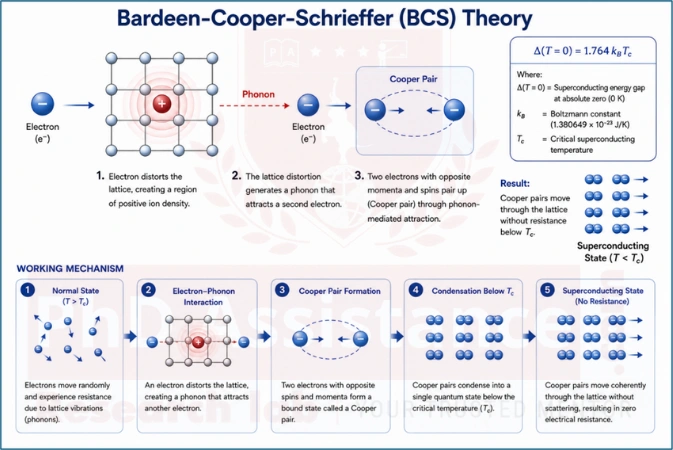
Bardeen-Cooper-Schrieffer (BCS) Theory
BCS Theory was presented by Bardeen, Cooper and Schrieffer in 1957. It is used in explaining the concept of conventional superconductivity using the formation of Cooper pairs. The interaction between electrons occurs through the phonon process, and hence there is no resistance below the critical temperature (Tc). BCS Theory is one of the theories that is widely applied to superconductivity studies.
Δ(T = 0) = 1.764 k₍B₎ T₍c₎
Where:
Δ(T = 0) = Superconducting energy gap at absolute zero (0 K)
kB= Boltzmann constant (1.380649 × 10⁻²³ J/K)
Tc= Critical superconducting temperature
Step 4: Evaluate Data Analysis Methods and Validation Techniques
Choosing proper analysis techniques is important to obtaining valid results from the research. Statistical analysis methods, simulation tools, and machine learning models must be assessed according to their data suitability, predictive power, computational performance, and interpretability.
Quantum Materials Data Analysis involves different methods of analysis including regression analysis, Principal Component Analysis (PCA), Random Forest, Artificial Neural Networks, Support Vector Machines, and uncertainty quantification. Validation procedures include cross-validation, sensitivity analysis, error calculation, and independent experiments to confirm findings from analysis.
What Research shows:
According to Gibson et al. (2025), deep learning algorithms could predict novel superconductors if there was verification through experimentation. The key point here is that computational prediction must be confirmed through laboratory experiments to ensure the correctness of the model.
Tips
Step 5: Evaluate Results and Develop Research Contributions
The final process of data analysis is interpretation of analytical findings and their contribution to science. Scientists need to assess if their results confirm current theory, offer new insights into the behaviour of materials, or develop better computational methods for superconductivity studies.
A good contribution to research must highlight how the discoveries contribute to our understanding of Quantum Materials Research at Cambridge University, improve Superconductivity Modelling, or even the computational techniques used in quantum materials research. The publication needs to be strong by providing good analytical evidence.
What Research shows:
Pogue et al. (2023) created a hierarchical neural network model to predict the superconducting critical temperatures and validated their performance through the use of novel superconducting alloys that were synthesised experimentally. This study showed that the integration of artificial intelligence and experimental validation enhances predictive accuracy.
Tips
Practical Solutions for Overcoming PhD Data Analysis Challenges
Conclusion
Data analysis accuracy is key to conducting good research in the field of quantum materials and superconductivity. Instead of basing research purely on computer-generated information, scientists need to analyse their datasets, use proper theories, verify their analysis models, and provide scientific interpretations of their findings through a Quantum Data Analysis method.
By adhering to a process flow, analysts would be able to ensure error-free analysis, improve Superconductivity Methods, and make valuable scientific contributions through Cambridge Quantum Research. Professionals who require PhD Data Analysis Assistance will also be able to improve their analysis process and make valuable research contributions internationally.
Looking for professional PhD Data Analysis help? Connect with our experts for assistance with Quantum Materials, superconductivity methods, statistical validation, and computational data interpretation to help you achieve high-quality research outcomes.
References
- Bardeen, J., Cooper, L. N., & Schrieffer, J. R. (1957). Theory of superconductivity. Physical Review, 108(5), 1175–1204. https://doi.org/10.1103/PhysRev.108.1175
- Adiga, S., & Waghmare, U. V. (2026). Accelerating the search for superconductors using machine learning. Computational Materials Science, 263, 114453. https://doi.org/10.1016/j.commatsci.2025.114453
- Gibson, J. B., Hire, A. C., Dee, P. M., Barrera, O., Geisler, B., Hirschfeld, P. J., & Hennig, R. G. (2025). Accelerating superconductor discovery through tempered deep learning of the electron-phonon spectral function. npj Computational Materials, 11, 7. https://doi.org/10.1038/s41524-024-01475-4
- Pogue, E.A., New, A., McElroy, K. et al. Closed-loop superconducting materials discovery. npj Comput Mater 9, 181 (2023). https://doi.org/10.1038/s41524-023-01131-3 .
- Stanev, V., Oses, C., Kusne, A. G., Rodriguez, E., Paglione, J., Curtarolo, S., & Takeuchi, I. (2018). Machine learning modeling of superconducting critical temperature. npj Computational Materials, 4, 29. https://doi.org/10.1038/s41524-018-0085-8
References
1. How can I overcome PhD data analysis challenges in quantum materials research?
Develop a structured workflow that includes data preprocessing, theoretical modelling, statistical validation, and result verification. This improves the accuracy and reproducibility of quantum materials research.
2. Why is data analysis important in superconductivity modelling?
Data analysis helps researchers interpret complex datasets, validate computational models, and accurately predict superconducting properties. It also strengthens the reliability of research findings.
3. Which analytical techniques are commonly used in quantum materials research?
Researchers use Density Functional Theory (DFT), machine learning, statistical analysis, and high-performance computing to analyse superconducting materials. These techniques support accurate modelling and prediction.
4. How is artificial intelligence transforming superconductivity research?
Artificial intelligence accelerates superconducting materials discovery by analysing large datasets and improving critical temperature predictions. It enhances computational efficiency when combined with physics-based models.
5. How can I improve the reliability of my PhD data analysis?
Use validated datasets, apply appropriate statistical techniques, and verify computational results with experimental evidence. Following a systematic workflow improves research quality and reproducibility.