
Why PhD data needs a passport
Advice on PhD data collection usually concentrates on getting the data: gaining access, building the instrument, reaching respondents. Far less is said about what happens to the data once it exists. In the United States, engineering data passes through many hands. A student records it, a supervisor and a university are responsible for it, a company or agency may have supplied it, software and collaborators process it, and a repository or an examiner may eventually see it. At each hand-over, someone else’s rules apply.
A data passport is a short record kept alongside the data that states the terms under which it was collected and may be used. It is deliberately brief so that it actually stays up to date. Table 1 lists six fields, with an illustrative entry for a hypothetical structural-monitoring dataset. The entries are examples only. The correct answers depend on your university, sponsor and partner.
| Passport field | Question it answers | Illustrative entry |
|---|---|---|
| Owner | Which institution or organisation owns the data? | University, under its research data policy; the partner keeps ownership of its own source records |
| Custodian | Who is responsible for the original data after the project ends? | Principal investigator, with a copy in institution-approved storage |
| Permitted users | Who may see raw, identifiable or restricted values? | Named research team only; examiners see anonymised or aggregated values |
| Permitted tools | Which software, cloud services and AI tools may process the data? | Approved analysis environment; no public AI tools for identifiable data |
| Destination | Where will the dataset, or a derivative of it, be published? | Anonymised subset in a domain repository with a DOI; restricted values withheld |
| Exit plan | What stays, and what may be copied, when the researcher leaves? | Originals stay with the PI; approved copy for the researcher |
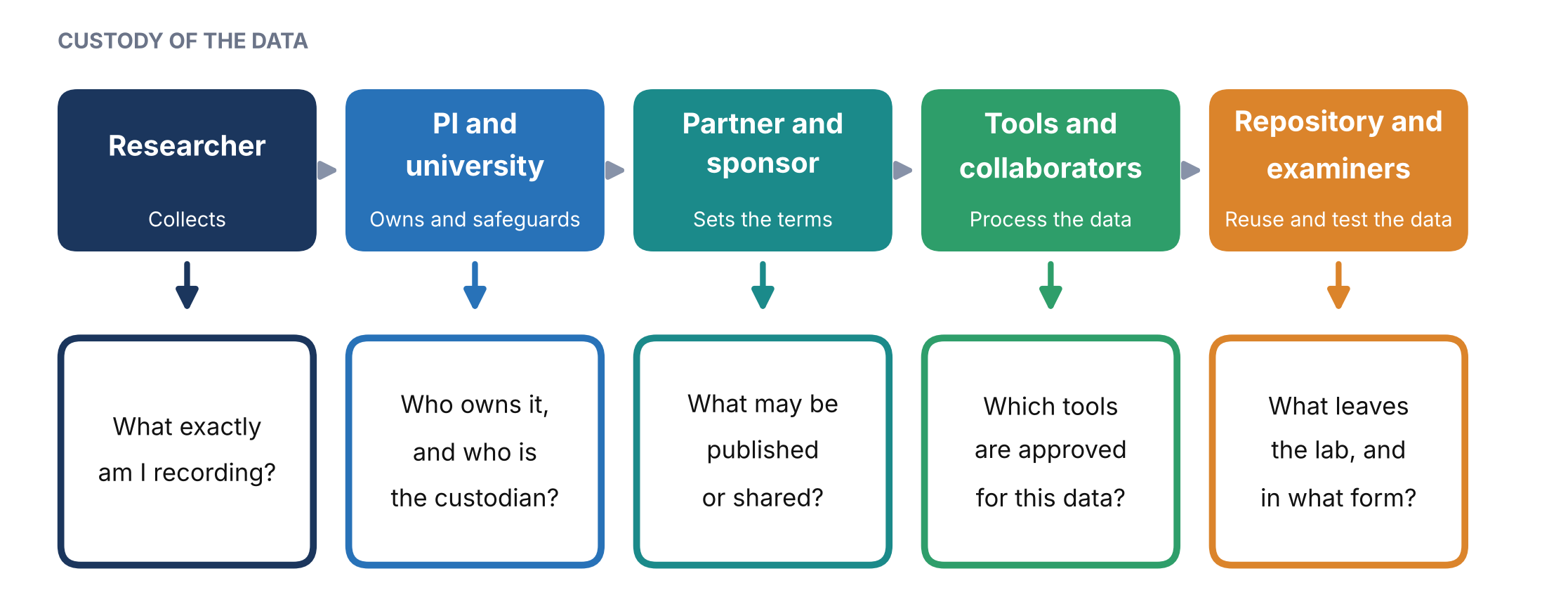
Figure 1 shows why the passport matters: the same dataset is held in turn by five different parties, and each hand-over raises a different question.
1. Who owns the data?
Many students assume that data they collected themselves belongs to them. At many US universities it does not. Virginia Tech’s Policy 13015, for example, states that the university owns research data, results and related materials from projects conducted under its auspices or with its resources. Principal investigators act as stewards and custodians, and access for collaborators is at the investigator’s discretion, subject to any data use or transfer agreements [1]. Other institutions word their policies differently, and a company that supplies data usually keeps ownership of its own records. Fill in the owner and custodian fields from your institution’s written policy and the signed agreements, not from assumption.
2. Who may see the data?
More people see the data than the researcher expects: the supervisory team, partner staff, collaborators at other institutions, examiners and, if it is published, anyone. Earlier promises limit who may be shown what, such as the terms of a data-use agreement or what participants were told when they consented. It is easier to decide in advance which fields could ever leave the lab than to retrofit anonymisation afterwards.
Repositories add their own conditions. DesignSafe, the data repository of the NSF-supported Natural Hazards Engineering Research Infrastructure, requires human-subjects data to follow its protected-data policies and expects depositors to supply the licences and permissions their data needs [2]. A permitted-users rule in the passport turns these conditions into something any team member can check in seconds.
3. Which tools may touch the data?
Generative AI has added a question earlier PhD students did not face. Interview recordings are transcribed by online services, cleaning scripts are drafted with code assistants and survey comments are summarised by chatbots, often without anyone checking where the data goes.
The University of Michigan’s human research protection programme is one example of how universities are responding. It advises researchers not to submit personally identifiable or sensitive information to third-party or public AI tools. Researchers should use only tools approved for the data’s classification level and covered by appropriate data protection agreements, and remember that AI can re-identify data previously considered de-identified. It also asks protocols to describe what data goes into and out of an AI system and whether participant data will be used to train it, and it requires IRB approval before any change in AI use [3]. Practice differs between universities, so check with your local IRB and information security office and record the answer in the tools field.
4. Where will the data go next?
A dataset that ends its life on a laptop is a missed contribution and a risk to the thesis. Many engineering fields now have repositories built for their data. DesignSafe accepts datasets, documentation, research software and reports in natural hazards engineering, assigns DOIs and expects submissions to be documented well enough for reuse [2].
Funder expectations point the same way. In August 2022 the White House Office of Science and Technology Policy told federal agencies to update their public access policies so that publications from federally funded research are available without the previous 12-month embargo, and to set out how the supporting data will be shared [4].
The practical lesson is to choose the destination early. A repository’s metadata and documentation requirements are easiest to meet when you log the data that way from day one. That is what the FAIR Guiding Principles (findable, accessible, interoperable, reusable) ask for in practice [5].
5. What happens when you leave?
The PhD ends, but the data does not. Under Virginia Tech’s policy, original data must be kept by the principal investigator at the university. Team members who remain keep the right to use it, and researchers who leave may take copies only subject to confidentiality restrictions, project requirements and their department head’s approval [1]. If you want to continue the work or publish further papers after graduating, settle the exit-plan field while you are still in the lab. Ask your graduate school separately about thesis embargo options if a partner needs time before results become public.
A short README that explains the file structure, variables and processing steps lets the next researcher continue without you, and gives examiners the same confidence.
What to do now
- Find your university’s research data policy and note who owns and who stewards the data.
- List every agreement (data-use, NDA, sponsor contract) that touches each dataset.
- Ask your IRB which AI and cloud tools are approved for your data classification.
- Pick a target repository and adopt its metadata template now.
- Write the exit plan with your PI and file it with the passport.
Frequently asked questions
Who owns PhD research data in the US?
Usually the university, under its research data policy, with the principal investigator as steward. Data supplied by a company or agency normally stays the partner’s property. Check your institution’s written policy and your signed agreements.
Can I use ChatGPT or other public AI tools on interview transcripts?
Not for identifiable or sensitive data at universities that follow guidance like Michigan’s. Use only tools approved for that data class, and get IRB approval before changing how AI is used in a study.
Can I take my PhD data with me when I graduate?
Often only a copy, and only with approval. Originals typically stay with the PI and the university. Agree the terms before you leave.
Do I have to make my PhD data public?
Not always, but federally funded projects increasingly expect data sharing, and many repositories and journals require it. Restricted values can be withheld while an anonymised subset is published.
Related reading: Research data management in universities: a critical review · Planning engineering PhD data collection in Saudi Arabia · PhD data analysis support
Key takeaways
- Ownership is set by your university’s research data policy and your signed agreements, not by who collected the data.
- Write the passport before the data arrives, and update it whenever an agreement, protocol or tool changes.
- Public generative-AI tools are a new risk. Check your IRB’s rules before you put any participant data into one.
- Choose the repository early, because its metadata rules are easiest to meet from day one.
- Settle your exit plan while you are still in the lab.