
Critical Review of Research Data Management Challenges in Academia: A Repository Framework Perspective
Introduction
The article under review conducts a critical examination of the research data management problems that academic institutions encounter when they attempt to handle research data under conditions of rising data requirements. The research exists within the larger changes that have affected scholarly communication because research data now holds equal importance to traditional publication formats.
Universities have started to treat research data management as a main priority because open science practices and reproducibility standards, and data transparency requirements have increased in importance. Universities need to establish organised frameworks which will enable them to make research data available and usable, and maintain its accessibility for future academic and public use. Academic research repositories continue to experience major operational issues because institutions lack proper facilities, and they need better guidelines, and researchers must improve their knowledge about research repositories.
The study makes a significant contribution to the discourse on research data management challenges in academia by highlighting the disconnect between policy expectations and actual data practices within universities. The research demonstrates that although research data has become more important, its current institutional management systems remain insufficient.
Summary of the article
The academic research data management system encounters significant operational challenges because universities do not have the required support infrastructure. Researchers and students use their personal laptops and email systems and external storage devices to manage research data because they do not have access to official repositories.
The research study examines higher education through cultural capital theory, while it disputes human capital theory, which treats skills as assets that people can use across different contexts. The authors show that doctoral education provides transferable skills, which include communication and networking, innovation and leadership, but these skills have different definitions according to various industry settings.
The absence of centralized infrastructure systems creates fundamental research difficulties for academic research repositories because they require platforms that enable data to be shared and reused while maintaining its long-term storage. The research identified multiple barriers which included inadequate training and absence of research policies and lack of metadata standards and insufficient funding for data management system development.
Participants recognized the value of research data repository management because they believed it would improve research visibility and foster collaboration between researchers and drive scientific progress.
Critique
Significance and contribution of the field
The research shows that universities need technical systems and administrative backing, policy creation, and partner participation to achieve their research data governance needs. The study demonstrates university research data governance because it shows that effective governance requires technical and operational systems, organisational support, policy development, and stakeholder involvement.
The article’s main strength lies in its demonstration that research data management serves as a strategic solution to present operational difficulties. The study presents a structured framework that allows readers to understand existing problems while receiving specific suggestions to enhance their data management techniques.
The study offers limited value because it investigates only one faculty at one university. The findings provide essential information because they demonstrate research data management methods used by universities across different academic disciplines and institutional types and international locations. The research findings need validation through tests at multiple universities to establish their general applicability.
Methodology and research design
The study benefits from its primary research design which employs an explanatory sequential mixed-methods design. The researchers achieve their study aims through their use of combined quantitative and qualitative methods which enable them to study academic research repository problems at both large and detailed levels.
The survey data provides a broad overview of data management practices among postgraduate students, while the interviews offer deeper insights into institutional perspectives and supervisory roles.
The research process gains increased credibility through PRISMA implementation in the literature review, which provides transparent research methods. The research establishes a solid theoretical base through its systematic process of finding and studying all applicable research materials.
The research method includes its own set of restrictions. The self-reported data used in the study creates bias risk because participants tend to either exaggerate or downplay their data management activities. The research study lacks observational and system-based data which would have shown actual research data management methods.
Argumentation and Use of Evidence
The article presents a coherent and well-supported argument that research data management problems in academic institutions need to be solved through institutional approaches that have been established through formal structures.
The authors show how their research results connect to broader discussions about Data management framework in academia because the study found that inadequate infrastructure and policy deficiencies lead to poor data handling practices. The researchers show that existing academic systems do not follow the FAIR principles, which their research needs to function properly.
The argument gains stronger support through the combined use of primary data and existing literature. The statistical data, together with tables and figures, present evidence that helps to explain the research findings and shows the existing problems.
The argument requires more strength through the addition of comparative examples from other universities. The research data governance practices of universities need to be studied through multiple different contexts to achieve a better understanding of the research data governance.
Ethical considerations and omissions
The article presents its content through an organised academic structure, which includes separate parts for literature review, methodology, research findings, and analysis. The research organisation combines theoretical frameworks with practical empirical evidence, which helps to advance Research data management in universities settings.
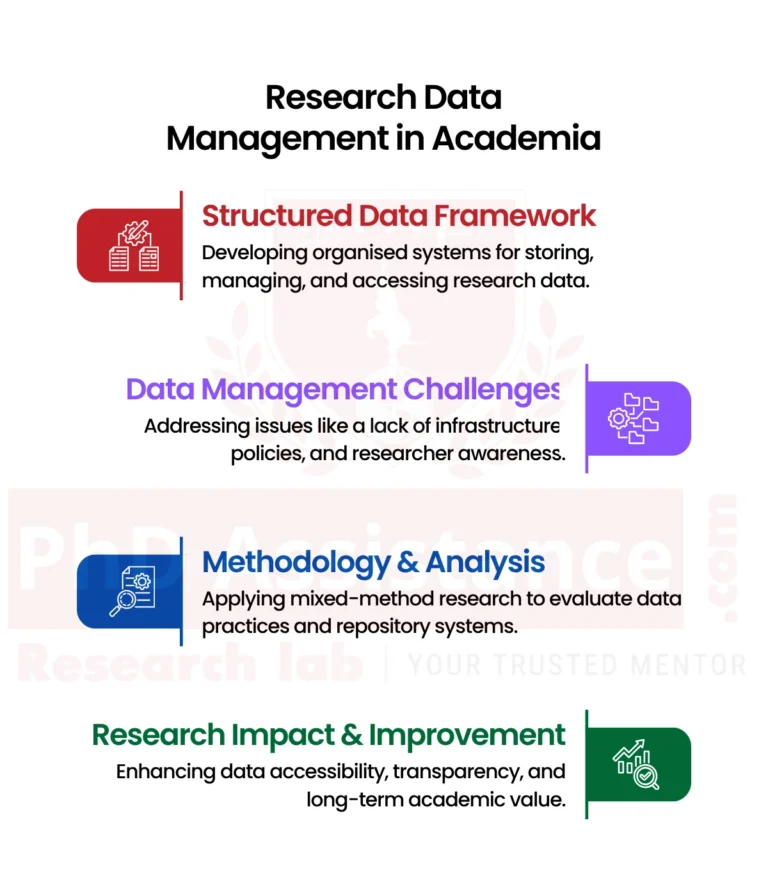
The research data management model is effectively demonstrated through the visual elements, which include the conceptual framework diagram that appears on page 22.
The writing style of the document becomes difficult to read because it contains sections that require specialised knowledge, especially when explaining system design and repository development. The study would achieve better readability through section simplification, which would extend access to the research material for both policymakers and practitioners.
Writing Style and Structure
The article presents its content through an organised academic structure, which includes separate parts for literature review, methodology, research findings, and analysis. The research organisation combines theoretical frameworks with practical empirical evidence, which helps to advance research data management practices used in university settings.
The research data management model is effectively demonstrated through the visual elements, which include the conceptual framework.
The writing style of the document becomes difficult to read because it contains sections that require specialised knowledge, especially when explaining system design and repository development. The study would achieve better readability through section simplification, which would extend access to the research material for both policymakers and practitioners.
Conclusion
The article provides a complete examination of research data management problems that universities face because their academic systems require better infrastructure, policies and institutional support.
The framework establishes a research data management framework that helps faculty members create repositories for data storage, sharing and data reuse purposes. The study shows that universities need to improve their research data governance systems because proper data management practices exist to ensure data accessibility, transparent operations, and permanent data storage.
The study has two main limitations, which require additional research because it investigates only one institution and does not study any ethical aspects. Future studies should expand the scope to include multiple institutions and global contexts while also exploring the role of policy and governance in addressing academic research repository challenges.
Reference
Zibani P, Rajkoomar M, Naicker N, Marimuthu F (2026), “Navigating research data management challenges in an academic landscape: a framework for a university of technology research repository context”. Digital Library Perspectives, Vol. 42 No. 1 pp. 5–31, doi: https://doi.org/10.1108/DLP-08-2024-0127