
Data collection as a sequence of decisions
Data collection problems in an engineering PhD are usually discussed as a list of things that can go wrong. A more useful question is when each problem should be dealt with. A problem that takes a few days to fix at the proposal stage can take months if it is discovered during main data collection.
This matters particularly in Saudi Arabia. Large energy, water, infrastructure and manufacturing programmes create rich opportunities for industry-linked research, but the data often sits with large organisations whose approval processes take time. Field conditions combine extreme heat with frequent dust, the national data protection regime is relatively new, and the engineering workforce is changing under localisation policy.
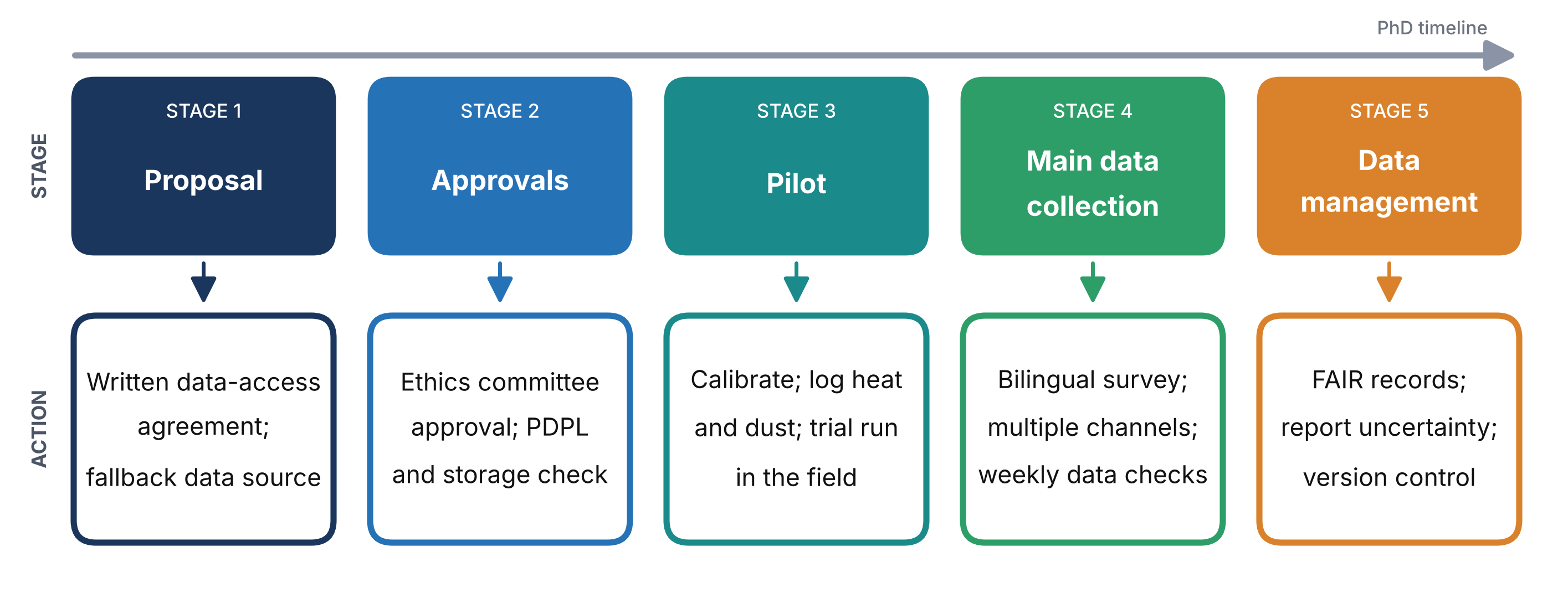
| Stage | Main risk | Decision to make before moving on |
|---|---|---|
| Proposal | Industry data is assumed in the plan but not secured | Agree the scope of data access in writing; identify a fallback data source |
| Approvals | Collection starts before ethics and data protection are confirmed | Obtain ethics committee approval; check PDPL obligations, including where data will be stored |
| Pilot | Instruments, rigs or questionnaires fail under real conditions | Run a small trial in the actual environment; calibrate and log ambient conditions |
| Main data collection | Too few responses, or gaps in field and test data | Recruit through several channels; check numbers and completeness weekly |
| Data management and write-up | Results cannot be traced to raw data or lack stated uncertainty | Keep FAIR-aligned records; report measurement uncertainty; version-control scripts |
Planning each stage
1. Proposal: secure data access early
Much engineering research in Saudi Arabia relies on data from industry and public-sector partners: operating records from oil, gas and petrochemical facilities, performance data from power and desalination plants, or monitoring data from large construction projects. These organisations typically route requests through legal, security and operational departments, and may release only part of what was asked for.
At the proposal stage, identify the data owner and a named contact. Agree in writing which variables, time periods, resolutions and formats will be shared, how confidential fields will be anonymised, and what the partner may review before publication. A proposal that depends entirely on one partner is fragile. Name a fallback, such as public datasets, simulation or a laboratory-scale experiment, that could still answer a narrower version of the question.
2. Approvals: research ethics and personal data
Engineering studies involve people more often than researchers expect: questionnaires for site engineers, interviews with project managers, occupant behaviour studies, and traffic or mobility data that can be linked to individuals. Two sets of rules apply.
- Research ethics. The Law of Ethics of Research on Living Creatures (2010) requires approval from a registered local research ethics committee before participants are contacted [1]. Our guide to Saudi Arabia’s research ethics law explains the committee process.
- Personal data. The Personal Data Protection Law (PDPL), regulated by SDAIA, has applied since September 2023. It treats location data as sensitive and requires breaches to be notified within 72 hours [2]. GPS traces, vehicle telematics and smart-building logs are common in transport, construction and energy research, so this matters. The PDPL also restricts transfers outside the Kingdom. If you plan to use overseas cloud storage or share data with co-supervisors abroad, confirm the arrangement with your institution now. See what the PDPL means for your research data.
3. Pilot: test instruments in real field conditions
A pilot is the cheapest place to discover that an instrument, test rig or data logger does not behave as it did in the lab. In a study in the Eastern Province, the power output of photovoltaic modules left uncleaned for more than six months fell by as much as 50% because of dust accumulation [3]. Similar dust and heat can affect anemometers, pyranometers, strain gauges, air-quality sensors and logger enclosures.
Run a short pilot in the actual deployment environment. Check calibration before and after, record cleaning and maintenance events, and log ambient temperature, humidity and dust alongside the main variables. This shows whether the planned sampling interval, sensor placement and maintenance schedule are realistic. For surveys and interview guides, the pilot is where wording, translation and completion time are tested with a small group of practitioners.
4. Main data collection: reach a changing engineering workforce
Surveys and interviews with engineers in Saudi Arabia must account for a workforce that is international and changing. Since 21 July 2024, private-sector establishments with five or more workers in engineering professions must localise 25% of those roles [4]. A sample drawn from a single firm or nationality group may therefore misrepresent the profession, and responses may differ between Saudi and expatriate engineers or between early-career and senior staff.
Offer questionnaires in Arabic and English, check translations by back-translation, and recruit through several channels: engineering firms, project sites, professional bodies and alumni networks. Check response numbers and missing data weekly against a sample size calculated in advance, so extra recruitment can start before the window closes. The same discipline applies to experimental and field campaigns, where regular completeness checks stop gaps from surfacing only at analysis.
5. Data management and write-up: make results traceable
This is where examiners test whether the data can be trusted. The FAIR Guiding Principles ask for findable, accessible, interoperable and reusable data. In practice that means consistent file naming, documented metadata and secure, persistent storage [5]. Report experimental and field results with an estimate of measurement uncertainty that follows recognised guidance such as the GUM [6].
Keep raw data unchanged and separate from processed versions, record every cleaning or exclusion decision, and put analysis scripts under version control so each figure and table in the thesis traces back to its source. Where a partner’s data is confidential, explain what was anonymised or aggregated and why, so examiners can judge the analysis without seeing restricted values.
What to do now
- Get a written data-access scope from each partner, and name a fallback.
- Book ethics review and map PDPL duties, including where the data will be stored.
- Schedule a field pilot with calibration and ambient logging.
- Set a target sample size and a weekly completeness check.
- Set up a raw/processed folder structure and version control on day one.
Frequently asked questions
Do engineering PhD surveys in Saudi Arabia need ethics approval?
Yes, if they involve human participants. Approval from a registered research ethics committee should be in place before anyone is contacted.
Does the PDPL apply to sensor or GPS data?
It applies to personal data, and location data that can be linked to an individual is treated as sensitive. Vehicle telematics and occupant-tracking data usually fall in scope.
Can I store Saudi research data on overseas cloud services?
The PDPL places conditions on transfers outside the Kingdom. Confirm the arrangement with your institution before collection starts.
How long should a field pilot run?
Long enough to cover at least one full cleaning and maintenance cycle and the range of conditions you expect. The aim is to test your sampling interval and maintenance schedule, not to collect results.
Related reading: Why Saudi PhD researchers struggle to collect reliable primary data · PhD support in Saudi Arabia · Who owns your PhD data? A data passport for US engineering researchers
Key takeaways
- Proposal: get industry data access agreed in writing, and name a fallback source.
- Approvals: ethics committee approval and PDPL checks come before any participant contact.
- Pilot: test instruments in real heat and dust, not just in the lab.
- Main collection: recruit through several channels and check completeness weekly.
- Write-up: keep raw data traceable and report measurement uncertainty.