

Enhanced Oil Recovery Efficiency Using AI-Optimized Polymer Flooding in Mature Reservoirs
August 12, 2026
Call for Papers: Advanced Modalities in Drug Development: Radiopharmaceuticals, ADCs, Delivery Systems and Biodistribution of Next-Generation Gene and Cell Therapies
August 13, 2026Why Saudi PhD Researchers Struggle to Collect Reliable Primary Data
- August 13, 2026
- Primary Data Collection
Introduction
Data collection is one of the most challenging stages of PhD research for many PhD students from Saudi Arabia. Difficulties in gaining access to organisations, selecting the right participants, obtaining permission, and ensuring the validity of collected data can negatively affect the research and its timeline.
There are several aspects of Business and Management PhD research carried out in Saudi Arabia, including organisational change, leadership, human resources management, entrepreneurship, strategic management, marketing, finance, organisational behaviour, and digital transformation. All these spheres require acquiring data from Saudi Arabia organizations and their employees, managers, entrepreneurs, clients, or other participants.
However, primary data collection is not just limited to the development of a questionnaire/interview guide. Researchers should also explain the rationale for the target population and sampling techniques used, instrument development/validation and how the data obtained answer the research question.
For instance, the Business Administration PhD program at King Saud University entails advanced research design, business statistics, applied multivariate analysis and a comprehensive examination before proceeding to the dissertation phase. Data collection needs to be approved in advance at some Saudi universities; Saudi Electronic University, for example, requires a data collection request and so forth.
For PhD students in Saudi Arabia who need additional support in collecting primary data and research methodologies, the PhD Assistance Research Lab provides customised PhD Data Collection Help in Saudi Arabia that ensures they meet the expectations of the universities.
What you will learn from this blog?
- Key challenges in Saudi PhD primary data collection.
- Issues with participant recruitment, questionnaire design, sampling strategy, and organisational access.
- Saudi university, ethics, and PDPL considerations.
- Practical strategies for stronger data collection.
Why Is Reliable Primary Data Important in a Saudi PhD?
However, for a Saudi PhD student conducting research, the acquisition of primary data does not just involve developing a questionnaire or doing an interview. The success of the final research is contingent upon how the researcher creates a logical link between the research issue, the Saudi research population, sample, data acquisition technique, and ethical issues.
This becomes increasingly significant in the field of Business and Management, where scholars might research Saudi SMEs, labour force, digitisation, fintech, tourism, entrepreneurship, organisational behaviour, sustainability, adoption of AI or any other topic related to the economic transformation of the Kingdom.
The development of the SME and the private sector environment in Saudi Arabia further presents research opportunities for business. As per the Vision 2030 Annual Report, there are more than 1.7 million SMEs in Saudi Arabia, and they contribute a growing share to the economy of Saudi Arabia. Nevertheless, for doctoral research, it is necessary to determine who would form the target population. Students can get PhD Data Collection Services in Saudi Arabia to accurately determine the target population suitable for their research.
This image shows SME growth in Saudi Arabia from the Vision 2030 annual report 2025
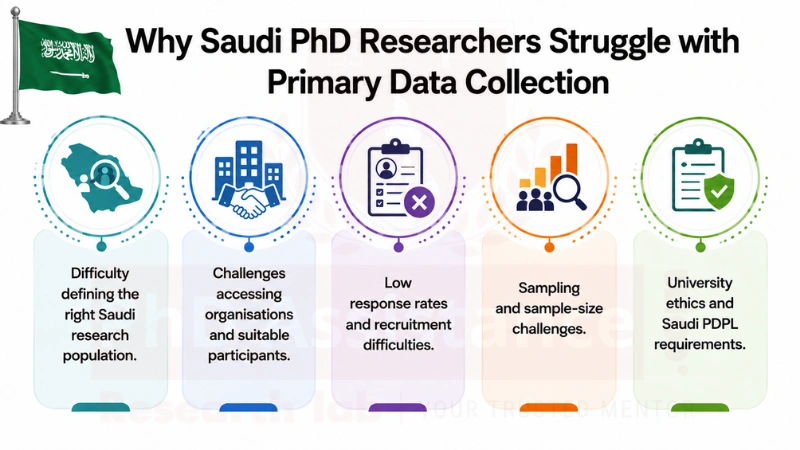
Why Saudi PhD Researchers Struggle to Collect Reliable Primary Data?
1. Reliable Primary Data for PhD Research Starts with the Right Saudi Population
A research topic for a Saudi PhD might appear to be easy to formulate. However, when you start working on your topic, it becomes clear that there are some difficulties in identifying the exact population for your study. For instance, a research project about digital transformation in Saudi SMEs must clarify whether your research will focus on micro, small and medium businesses.
Similarly, research regarding Saudization, engagement of workers, Artificial Intelligence, entrepreneurship, FinTech, tourism and transformation of organisations would require a more specific target group than a general one named as “Saudi employees” or “Saudi firms.” So, Reliable Primary Data for PhD Research is based on an appropriate target population rather than the public.
Key considerations:
- The Saudi target population
- Sampling unit
- Sector and geographic scope
Research Example:
A study of technology-based SMEs in Saudi Arabia on entrepreneurial intention, digital leadership, readiness for change, and digital entrepreneurship with respect to Vision 2030. In this study, 349 technology-based SMEs were identified as the sampling population, and 149 survey responses from managers were obtained, which shows the significance of specifying the organisation and respondents’ identity before primary data collection (Alshammari, 2026).
2. University Requirements Can Shape Data Collection
The Saudi Arabian doctoral programs have considerable importance to research methodology and analysis skills, and these can impact the way that researchers conduct their study.
For instance, the King Saud University PhD program in Business Administration involves research skills and statistical analysis, advanced business statistics, econometrics, applied multivariate analysis, and advanced research design. The program also involves a comprehensive examination and dissertation phase.
In addition, the PhD in Business Administration offered by KFUPM Business School includes methodological training across quantitative data collection, analytics, and econometrics methods, while research is linked to the Vision 2030 key sectors of Saudi Arabia.
Thus, PhD Business Research Data Collection should be conducted in relation to the research methodology. The sampling, questionnaire or interview structure, sample size, and the analysis planned should be consistent with the research methodology that is approved.
3. Organisational Access Can Be a Major Fieldwork Challenge
Finding participants may even be more challenging than crafting the questionnaire for researchers conducting Business and Management studies.
For instance, a Saudi PhD study may need people from small and medium enterprises (SME), senior management, HR personnel, workers, entrepreneurs, banks, the health sector, technology firms, or government-related institutions.
For instance, when conducting research concerning AI implementation in Saudi Arabian organisations, it is ideal if the participants recruited for the study understood the concepts of technology implementation and organisational decision-making.
Researchers need to find realistic means of accessing and recruiting participants for the study.
Research example:
However, a Saudi Arabian study on the use of AI among healthcare professionals did not consider the public. The survey considered only licensed healthcare professionals who had worked for at least one year and omitted interns and administrative staff members. 400 questionnaires were distributed, and 314 responses were received; most respondents were working for the Ministry of Health (Alsaedi et al., 2024).
This demonstrates that selecting an appropriate target population is more important than simply increasing the number of participants.
4. Recruitment Must Reflect the Saudi Context
The effective sampling strategies in other countries may not be ideal in Saudi Arabia. When planning to conduct fieldwork research, researchers must consider the following: Ramadan, Hajj and Umrah seasons, holidays, the organisation’s calendar, regional considerations, and Arabic-English questionnaires.
The target group needs to be considered too. If the research involves Saudi women entrepreneurs, SME owners, health practitioners, consumers, government workers, or top managers, different approaches may apply.
Best method: Focus the recruitment on the traits of the real Saudi population under study, not just because they can be accessed easily.
Research example:
In a study conducted on Saudi women entrepreneurs, data were collected from 256 participants located in five major Saudi cities by utilising snowball sampling. This study concentrated on Saudi women entrepreneurs, and their survey data were analysed using SmartPLS 4 (Iqbal & Ahmad, 2024).
It clearly shows that the recruitment process must take into consideration the geographic distribution of the population being researched
Explore the guidance at PhD Assistance Research Lab to address the PhD Business Data Collection Challenges in Saudi Arabia
5. Sampling and Sample Size Need a Clear Rationale
The number of responses will not necessarily guarantee the reliability of primary data collected. For the study on Saudi SMEs, the researcher is expected to define the SME population, identify the eligible organisations and the criteria for their selection, and justify why the selected respondents constitute the research population.
In addition, the sample size should be related to the intended analytic approach. Studies involving regression, structural equation modelling, multivariate analysis, and other sophisticated techniques need a proper methodological rationale as opposed to an arbitrary sample size.
The quality of data obtained is key in determining the validity of statistical analysis and conclusions.
Key considerations: Considerations for Sample Size Justification should include Population, Research Design, Sampling Method, and Analysis Method—not the Number of Participants Available Alone
6. Research Ethics and Personal Data Protection
The ethics and data protection issues must be addressed before collecting any primary data. The Saudi doctoral students must understand their institution’s ethics guidelines and consider the requirements for collecting and processing personal data as per the PDPL of Saudi Arabia.
This is especially critical for research that processes any information regarding employees, demographics, contact details, customers, health, or any other kind of sensitive data.
For instance, the research-ethics procedure of Saudi Electronic University requires ethics documentation and research documentation, whereas its data collection procedure consists of ethics approval and research documentation.
Researchers should therefore plan for:
- Participant information and informed consent
- Data minimisation
- Anonymisation or pseudonymisation where appropriate
- Secure data storage
- Access controls
- Data retention and disposal
- University ethics approval
- Applicable Saudi data-protection requirements
Quick Self-Check for Saudi PhD Researchers
- Is my Saudi target population clearly defined?
- Does my sample represent the population relevant to my research question?
- Have I identified realistic Saudi participant-access channels?
- Have I considered Arabic-English translation where necessary?
- Have I planned for Ramadan, Hajj, holidays and organisational schedules?
- Have I considered applicable Saudi personal-data requirements?
- Is my sample size justified by my planned analysis?
- Does my research address a clearly defined Saudi business or societal context?
Conclusion
For Saudi doctoral-level research, reliable primary data cannot simply be obtained from many responses. It is necessary to create a cohesive methodology for the Saudi research environment, the intended audience, sampling, instrument, recruitment, ethics, and analysis.
In the context of Business and Management, this implies gaining knowledge about the Saudi organisations, industries, workers, SMEs, customers or institutions pertinent to the research problem. Early preparation may help researchers overcome the recruitment problem, provide a good methodology and increase the level of evidential validity.
Facing challenges collecting reliable primary data for your research in Saudi Arabia? PhD Assistance Research Lab provides expert support with research design, sampling, data collection, ethics, and analysis planning to strengthen your research methodology.
Book a Free Expert Consultation and receive structured academic guidance.
FAQs:
1. What are some common challenges students encounter when conducting research?
Common challenges include literature review, research design, data collection, participant recruitment, statistical analysis, time management, ethical approval, and interpreting research findings.
2. Which primary data collection methods are suitable for Saudi Business and Management PhD research?
Surveys, interviews, focus groups, experiments, observation and case studies can be suitable depending on the research questions and methodology.
3. Do Saudi PhD researchers need ethics approval?
Requirements vary by university and research context. Researchers should confirm the applicable ethics procedure with their university and supervisor before collecting data.
4. Does the Saudi PDPL apply to PhD research?
It can apply when researchers process personal data. Researchers should consider the PDPL alongside their university’s ethics and data-management requirements.
5. How can researchers improve questionnaire reliability?
Using appropriate validated measures, pilot testing the instrument, assessing reliability and validity, and documenting any adaptations can strengthen questionnaire quality.
References
- Alshammari, K. H. (2026). Entrepreneurial Intention, Digital Leadership, and Willingness to Change in Technology-Based SMEs: A Saudi Vision 2030 Perspective. St. Theresa Journal of Humanities and Social Sciences, 12(1) https://so19.tci-thaijo.org/index.php/sjhs/article/view/2849
- Alsaedi, A. R., Alneami, N., Almajnoni, F., Alamri, O., Aljohni, K., Alrwaily, M. K., Eid, M., Budayr, A., Alrehaili, M. A., Alghamdi, M. M., Almutairi, E. D., & Eid, M. H. (2024). Perceived Worries in the Adoption of Artificial Intelligence Among Healthcare Professionals in Saudi Arabia: A Cross-Sectional Survey Study. Nursing reports (Pavia, Italy), 14(4), 3706–3721. https://doi.org/10.3390/nursrep14040271
- Iqbal, T., & Ahmad, S. (2024). Women entrepreneurs in emerging Saudi Arabia: Exploring the impact of innovation, risk and perseverance. Journal of Entrepreneurship and Public Policy, 14(2), 288–310. https://doi.org/10.1108/JEPP-01-2024-0005
- King Saud University, College of Business Administration. (n.d.). PhD in Business Administration. https://cba.ksu.edu.sa/en/P.h.D-mba
- King Fahd University of Petroleum and Minerals, KFUPM Business School. (2026). PhD in Business Administration: Program overview. https://kbs.kfupm.edu.sa/phd/program-overview/
- Saudi Electronic University. (2026). Scientific research ethics. https://seu.edu.sa/en/deanships/graduate-studies-research-and-innovation-deanship/research-ethics/
- Saudi Data & AI Authority. (n.d.). Personal Data Protection Law. https://dgp.sdaia.gov.sa/wps/portal/pdp/knowledgecenter/details/PDPL
