
The source and the debate it joins
The paper under review is Ballarino and Cantalini (2026), "The PhD premium: Diverging occupational returns to the PhD credential in 20 European countries", published in Research in Higher Education (volume 67, issue 2; online in December 2025). Both authors are at the University of Milan. The study asks whether the occupational advantage of a doctorate has changed as doctoral education has expanded across Europe.
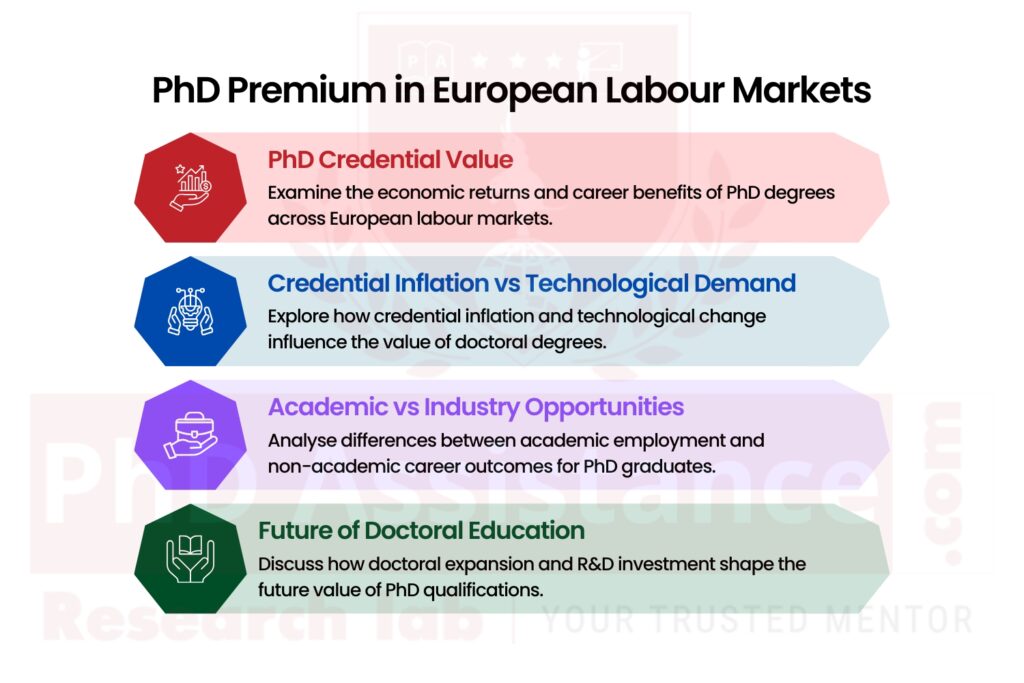
The authors frame the question with two contrasting scenarios. The first, inflation of educational credentials, draws on the view that the value of a qualification is partly positional and that it signals ability to employers (Spence, 1973; Collins, 1979). If more people hold a doctorate, the signal weakens and the premium should fall. The second, skill-biased technological change, holds that technology raises demand for highly skilled workers faster than supply in many periods (Goldin & Katz, 2008; Acemoglu & Autor, 2011), so the premium can persist or grow even as numbers rise. The authors add a coevolution argument: well-designed public policy can keep the supply of, and demand for, high skills in balance (Ballarino & Cantalini, 2026).
Most earlier evidence on the returns to a doctorate is national. Studies in Germany found a positive income effect of the doctorate in nearly all fields (Mertens & Röbken, 2013); in the United Kingdom, a premium over the master's degree that depends heavily on reaching managerial positions (Marini & Henseke, 2023); and in Italy, falling academic employment and more fixed-term contracts after reforms and the economic crisis (Passaretta et al., 2019). A comparative design across many countries is the paper's main promise.
What the study did and found
The data are from the European Union Labour Force Survey for 2009 to 2020, covering 20 countries. The sample is employed people aged 35 to 64: 11,471,630 individuals, of whom 128,561 held a PhD, about 1.1% of the total and 3.7% of tertiary graduates (Ballarino & Cantalini, 2026). The PhD premium is defined against college (tertiary) graduates, not against the whole workforce.
Three outcomes are analysed, each as a binary variable in a linear probability model: holding an academic position (ISCO-88 code 231, college and university teaching professionals); holding a non-academic high-status position (ISCO major groups 1 and 2, managers and professionals, excluding code 231); and having an income in the top 30% of the distribution, the survey's top three income deciles, analysed for employees only.
The two-step design
In the first step, the authors estimate 60 separate individual-level models, one for each country in each of three periods (2009 to 2012, 2013 to 2016 and 2017 to 2020), controlling for sex, foreign birth, region, age and survey year. Each model yields a PhD coefficient: the country-period premium. In the second step, these 60 premiums become the dependent variable in weighted least squares regressions on two macro-level variables: the proportion of PhD holders in the population aged 35 to 64 and public spending on research and development (R&D) as a percentage of GDP. Weights reflect the precision of each first-step estimate, and standard errors are clustered by country (Ballarino & Cantalini, 2026).
Main results
The premium is positive almost everywhere. For academic positions it is universally positive, ranging from 40 percentage points in Spain to 5 in Luxembourg; for top-30% income it ranges from 31 points in Finland to 5 in the Czech Republic. For non-academic high-status jobs the picture is mixed: negative estimates are found in Portugal, Lithuania, Italy, Denmark and Greece (Ballarino & Cantalini, 2026).
| Outcome | Model | Proportion of PhD holders | Public R&D spending | R2 |
|---|---|---|---|---|
| Academic position | 1 | -0.06*** (0.01) | 0.48 | |
| Academic position | 2 | -0.08*** (0.03) | 0.37 | |
| Academic position | 3 | -0.05** (0.02) | -0.04 (0.03) | 0.55 |
| Non-academic high-status job | 1 | 0.07*** (0.02) | 0.32 | |
| Non-academic high-status job | 2 | 0.13*** (0.02) | 0.57 | |
| Non-academic high-status job | 3 | 0.03 (0.02) | 0.11*** (0.03) | 0.60 |
| Top-30% income | 1 | 0.00 (0.01) | 0.00 | |
| Top-30% income | 2 | 0.02 (0.02) | 0.09 | |
| Top-30% income | 3 | -0.02* (0.01) | 0.03 (0.02) | 0.13 |
The table carries the paper's argument. Where doctoral holders are more common, the academic premium is smaller, and this holds when R&D spending is controlled. Where public R&D spending is higher, the non-academic premium is larger, and once spending is controlled the proportion of PhD holders no longer matters. The income premium is barely related to either variable. The authors conclude that two mechanisms operate: credential inflation in academia, where professorships are limited by public funding, and technological demand outside it (Ballarino & Cantalini, 2026).
Strengths
- Comparative scope. Twenty countries and three periods, with a common data source and common definitions, allow patterns to be compared that single-country studies cannot reveal.
- Separating outcomes. Treating academic jobs, non-academic high-status jobs and income separately is the key design choice. A single "return to the PhD" would have averaged opposite associations and hidden the main finding.
- Theory before data. The two scenarios generate opposite predictions for the same coefficient, which makes the results interpretable rather than descriptive.
- Transparent modelling. The two-step approach is simple to follow, weights estimates by their precision, clusters errors by country and reports robustness checks, including models with country fixed effects.
Limitations and methodological issues
The authors are candid about most of the limits, and a careful reader should keep them in view when citing the study.
- Association, not causation. The second step has 60 observations from 20 countries. Countries with more PhD holders and higher R&D spending differ in many other ways, from industrial structure to how universities are funded. The authors note that when country fixed effects are added, the negative academic association disappears, so the results are driven mainly by differences between countries rather than by change within them (Ballarino & Cantalini, 2026).
- A short window. Twelve years, grouped into three periods, give little leverage on how premiums change over time within a country, and some countries have few PhD holders in the survey.
- Coarse income measure. The survey records income in deciles, so the income outcome is a threshold (top 30%) rather than earnings. Real differences in pay above the threshold are invisible, which may help explain why the income results are weak.
- Fields of study. The paper reports supplementary STEM and non-STEM analyses but explains that the survey records field of study fully only up to 2013, so the main results are, in the authors' words, likely a gross average across fields.
- Who is a PhD holder. The survey cannot separate a first job from later career progression, and the age band of 35 to 64 means recent expansion is reflected mainly in younger cohorts not yet in the sample.
- Heterogeneity. Sex and foreign birth are controlled, but the premium is not estimated separately for women and men or for migrants. Evidence from the United Kingdom suggests the premium can differ by gender (Marini & Henseke, 2023).
There is also a measurement question about the occupational outcomes. Code 231 covers university and higher education teaching professionals, which includes many fixed-term and teaching-focused posts as well as professorships, so "professorship" in the paper should be read as an academic occupation rather than a tenured chair. Finally, the analysis uses anonymised secondary data, which minimises risks to participants, but the interpretive responsibility remains: national averages should not be read as predictions for an individual.
How the study fits the wider evidence
The finding that academic prospects worsen as doctoral output grows matches national evidence. In Italy, cohorts graduating after reforms and the financial crisis were less likely to work in academia and more likely to hold fixed-term contracts or work abroad (Passaretta et al., 2019). In the United States, many humanities and social science doctorates who sought tenure-track posts did not obtain them, yet reported satisfaction in other careers (Main et al., 2019). A review of doctoral employment research argues that most doctoral graduates now work outside academia and that the evidence base on their careers remains thin (Hancock, 2021), and a European study of labour market prospects stresses large differences by country, sector and field (Hnatkova et al., 2022).
The non-academic result aligns with research on how technology reshapes demand for skills (Acemoglu & Autor, 2011). It also fits the British finding that much of the doctoral premium depends on reaching leadership roles (Marini & Henseke, 2023): the outcome in the paper that tracks expansion and R&D most closely is access to managerial and professional jobs, not income itself.
Reading the numbers: an illustrative example
The following example is illustrative and uses only the published coefficients. Take two hypothetical country-periods that differ by one unit in the proportion of PhD holders, with everything else in Model 1 unchanged. The coefficient of -0.06 for the academic outcome implies that the predicted academic premium is about 6 percentage points lower in the country with more PhD holders. If the premium in the first country were 25 points, the model would predict about 19 in the second.
Three cautions apply. First, this is a comparison between countries, not a forecast of what happens when a country expands its doctoral programmes; the fixed-effects results warn against that reading. Second, the premium is a difference in probabilities relative to college graduates, not the chance that any one PhD holder becomes an academic. Third, with 60 observations clustered in 20 countries, standard errors deserve as much attention as the coefficients.
| Claim | Supported by the study? | Why |
|---|---|---|
| PhD holders are more likely than college graduates to work in academia in all 20 countries | Yes | Academic premium positive everywhere (5 to 40 points) |
| More PhD holders are associated with a smaller academic premium | Yes, across countries | Negative coefficient in Models 1 and 3; not within countries |
| Higher R&D spending creates non-academic jobs for PhD holders | No, only an association | Cross-sectional design; causal effect not identified |
| The income premium is shrinking as doctorates expand | No | Income coefficients near zero and mostly not significant |
| A PhD pays off equally in every field | Not tested in full | Field data limited; main results average across fields |
What it means for doctoral researchers
For anyone at the planning stage, the study is a reminder that the value of a doctorate depends on where you intend to use it. Academic posts are a limited, publicly funded pool, and the advantage a PhD confers in competing for them is smaller where many people hold one. Outside academia, the premium appears strongest where economies invest heavily in research. Neither result tells you what will happen to you, but both argue for keeping more than one route open from the start.
- Investigate the doctoral labour market in the country where you plan to work, including the share of graduates who find academic posts.
- Build evidence of skills valued outside academia, such as project management, data analysis and communication with non-specialists, alongside your research.
- Use the viva and the final year to articulate your contribution in terms that non-academic employers recognise as well as examiners.
- When you cite this paper, describe its findings as associations between countries, and name the outcome (academic job, non-academic job or income) you are referring to.
Related reviews in this series look at transversal skills and industrial employability, PhD employability beyond academia and careers for humanities PhDs.
Common mistakes when citing studies of the PhD premium
- Treating a cross-country association as the effect of a policy change within one country.
- Reporting a "PhD premium" without saying which outcome and which comparison group it refers to.
- Equating an occupational code for higher education teaching with a permanent professorship.
- Reading an income threshold (top 30%) as a measure of average pay differences.
- Generalising from a sample aged 35 to 64 to recent graduates entering the labour market now.
- Ignoring the standard errors and the number of higher-level units in a two-step model.
Key takeaways
- Ballarino and Cantalini (2026) find a positive PhD premium in 20 European countries, measured against college graduates, for academic jobs and top-30% income.
- Across countries, more PhD holders go with a smaller academic premium, consistent with credential inflation (Collins, 1979; Spence, 1973).
- Higher public R&D spending goes with a larger non-academic premium, consistent with technological demand for skills (Acemoglu & Autor, 2011).
- The design is cross-sectional and the academic association disappears within countries, so the results are associations, not effects.
- Doctoral researchers should plan for both academic and non-academic careers, as national studies also suggest (Passaretta et al., 2019; Hancock, 2021).