
Critical Review of PhD Employability Beyond Academia Through a Cultural Capital Lens
Introduction
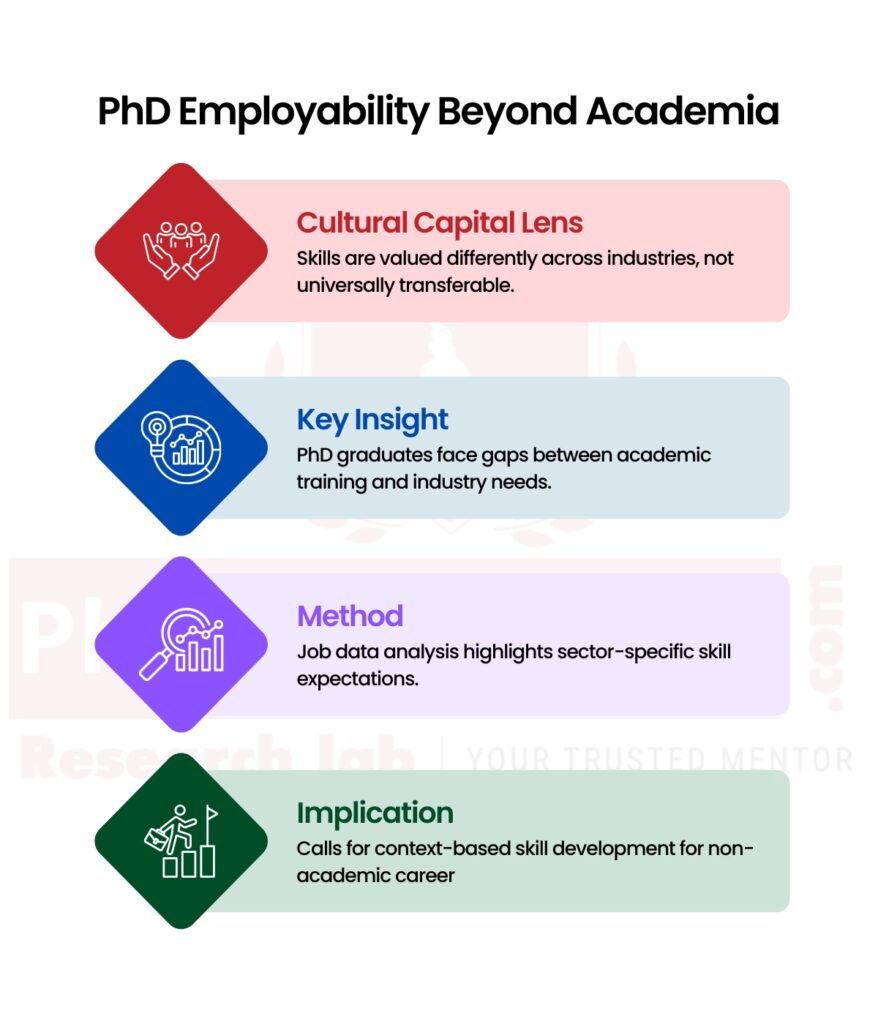
The reviewed article addresses this challenge through cultural capital theory, which it applies to higher education to investigate skill expectations across different industries. The authors demonstrate that professional cultures dictate skill recognition and assessment rather than assuming transferable skills from doctoral education operate identically across all fields.
The issue of PhD employability beyond academia has become central to contemporary higher education debates. As academic job markets contract globally, doctoral graduates increasingly pursue non-academic careers, making employability a priority for universities, policymakers and industry stakeholders. The current situation requires organisations to establish better methods for defining PhD graduates’ essential skills that directly relate to their professional development across different work environments.
The critical review assesses all aspects of the study, including its theoretical framework and research design, together with its findings and their impact on academic and industrial transition studies for PhD graduates.
Summary of the article
The article investigates how PhD holders find work outside academic positions by studying research-intensive job advertisements, which total 1,800 postings from Australia and New Zealand and cover the healthcare and information technology fields.
The research study examines higher education through cultural capital theory, while it disputes human capital theory, which treats skills as assets that people can use across different contexts. The authors show that doctoral education provides transferable skills, which include communication and networking, innovation and leadership, but these skills have different definitions according to various industry settings.
The research results show that healthcare employers focus on empathy and compliance with regulations, and the development of professional skills through teamwork. The research demonstrates that PhD graduates need specific industry skills because their skills are tied to particular work environments.
The study demonstrates that doctoral students face challenges when moving from academia to industry because they have advanced research skills but lack the required skills for industry work.
Critique
Significance and contribution of the field
The study makes a meaningful contribution to research on doctoral careers by integrating capital theory in higher education into employability discourse. The theoretical perspective enables researchers to examine PhD graduate employability through several career pathways, which include more than academic environments, because practical abilities development requires cultural understanding instead of basic skills learning.
The research successfully changes public discussions about essential work skills PhD graduates need to master because it shows that skill evaluation depends on established professional benchmarks and government regulations, and the specific needs of various industries. The study provides essential information that enables an understanding of why academic professionals face challenges during their Academic to industry transition.
The study provides strong conceptual contributions, but its two-industry examination restricts its potential for general application. The framework needs to expand into additional industries because this process will improve its capacity to show how skills move between different work settings.
Methodology and research design
The article uses a culturally aware Move-Step linguistic analysis method to examine job advertisements through its dual research method, which includes both quantitative and qualitative research methods.
The method permits researchers to study industry-specific PhD degree programs because it shows how different industry sectors define required skills. The study demonstrates that social and cultural factors shape Transferable skills in doctoral education by measuring skill requirements and their contextual usage.
The study achieves greater reliability through its analysis of 1,800 job advertisements, while statistical testing establishes valid results for industry comparisons. The use of job advertisements fails to demonstrate actual workplace situations and the real experiences of doctoral graduates who transition from academic to industrial work.
Argumentation and Use of Evidence
The authors present a coherent argument that challenges conventional human capital models of doctoral employability.
The article demonstrates its main point by establishing a direct connection between its empirical findings and cultural capital theory, which exists in higher education. The comparison between healthcare and IT provides persuasive evidence that PhD employability in academia requires contextual awareness rather than abstract skill acquisition.
The article would improve through the inclusion of first-hand accounts, which PhD graduates provide to support the textual analysis of job advertisements. Including lived experiences could provide deeper insight into how doctoral scholars interpret and adapt their industry-relevant skills in real professional settings.
Ethical considerations and omissions
The research uses historical job advertisement records and data from particular industries, which limits its findings. The research establishes a solid theoretical foundation, yet it needs more empirical evidence about graduate outcomes to prove that doctoral education transfers to transferable skills. The cultural capital framework needs expansion to investigate worldwide PhD employability patterns that extend beyond academic fields in non-Western regions.
Writing Style and Structure
The article maintains a structured and academically rigorous presentation. The study achieves a better understanding through its theoretical elements and empirical research, which increases its academic credibility. The explanation of cultural iceberg and habitus concepts provides accessible entry points into cultural capital theory in higher education for readers unfamiliar with sociological frameworks.
Theoretical density of the text creates difficulties for readers who want to develop practical skills that PhD graduates need for success in their fields. Theoretical density of the text creates difficulties for readers who want to develop practical skills that PhD graduates need for success in their fields.
Conclusion
The study uses a new framework to evaluate PhD employability, which shows that generic skills and transferable skills lead to doctoral career paths. The authors use cultural capital theory to show that educational systems embed professional skills into their academic frameworks and specific industry practices.
The research demonstrates that doctoral graduates who possess strong research skills face obstacles when transitioning from academic environments to professional work. The study demonstrates that conventional transferable skills used in doctoral programs should be replaced with context-specific training methods that take into account cultural differences in employability skills.
Future research should expand empirical investigations across additional industries and geographic contexts to deepen understanding of industry-relevant skills for PhD graduates and to further advance doctoral career development scholarship.
Reference
Chen, L., Mewburn, I., Suominen, H., & Grant, W. (2026). PhD employability beyond academia: An analysis of industry skills emphasis through a cultural capital lens. Higher Education Research & Development, 45(1), 81–99. file:///C:/Users/user/Downloads/PhD%20employability%20beyond%20academia%20%20an%20analysis%20of%20industry%20skills