Critical Review: Career Transition and Professional Development Beyond Academia for Humanities PhDs
Career Transition and Professional Development Beyond Academia for Humanities PhDs
Introduction
Doctoral education in the humanities has traditionally been structured to prepare students for an academic career. However, the limited availability of faculty positions, together with changing labour market demands, necessitates students to explore non-academic career options. The transition to non-academic work creates uncertainty and anxiety for many PhD graduates because institutions provide insufficient support, leading them to believe their abilities can only be used for academic work.
Williams and Williams (2025) explore the challenges faced by humanities doctoral graduates when moving beyond traditional academic careers and propose practical strategies to support successful career transitions. The article presents various difficulties, which include skill translation difficulties, professional identity challenges, networking obstacles and personal branding issues, while providing practical solutions to assist people in developing their careers.
The critical review assesses the article through its examination of conceptual components, its research methods and its supporting evidence and arguments and their connection to research about doctoral education and professional development.
Summary of the Article
The humanities PhD students and graduates from their studies face specific obstacles that prevent them from achieving their professional goals. The article presents five key challenges and corresponding strategies that support professional development outside academia.
It demonstrates how doctoral students face difficulties when they attempt to convert their specific academic knowledge into professional skills that employers require. The authors present their argument that doctoral programs focus on academic careers as their primary objective, which creates two major problems for students who want to explore different work possibilities.
Critique
Significance and Contribution to the Field
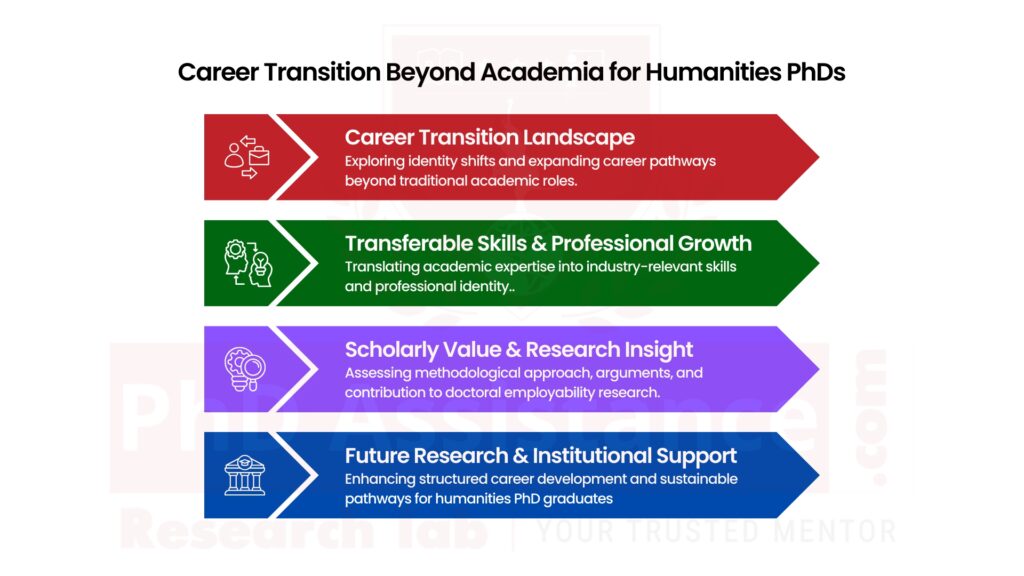
A significant contribution to research on doctoral career development was made by addressing the growing need for structured support for non-academic career pathways. The research shows that doctoral programs fail to fulfil employment requirements because students need to develop both their professional capabilities and their capacity to work in different work environments.
The practical integration is one of its primary strengths, as universities and career development practitioners provide practical advice through their specific strategies, which include networking, personal branding and skill translation. The article also contributes to the broader discourse on employability and graduate outcomes in higher education.
The main purpose is to offer professional guidance instead of an empirical study, which bases its findings on theoretical concepts. The research provides valuable insights, but its lack of comprehensive theoretical frameworks prevents it from making substantial contributions to the understanding of doctoral employability and career transitions.
Methodology and Research Design
The methodology is a descriptive and reflective approach that applies professional experience and practitioner insights as its research foundation instead of formal empirical research methods. The authors use their career coaching experience together with existing literature to discover common difficulties that humanities PhD graduates encounter.
This practitioner-based methodology is used to develop their practical recommendations, which improve real-world work situations. The study findings lack generalisability because the research did not use systematic data collection methods or participant sampling techniques, nor did it conduct statistical analysis. The article requires empirical evidence through surveys and interviews and longitudinal tracking of doctoral graduates to support its claims and strengthen its research validity.
Argumentation and Use of Evidence
A clear and logically structured argument is developed, which demonstrates the significance of transferable skills, professional identity and strategic career planning. The authors use narrative examples and practical scenarios to demonstrate key points, which help readers to better understand the material.
The use of illustrative cases, such as doctoral graduates transitioning into user experience research or project management roles, provides concrete evidence of how academic skills can be applied in professional contexts. The study’s evidence base consists mainly of anecdotal evidence together with descriptive information. The article would benefit from additional empirical studies of labour market data, and comparative analyses which would enhance its evidence base and academic strength.
Ethical Considerations and Omissions
The emotional and psychological challenges that doctoral students face when they experience career uncertainty and their professional identity changes have been discussed. The program establishes accessible career development methods that help students develop confidence and build professional connections while they conduct self-assessment.
A minimal explanation about structural inequalities and systemic barriers that impact doctoral graduates’ career opportunities through their socioeconomic status, institutional prestige and international labour market differences has been given in the study. A more critical examination of these structural factors would enhance the comprehensiveness of the analysis.
Writing Style and Structure
Content is presented through a straightforward academic writing style that provides both academic analysis and practical advice. The structured organisation into thematic sections of the document enables readers to identify essential challenges and solutions because they can navigate the content with greater ease.
Through the combination of narrative tone and real-world case studies, it provides practical benefits to doctoral students and early-career researchers. The writing describes events in such a way that it prevents the author from conducting thorough analytical work. The research would achieve greater scholarly value through an examination of employment and career development theoretical frameworks.
Conclusion
The research shows how doctoral education and career development fields benefit from their research, which demonstrates the career transition challenges faced by humanities PhD graduates who leave academic fields. The article shows that academic research scholars need three vital components to establish successful career paths that extend beyond their teaching positions.
It offers practical guidance and easy-to-understand insights, but its descriptive and practitioner-focused approach limits its research and theoretical development. Future research should use systematic data collection methods together with cross-disciplinary analysis to achieve a better understanding of doctoral career paths and the long-term effects of professional development programs.
Significant information was provided that doctoral students, educators, and institutions can use to help humanities PhD graduates achieve diverse career paths while improving their employment prospects in today’s fast-changing global job market.
For researchers seeking expert support in developing research publications, the PhD Assistance Research Lab offers specialised academic guidance tailored to doctoral scholars and early-career researchers.
Reference:
Williams, A., & Williams, F. (2025). How to thrive beyond academia with a humanities PhD. Public Humanities, 1, e54, 1–8. https://doi.org/10.1017/pub.2024.53
Methodology and Research Design