
The study and its context
The study under review, "A Decade of Medical Pharmacology Speciality and PhD Theses in Turkey: A Comparative Study", analyses theses in medical pharmacology completed in Turkey between 2010 and 2020. This review therefore works from the study's design and findings as they were summarised, and readers should consult the original before relying on any figure.
Two kinds of thesis are compared. Physicians training as specialists in medical pharmacology write a specialty (residency) thesis as a requirement of specialist training, while PhD candidates in pharmacology, who may come from medicine, pharmacy or the life sciences, write a doctoral thesis. Both are deposited in the Council of Higher Education's National Thesis Center, an open archive that has made a series of Turkish studies of thesis output possible (Council of Higher Education, n.d.).
What the study did and reported
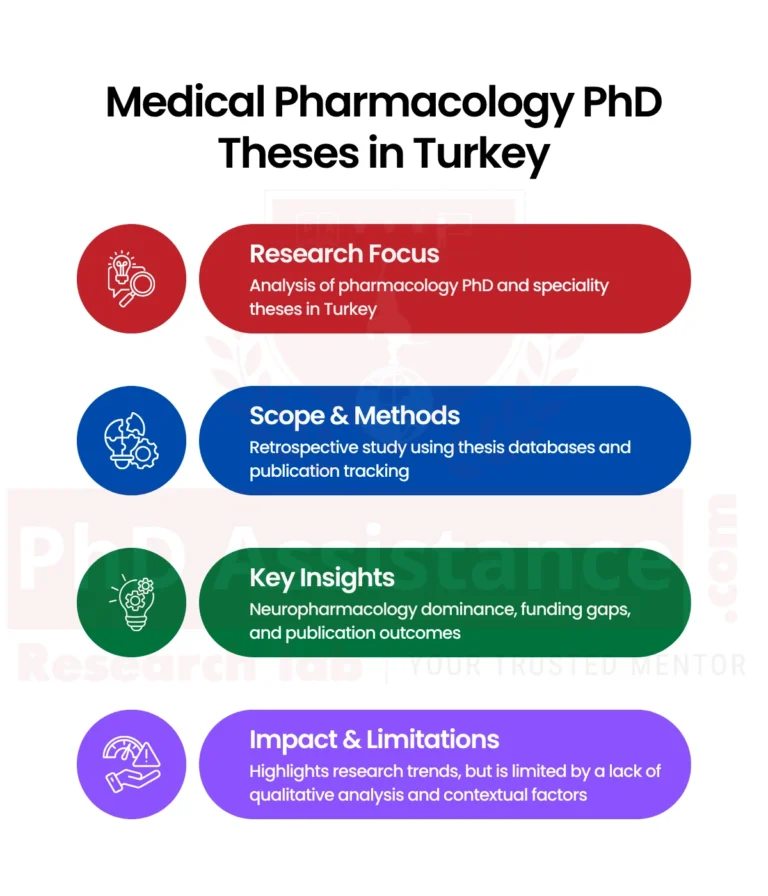
The study is a retrospective analysis of the archive. For each thesis it recorded the research subject, whether the work received financial support, and whether it was later published, searching Web of Science, PubMed, Google Scholar and TR Dizin, the Turkish national citation index, for resulting articles.
- Funding: almost half of the specialty theses received no research funding, while PhD theses were funded more often.
- Topics: neuropharmacology was the most common subject for both specialty and PhD theses, followed by cardiovascular pharmacology.
- Clinical pharmacology appeared more often in specialty theses than in PhD theses.
- Publication: many theses led to articles in journals indexed in the Science Citation Index Expanded (SCI-E).
The summary does not report the number of theses of each type or the exact publication rates, which limits what a reader can conclude about the size of the differences.
How the study fits Turkish research on thesis output
The study belongs to a well-established Turkish genre: retrospective analyses of the National Thesis Center that ask how often theses become journal articles. These studies make a useful comparison set because they share a data source and broadly similar methods.
| Study | Field and thesis type | Period | Theses | Reported publication |
|---|---|---|---|---|
| Eser (2020) | Pharmacology, specialty | 2006 to 2016 | 108 | 61 (56.5%) published; 47 in SCI or SCI-E journals |
| Ateşoğlu Karabaş and Solgun Dağ (2024) | Anatomy, doctoral | 2009 to 2019 | 148 | 82 (55.4%) published; 53 (35.8% of all theses) in SCI or SCI-E journals |
| Petekkaya and Altin (2022) | Forensic medicine, specialty | 1983 to 2020 | 383 | Publication reported in several categories; see the paper. Most common topic: clinical forensic medicine and trauma (15.1%) |
| Sengun and Abacioglu (2025) | Radiation oncology, specialty | 2003 to 2023 | 277 | 52.3% published, on average about 4.8 years later; 58.6% of these in SCI-E journals |
| Tunce et al. (2026) | Pathology, endocrinology, urology, specialty | 2018 to 2022 | 1,245 | 25.0%, 21.9% and 37.0% converted to original articles |
Two points stand out. First, the earlier pharmacology study found a high rate of publication in SCI-E journals among specialty theses (Eser, 2020), which is consistent with what the reviewed study reports. Second, publication rates vary widely with the field, the period and, importantly, the method: Tunce et al. (2026) searched only PubMed and Google Scholar and counted only original research articles, and they note that this may miss work indexed elsewhere or published under changed titles. Rates from different studies are therefore not directly comparable unless the search and matching rules are the same.
Argument, evidence and presentation
As summarised, the study presents its findings descriptively, comparing proportions between the two thesis types, and argues that postgraduate pharmacology research in Turkey has kept consistent thematic priorities over the decade. The structure is conventional and clear, moving from methods to results and discussion, and the specialty versus PhD contrast gives the paper a clear organising idea.
The argument would be stronger in three ways. First, a claim of consistent priorities needs the topic distribution shown year by year, not only in total, so that readers can see stability or change. Second, comparisons of proportions should be accompanied by the counts behind them and by a test or confidence interval, so that small differences are not over-read. Third, the discussion would benefit from engaging with the earlier Turkish pharmacology study (Eser, 2020) and with thesis-output studies in other fields (Table 1), which would show whether pharmacology is typical. Clinical pharmacology, which is central to drug development, also deserved fuller discussion, since its concentration in specialty theses may reflect where clinical pharmacology training and patient access sit in the Turkish system.
Strengths of the study
The study's main strength is coverage. Using the national archive over ten years allows a complete picture of pharmacology theses rather than a sample, and searching several databases, including the national index, reduces the risk of missing articles published in Turkish journals, a limitation acknowledged in studies that searched fewer sources (Tunce et al., 2026).
The comparison of specialty and PhD theses is also useful. Funding differences matter for training: a specialty thesis completed without funding is likely to be smaller in scale, and the finding that almost half were unfunded raises questions for departments and funders. The topic profile, with neuropharmacology and cardiovascular pharmacology dominant, gives prospective researchers a picture of where supervision and laboratory capacity are concentrated.
Limitations and methodological issues
Counting is not evaluating
An archive study records attributes of theses; it does not appraise their methods, originality or contribution. Why are specialty theses less often funded? Do supervisors or institutions explain differences in publication? These questions need data from the people involved, through surveys or interviews, or linkage to institutional records.
Publication and indexing are not impact
Publishing in an SCI-E journal shows that work passed peer review in an indexed journal; it does not show international influence. The Leiden Manifesto warns against using journal-level indicators to judge individual pieces of research and recommends combining metrics with expert judgement (Hicks et al., 2015). A stronger design would add citation counts with a clear time window, as Tunce et al. (2026) did, and would report journal quartiles or fields with care.
Comparing unlike groups
Specialty and PhD theses differ in their authors, purpose, duration and resources. Without adjusting for institution, year and supervisor, a difference in funding or publication may reflect those factors rather than the type of thesis. Research on doctoral education consistently finds that supervision and peer relationships shape progress and outcomes (Sverdlik et al., 2018; Matheka et al., 2025), and how supervisors conceive of their role varies (Lee, 2008). A multivariable analysis, or at least stratified tables, would make the comparison more convincing.
Matching theses to articles
The study does not report how theses were matched to articles (title, author names, supervisor names) or how ambiguous matches were resolved. Matching rules drive the results, as the Turkish comparison studies show, and should be stated so that others can reproduce them (Tunce et al., 2026).
Wider context and omissions
The study uses public archive records and involves no human participants, so ethical risk is low. Its more important omissions are contextual. It does not compare Turkish trends with those elsewhere, examine regional or institutional differences in resources, or follow graduates' careers. Whether a thesis is published is closely tied to whether its author stays in research: Sengun and Abacioglu (2025) found significantly higher publication among radiation oncology residents who pursued academic careers, and studies of the transition to independent research show how much the doctoral environment shapes who continues (Lovitts, 2008). Linking thesis records to career outcomes would turn a descriptive study into an explanatory one.
Internationally, low conversion of theses into articles is not unique to Turkey. In psychology, Evans et al. (2018) found in a stratified random sample of 910 dissertations that only about a quarter (25.6 per cent) were ultimately published in peer-reviewed journals, usually within two to three years, and that published dissertations were cited and appeared in influential journals. The barrier appears to be conversion rather than quality. This supports arguments that doctoral training should treat writing for publication as part of the thesis rather than as a later, optional step (Kamler, 2008).
What this means for doctoral and specialty researchers
For researchers now writing a thesis in pharmacology, the comparison studies carry practical lessons.
- Plan for publication from the start: decide which chapters could become articles and write the methods to journal reporting standards (Kamler, 2008).
- Seek funding, even small internal grants, early; unfunded theses tend to be smaller and harder to publish.
- Discuss authorship and publication plans with your supervisor before data collection.
- Aim to submit within a year of the defence; average delays of several years are common in Turkish data (Sengun & Abacioglu, 2025; Tunce et al., 2026).
- Keep a record of the thesis number and title so that later articles can be traced to the thesis.
For related guidance, see our article on turning a thesis into a manuscript and, for pharmacology in another setting, writing a pharmacology dissertation in the UAE and research gaps in receptor pharmacology.
Worked example: reading a thesis-output study critically (illustrative)
Suppose a hypothetical study reports that 60% of PhD theses and 45% of specialty theses in a field were published. Before accepting that PhD theses are "more productive", a careful reader would ask:
| Question | Why it matters |
|---|---|
| How were theses matched to articles? | Strict title matching undercounts; loose matching overcounts. |
| Which databases were searched? | Omitting national indexes misses articles in local journals. |
| Were years of completion comparable? | Recent theses have had less time to be published. |
| Were institutions and funding taken into account? | Differences may reflect resources, not thesis type. |
| How was "impact" measured? | Indexing is not impact; citation counts need a fixed window. |
Conclusion
The study offers a useful descriptive map of a decade of Turkish pharmacology theses: what they studied, how often they were funded, and that many reached indexed journals. Its value is limited by the absence of explanatory analysis, its treatment of indexing as a sign of impact, and, for readers, the difficulty of tracing the original record. Read alongside the other Turkish thesis-output studies, it supports a clear message for doctoral and specialty researchers: plan the thesis so that it can be published, and do so early.
Key takeaways
- The reviewed study maps funding, topics and publication of Turkish medical pharmacology specialty and PhD theses from 2010 to 2020.
- Neuropharmacology and cardiovascular pharmacology dominated; about half of specialty theses were unfunded.
- Archive studies count attributes; they do not measure quality, and indexing is not impact (Hicks et al., 2015).
- Publication rates in Turkish thesis studies vary with field, period and matching method (Eser, 2020; Tunce et al., 2026).
- Treating writing for publication as part of the thesis improves the chance that the work is used (Kamler, 2008; Evans et al., 2018).