
- / Title
Graphene-Based Nanocomposite Membranes for Selective Gas Separation in Industrial Filtration
Info: Graphene-Based Nanocomposite Membranes for Selective Gas Separation in Industrial Filtration | phdassistance.com
Published: 1st August 2026 in
Graphene-Based Nanocomposite Membranes for Selective Gas Separation in Industrial Filtration | phdassistance.com
Share this:
Related Services
Introduction
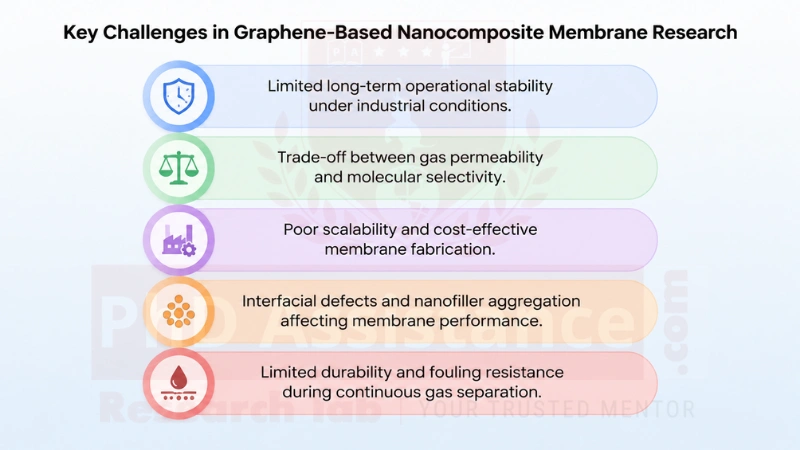
The increasing need for energy-efficient gas purification technologies, the continual evolution of nanomaterials, and the emerging focus on sustainable separation techniques have driven extensive research into membrane technology. This trend has motivated scientists to discover new materials that will increase gas permeation rates, improve molecular selectivity and efficiency of membranes, as well as reduce energy requirements and minimise the environmental footprint of membranes. Graphene-Based Nanocomposite Membranes have been developed with a view to achieving superior mechanical properties and efficient molecular separation performance by providing flexible transport pathways. Even though such membrane technologies have shown great promise, there are still many challenges associated with their application in industrial processes.
Proposed PhD Title 1: Adaptive Nanowindow Engineering in Graphene-Based Nanocomposite Membranes for Selective Gas Separation through Dynamic Rim Chemistry
Membrane-based techniques have been seen as an energy-efficient means of gas purification compared to existing traditional techniques owing to their capacity to cut costs and minimise the impact on the environment. The emergence of Graphene Membranes has shown much promise in molecular separation owing to the thin structure and high transport capabilities of the technology. According to Vallejos-Burgos et al. (2018), the flexibility of the nanowindow rim, as well as the functional groups, plays a vital role in influencing the molecular permeation that allows better oxygen-nitrogen separation compared to existing membranes. Although such developments have been made, the response of such pores when subjected to dynamic operations is not well studied. Adaptive membrane design capable of controlling molecular transportation through controllable pore chemistry would be of great benefit in the future for Filtration systems.
Problem Statement:
The current membrane technology employs the use of pore structures that do not change in order to adapt to the different changes of the molecular interaction process in the gas separation process. This makes such membrane systems inefficient due to changes in operation and unable to employ the use of intelligent membrane technology to operate efficiently.
Research Gap:
Previous research has emphasised the need for flexibility of nanowindows to facilitate molecular transport, but few studies have designed membranes that adaptively manipulate the dynamics of the rim of the pores to maximise permeation, selectivity, and longevity in Mixed Membranes.
Research Question:
Is it possible to enhance molecular transport and separation properties of graphene-based membranes by adapting the chemistry of pore rims dynamically?
Outcome:
The anticipated outcome of the suggested study will involve the fabrication of an intelligent adaptive graphene nanocomposite membrane that will enhance selective gas separation through intelligent regulation of pores, hence improving membrane performance, lifetime, and design of Separation Membranes of the future generation.
Reference:
Vallejos-Burgos, F., Coudert, F.-X., & Kaneko, K. (2018). Air separation with graphene mediated by nanowindow-rim concerted motion. Nature Communications, 9, 1812.
Proposed PhD Title 2. Machine Learning-Driven Functionalisation Strategies for Graphene Oxide Membranes to Enhance CO₂ Adsorption and Molecular Selectivity
Rising interest in the development of sustainable carbon capture technologies has led to an increase in efforts in developing new membranes which can increase the efficiency of gas absorption and separation. Polymer-functionalized graphene structures have been identified as some of the materials that can be used to improve the efficiency of the membranes through their surface chemistries. Stankovic et al. (2022) have found that different functionalities of the polymers influence the behaviour of CO2 adsorption and proved that density functional theory can predict the properties of the materials even before any experimentation. While screening techniques have been helpful in material selection, the use of artificial intelligence in the screening process is still untouched.
Problem Statement:
Modern developments in membranes are largely based on empirical synthesis and traditional computing, thus making the optimisation of membrane functionalisation costly, lengthy, and laborious. In the absence of intelligent prediction systems, the discovery of an optimum set of materials, which would provide exceptional performance for Selective Gas segregation processes, is not achieved. This makes technology development slow, hindering fast advancements in membrane materials for industrial purposes.
Research Gap:
While density functional theory has enhanced polymer-functionalised nanocomposites evaluation, only a few studies have explored the application of machine learning to computational material screening to optimise Graphene Membranes by using predictive molecular design with less development and experimentation costs.
Research question:
Is it possible to enhance the design and functionalization of graphene-based membrane materials using machine learning-driven computational optimisation techniques for carbon dioxide adsorption and molecular selectivity?
Outcome:
The proposed research would enable the creation of an intelligent materials discovery framework that involves computational chemistry and predictive learning to enhance the process of membrane optimisation through improved adsorption properties for Industrial Filtration and the advancement of Mixed Membranes.
Reference:
Stankovic, B., Barbarin, I., Sanz, O., Tomovska, R., & Ruipérez, F. (2022). Experimental and theoretical study of the effect of different functionalities of graphene oxide/polymer composites on selective CO₂ capture. Scientific Reports, 12, 15992.
Proposed PhD Title 3. Hierarchical Graphene Nanolaminate Architectures for High-Performance Hydrogen Purification in Gas Separation Membranes
Hydrogen has emerged as one of the vital sources of clean energy, which is necessary for industrial manufacturing, petrochemicals, and the development of future energy systems. The increasing use of hydrogen has raised the demand for purification technology to separate hydrogen from other gases such as CO2, methane, and nitrogen at the minimum energy cost. Graphene-based membrane technology has shown immense promise due to its thinness and high tunability and selectivity, in addition to high mechanical stability. Chuah et al. (2020) have discussed the advances that have been made in graphene membrane designs such as nanoporous graphene, laminates, and composites while focusing on the challenges left in matching selectivity and permeability. However, more work needs to be done in the engineering of hierarchical membrane design to improve transport efficiency and structural stability for Filtration purposes.
Problem Statement:
Membrane systems for graphene currently still suffer from the problem of balancing gas permeation and selectivity, which prevents efficient hydrogen purification at an industrial scale. The problem leads to the lack of applicability of membrane systems in comparison to traditional methods of hydrogen purification and hinders the competitiveness of this technology. Moreover, membrane stability under high transportation performance is a crucial issue.
Research Gap:
Despite the progress made recently, there is little research focusing on hierarchical nanolaminate structures that have the potential to overcome the permeability-selectivity trade-off challenges in Graphene Oxide Membranes used for hydrogen purification.
Research Question:
Is it possible for hierarchical nanolaminate structures to improve hydrogen purification performance through increasing permeability, selectivity, and membrane stability?
Outcome:
The proposed research would be successful in developing a new generation of membranes that will eliminate the transport restrictions existing in the present, which would result in effective Selective Separation and will contribute to the development of the next generation of Mixed Membranes.
Reference:
Chuah, C. Y., Lee, J., & Bae, T.-H. (2020). Graphene-based Membranes for H₂ Separation: Recent Progress and Future Perspective. Membranes, 10(11), 336.
Proposed PhD Title 4. Defect-Minimised Interfacial Engineering of Polysulfone–Graphene Nanocomposites for Enhanced CO₂/CH₄ Separation Performance
An increase in the need for efficient membrane technology has prompted scientists to design advanced nanocomposites that will help increase the efficiency of purification of gas during the natural gas process. Nanocomposites using a polysulfone matrix have received much appreciation due to their good thermal properties and good mechanical properties, along with compatibility with graphene nanomaterials. The work by Kadhum et al. (2025) has proved that the use of graphene oxide in polysulfone membranes increased the permeability of membranes. However, the problem with the aggregation of fillers and interfacial defects is still playing an important role in affecting the consistency of membranes. Advanced interfacial engineering might lead to the design of robust Mixed Membranes with improved structural and transport properties, which can be useful for developments in Filtration technology.
Problem Statement:
Graphene-enhanced polymer membranes have shown higher efficiencies of separation processes; however, problems such as low interfacial compatibility and clustering of nanoparticles lead to the creation of structural flaws that decrease stability and permeation efficiency, making graphene-polymer membranes unsuitable for use as Gas Separation Membranes.
Research Gap:
Current works are more concerned with the concentration of the fillers and membrane structures, while few works have studied the use of defect-minimised interfacial engineering techniques that can help in optimising the compatibility of the polymer–nanofiller in Graphene Membranes for reliable operation.
Research Question:
How can defect-minimised interfacial engineering make polymer–graphene compatible for improving the durability and gas transport of membranes?
Outcome:
This study will provide a sophisticated method of interfacial engineering that enhances the structural stability and separation effectiveness of membranes to ensure a highly reliable Selective Separation process and scalable manufacturing of nanocomposite membranes.
Reference:
Kadhum, A. A., et al. (2025). Polysulfone/Graphene Oxide Mixed Matrix Membranes for CO₂/CH₄ Separation. Membranes, 15.
Proposed PhD Title 5. Bio-Inspired Crosslinking Strategies for Graphene Nanofilm Membranes to Achieve Durable Carbon Dioxide Separation
Invention and development of membrane technology have opened up substantial possibilities for the design of sustainable gas purification technologies that will be more efficient and durable. Structures of crosslinked graphene nanofilms are especially promising due to the ability of their transport channels to improve both permeability and molecular selectivity. According to the findings of Lu et al. (2023), melamine-assisted crosslinking helped to increase the strength of graphene oxide nanofilms and minimise the defects while separating carbon dioxide. Even though crosslinking methods allowed to make membranes better, the available materials are still vulnerable to degradation under harsh conditions. Investigation of bioinspired dynamic crosslinking methods that would help to improve the durability of membranes can open a new way of designing highly durable Graphene Membranes suitable for the current demands of Filtration.
Problem Statement:
The current cross-linked graphene-based membranes have problems related to structural degradation that occurs over time, thus making them incapable of maintaining constant gas permeability throughout continuous operation. This problem makes it impossible for such membranes to be durable and applicable on a large scale. In addition, this limitation makes them economically non-viable.
Research Gap:
Previous studies have largely emphasised synthetic crosslinking techniques, and there has been less emphasis on bio-inspired crosslinking methods that could enhance the structural stability and molecular transport performance in Mixed Matrix Membranes used for the purification of carbon dioxide.
Research Question:
Are there any bio-inspired crosslinking methods that could improve the structural stability and molecular transport of graphene nanofilm membranes?
Outcome:
This proposed research aims to develop a new design of the membrane that increases its performance in terms of durability and efficiency of Selective Separation and thus contributes to developing highly efficient Separation Membranes.
Reference:
Lu, Y., et al. (2023). Graphene Oxide–Melamine Nanofilm Composite Membranes for Efficient CO₂ Separation. Separation and Purification Technology.
Need assistance finalising your dissertation topic in “Machine Learning Prediction of Carbapenem-Resistant Enterobacteriaceae Outbreaks”? Selecting a strong, researchable topic can be challenging — but you don’t have to do it alone.
Our research consultants can help refine your ideas, identify literature gaps, and guide you toward a topic that aligns with current academic trends and your programme requirements.
Contact us to begin one-on-one topic development and refinement with PhdAssistance.com Research Lab.
Share this:
Cite this work
PhDAssistance. (n.d.). Virtual Influencers Dissertation Titles Retrieved 30th January 2026, from https://phdassistance.com/title/virtual-influencers/
“Virtual Influencers Dissertation Titles, https://phdassistance.com/title/virtual-influencers/
“Virtual Influencers Dissertation Titles” PhDAssistance, PhDAssistance, Tuesday, January 30th,2026.
PhDAssistance, n.d. Virtual Influencers Dissertation Titles[Online]. Available at: https://phdassistance.com/title/virtual-influencers/ [Accessed January 30th, 2026].
PhDAssistance. Virtual Influencers Dissertation Titles[Internet]. PhDAssistance; [cited 2026 January 30th]. Available from: https://phdassistance.com/title/virtual-influencers/
PhDAssistance (n.d.).
Virtual Influencers Dissertation Titles. Retrieved January 30th, 2026, from https://phdassistance.com/title/virtual-influencers/
PhDAssistance, Virtual Influencers Dissertation Titles(PhDAssistance, n.d. January 30th accessed 2026.
Study Resources
Free resources to assist you with your university studies!