
- / Title
Techno-Economic Optimisation of Solar-Powered Electrolysis for Green Hydrogen Production in Desert Climates
Info: Techno-Economic Optimisation of Solar-Powered Electrolysis for Green Hydrogen Production in Desert Climates | phdassistance.com
Published: 25th August 2026 inTechno-Economic Optimisation of Solar-Powered Electrolysis for Green Hydrogen Production in Desert Climates | phdassistance.com
Share this:
Related Services
Introduction
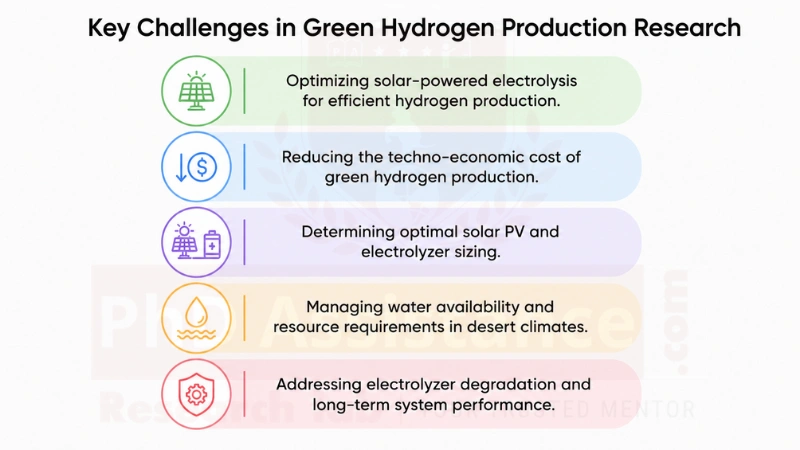
The growing demand for sustainable energy has increased interest in the technical and economic aspects of hydrogen production. Solar electrolysis provides great opportunities for generating hydrogen that produces minimal carbon emissions, especially in areas with abundant sunlight. Nevertheless, variations in solar energy availability, electrolyser efficiency, water consumption, size of the system, initial investment and operating costs, and device deterioration may create challenges for the development of sustainable and cost-effective hydrogen production. Thus, more studies are concentrated on Green Hydrogen Production using the techno-economic analysis of solar electrolysis. Despite numerous studies, important difficulties still exist in optimal electrolyser sizing, cost reduction of hydrogen production, water consumption, intermittency of renewables, and operation in desert conditions.
Proposed PhD Title 1: Geospatial and Techno-Economic Modelling of Solar-Powered PEM and Alkaline Electrolysis for Green Hydrogen Production in Saharan Desert Zones: A Niger Case Study
Electrolysis via solar energy is another viable option for the production of green hydrogen in arid regions since the high amounts of solar radiation can yield renewable electricity. In their paper, Boubé et al. (2025) illustrated the potential of producing hydrogen via solar energy in Niger using the method of geospatial and Techno-economic analysis of green hydrogen and utility-scale configurations using PEM and alkaline electrolysers. It was also noted that choosing a water source is a vital aspect, as both domestic water resources and desalination of water should be considered in the cost estimation of hydrogen production. However, further research is needed to integrate geographical suitability, electrolyser selection, water availability, and economic performance within a unified optimisation framework. With that said, this research may continue on the work of Boubé et al. and create an optimised system that incorporates all aspects mentioned above.
Problem Statement:
However, existing studies that evaluate desert hydrogen only find the appropriate location and compare PEM and alkaline technologies, yet the choice needs to be made via a joint optimisation of location, technology, water availability, and cost of hydrogen. Such an approach is needed for investment purposes; otherwise, the best location does not necessarily give the optimal solution.
Research Gap:
The research gap involves the narrow application of geospatial suitability, water source options, electrolyser options, and techno-economic optimisation into one integrated decision-making process for desert solar hydrogen production systems under water-limited conditions.
Research Question:
How can geospatial techno-economic optimisation identify cost-effective configurations for solar-powered electrolysis in desert environments?
Outcome:
The study will build an optimal geospatial model that will identify the best locations, technologies, water routes, and configurations. The study will evaluate the levelized cost of hydrogen and investment performance for desert situations, providing a plan to produce hydrogen through solar energy.
Reference:
Boubé, B.D., Bhandari, R., Saley, M.M., Bonkaney, A.L., & Adamou, R. (2025), Energies, 18, 1872.
Proposed PhD Title 2. Optimal Sizing and Financial Feasibility of Off-Grid Alkaline Electrolyser–Solar–Wind Hybrid Systems for Green Hydrogen Production in Desert Coastal Regions
The generation of green hydrogen in desert coastal areas benefits from plentiful solar and wind energy sources coupled with seawater desalination to mitigate freshwater constraints. León et al. (2023) have conducted a study into the technological and economic feasibility of autonomous green hydrogen facilities in Chile through the optimisation of an alkaline electrolyser, a desalination system, and renewable solar and wind power plants. The researchers focused on CAPEX, OPEX, hydrogen production cost, profitability, and sensitivity to economic factors. Nevertheless, the intermittency of renewables and uncertainties associated with equipment and operation costs may greatly affect the use of an electrolyser and the profitability of the whole project. In continuation of the work of León et al., future research could utilise the simulation and optimisation of renewable variability, electrolyser usage, desalination needs, and economic uncertainties to improve Green hydrogen techno-economic optimization.
Problem Statement:
Desert hydrogen generation systems in off-grid configurations have to deal with the issues of intermittency of renewables, uncertain capital costs, and the constraints associated with capacity factor, which can impact the bottom line of profitability significantly. Pre-feasibility studies in the existing literature do not address these interrelated factors via dynamic modelling and optimisation.
Research Gap:
The major gap in this respect is the lack of a thorough techno-economic optimisation analysis considering renewable intermittency, desalination and electrolysis operations, uncertainties, and financial performance of the desert coast.
Research question:
How can techno-economic optimisation help to optimise the design of off-grid solar hydrogen systems?
Outcome:
This study will provide an uncertainty-aware optimisation model for solar-powered energy with desalination and integration of renewables for off-grid operation. It will determine the optimal sizing of the components, operating policies, cost ranges of LCOH, and financial barriers.
Reference:
León, M., Silva, J., Ortiz-Soto, R., & Carrasco, S. (2023). Energies, 16, 5327.
Proposed PhD Title 3. PV-PEM Electrolyser Capacity Optimisation for Off-Grid Green Hydrogen Production in Hot Arid Climates: Experimental Insights from Baghdad
The performance of solar electrolysis in hot arid environments depends upon factors such as solar radiation, temperature of photovoltaics, loading of the electrolyser, and correlation between renewable power generation and electrolyser capacity. Hassan et al. (2023) explored the impact of an off-grid photovoltaic system combined with a PEM electrolyser in Baghdad through experimental meteorological data along with varying electrolyser capacities. It was found that the correlation between the PV system and electrolyser capacity has a considerable impact on the cost of hydrogen production, and an 8 kW electrolyser emerges as the most efficient one for the studied 12 kWp PV system. However, the comparison of capacities at discrete points does not provide a generalised approach to system design under varying hot, arid conditions. Furthering the research of Hassan et al., this project can help formulate a general model of optimal capacity ratio considering temperature effects on PV performance, electrolyser efficiency, operation, and cost of hydrogen.
Problem Statement:
PV-PEM analysis done in arid and hot regions provides suitable electrolyser capacity, but there is less help from the comparison of different capacities in the context of overall system sizing. There is an urgent need to better correlate temperature impact, operational conditions, and performance in capacity optimisation for deserts.
Research Gap:
The gap lies in the absence of a general optimisation framework that accounts for PV output capacity, electrolysis process efficiency, operational conditions, and hydrogen cost in hot arid regions.
Research Question:
What PV-to-electrolyzer capacity ratio minimises hydrogen production costs in hot arid climates?
Outcome:
This study will generate optimal sizing relationships between PV modules and electrolysers for hot arid climates using temperature-dependent performance and cost models. The project will determine cost, usage, output, and sensitivity information to provide practical guidelines for solar energy-based hydrogen production under desert environments.
Reference:
Hassan, Q., Abdulrahman, I.S., Salman, H.M., Olapade, O.T., & Jaszczur, M. (2023). Energies, 16, 744.
Proposed PhD Title 4. A Systematic Techno-Economic Review of Solar-Driven Green Hydrogen Technologies for Remote, Off-Grid, and Arid Regions of Sub-Saharan Africa
The use of green hydrogen in providing energy access to off-grid and remote areas can be achieved through its ability to provide long-term energy storage and coupling with renewable electricity generation. Msweli et al. (2025) carried out a detailed review of green hydrogen technology in remote and off-grid areas in Sub-Saharan Africa, where they highlighted challenges relating to such technologies. It was revealed from the literature that alkaline and proton exchange membrane electrolysers are currently appropriate for off-grid regions, while high water usage, land requirements, platinum group metal dependence, high levelized cost of hydrogen, and lack of financing are important challenges. In addition to this, it has been highlighted that water security design, material innovations, blended finance, hybrid mini-grids, integrated water-energy planning, and socioeconomic analysis at the community level are needed. This paper can be used to design a techno-economic multi-objective optimisation framework that will consider all these factors in desert regions.
Problem Statement:
Desert settlements have to cope with a mix of expensive hydrogen, limited water availability, space shortages, material dependency, and poor infrastructure. Traditional techno-economic assessment usually focuses on production costs, while not considering optimisation of resource utilisation, reliability, and energy access impacts together at community-level operations.
Research Gap:
Limited optimisation for multiple objectives that takes into consideration economics, water, land use, materials, and access to energy at the community level in desert hydrogen systems in desert environments with water scarcity.
Research Question:
How can multi-objective optimisation address the hydrogen price, water consumption, land use, and energy access in desert areas?
Outcome:
The research work will provide a multi-criteria optimisation methodology that analyses the cost of hydrogen, water usage, land usage, materials needed, and energy access gains. The study will find optimal solutions for solar-powered hydrogen production and enhance resilience and accessibility at affordable costs.
Reference:
Msweli, N., Nnachi, G.U., & Richards, C.G. (2025), Energies, 18, 5035.
Proposed PhD Title 5. Degradation-Aware Cost Optimisation of Renewable-Powered Water Electrolysis Systems: Replacement Strategies for Long-Term Green Hydrogen Production in High-Irradiance Environments
Degradation of the electrolyser is one of the critical aspects in determining the economic viability of green hydrogen generation since poor degradation affects energy consumption and may cause premature replacement. Arnold et al. (2025) proposed a technique for techno-economic optimisation considering the impact of degradation of electrolysers on the economics of hydrogen production and stack replacement timing. The results revealed that variability in degradation levels may result in large discrepancies in replacement periods, indicating the significance of considering degradation in terms of green hydrogen project planning. Nonetheless, the researchers outlined several limitations of annual degradation modelling and neglecting the cold start and warm start regimes, which may accelerate degradation. In addition to the findings of Arnold et al., the current PhD study may use their methodology to develop a dynamic degradation-aware optimisation model for solar electrolysis in a high-irradiance desert environment.
Problem Statement:
Solar electrolysers are subjected to fluctuating loads and cycles that may affect degradation, energy consumption, the lifespan of the stack, and replacement cost. The existing optimisation of degradation has used simplified annual degradation assumptions while ignoring the effects of start-stop, and therefore, the optimisation cannot be applied to other types of cycling operations.
Research Gap:
The gap is the absence of a dynamic degradation-aware optimisation framework that links solar variability, electrolyser cycles, stack ageing, stack replacement, and the lifetime cost economics of hydrogen production in high-sun desert areas.
Research Question:
How can degradation-aware optimisation minimise the lifetime cost of solar-powered energy in desert climates?
Outcome:
The study will develop a dynamic degradation-based model for solar-powered electrolysis and determine optimal operating strategies, replacement schedules, degradation thresholds, and lifetime LCOH.
Reference:
Arnold, M., Brandt, J., Tjarks, G., Vanselow, A., & Hanke-Rauschenbach, R. (2025), Cost-optimised replacement strategies for water electrolysis systems affected by degradation, arXiv:2508.16370.
Need assistance finalising your PhD topic in green hydrogen production? Developing a strong research topic around techno-economic optimisation, desert climates, electrolyser sizing, and degradation can be challenging — but you don’t have to do it alone.
Our research consultants can help refine your ideas, identify literature gaps, and guide you toward a topic that aligns with current academic trends and your programme requirements.
Contact us to begin one-on-one topic development and refinement with PhdAssistance.com Research Lab.
FAQs:
- How is green hydrogen produced using solar energy?
Solar PV panels generate electricity that powers an electrolyser to split water into hydrogen and oxygen. Since the electricity comes from solar energy, the hydrogen is produced with very low greenhouse gas emissions. - How does solar-powered electrolysis work?
Solar panels convert sunlight into electricity, which powers an electrolyser. The electrolyser splits purified water into hydrogen and oxygen. The hydrogen can then be stored, compressed, or transported. - What is techno-economic optimisation in green hydrogen production?
It identifies the most cost-effective system configuration by balancing factors such as solar capacity, electrolyser size, hydrogen output, efficiency, capital costs, and operating costs. - What factors affect the cost of green hydrogen production?
Key factors include solar availability, PV and electrolyser costs, electrolyser efficiency, water treatment, hydrogen storage, maintenance, financing, degradation, and plant lifetime. - How is the levelized cost of green hydrogen calculated?
LCOH represents the average cost of producing one kilogram of hydrogen over a project’s lifetime. - LCOH = Total discounted lifetime costs ÷ Total discounted hydrogen production
A lower LCOH generally indicates a more economically viable hydrogen system.
Share this:
Cite this work
PhD Assistance. (n.d.). Techno-Economic Optimisation of Solar-Powered Electrolysis for Green Hydrogen Production in Desert Climates. Retrieved August 20, 2026, from https://www.phdassistance.com/title/green-hydrogen-production/
PhD Assistance. “Techno-Economic Optimisation of Solar-Powered Electrolysis for Green Hydrogen Production in Desert Climates.” PhD Assistance, n.d. Web. 20 Aug. 2026.
PhD Assistance. “Techno-Economic Optimisation of Solar-Powered Electrolysis for Green Hydrogen Production in Desert Climates.” PhD Assistance. Web. 20 Aug. 2026.
PhD Assistance (n.d.) Techno-Economic Optimisation of Solar-Powered Electrolysis for Green Hydrogen Production in Desert Climates. Available at: https://www.phdassistance.com/title/green-hydrogen-production/ (Accessed: 20 August 2026).
PhD Assistance. Techno-Economic Optimisation of Solar-Powered Electrolysis for Green Hydrogen Production in Desert Climates [Internet]. [cited 2026 Aug 20]. Available from: https://www.phdassistance.com/title/green-hydrogen-production/
PhD Assistance. “Techno-Economic Optimisation of Solar-Powered Electrolysis for Green Hydrogen Production in Desert Climates.” PhD Assistance. Retrieved August 20, 2026, from https://www.phdassistance.com/title/green-hydrogen-production/
PhD Assistance, ‘Techno-Economic Optimisation of Solar-Powered Electrolysis for Green Hydrogen Production in Desert Climates’ (PhD Assistance, n.d.) https://www.phdassistance.com/title/green-hydrogen-production/ accessed 20 August 2026.
Study Resources
Free resources to assist you with your university studies!