
Critical Review of Integrated Electrolysis, Water Treatment and Solar Energy for Sustainable Green Hydrogen Production
Introduction
Green hydrogen can be manufactured through water electrolysis by using renewable energy sources. However, its sustainability cannot be assessed solely from the electricity source because water treatment, equipment manufacture, infrastructure, operation and end-of-life impacts also contribute to the overall environmental footprint..
Badruzzaman et al. (2025) study the broad perspective through the incorporation of treated wastewater, water purification processes, PEM electrolysis, and renewable energy sources. This model analyses eight combinations of RO/UF with power from grid, PV, ST, and PTC systems. This study analyses capital expenditures (CAPEX), operational expenditures (OPEX), energy and exergy efficiencies, CO₂ equivalent emissions, and sustainability criteria.
The major advantage is its water-energy-environment-economic approach. Nevertheless, there are still doubts as to the choice of PEM, requirements of wastewater treatment, assumptions of economics, and lack of comparison to alkaline, AEM, and SOECs.
This critical review thus attempts to assess the feasibility of the proposed integrated system from both technical and economic perspectives and also the limitations to its generalizability for large-scale hydrogen production.
Summary of the article
Badruzzaman et al. (2025) present eight models based on RO and UF treatment and four electricity types. The system is operated by a 100-MWh Siemens Silyzer 300 PEM electrolyser, operating with 75% efficiency and producing about 1,904 kg/h of hydrogen. The water requirement is approximately 17.19 m³/h or 41.
The economic results show a substantial difference between configurations. Grid-based cases have CAPEX of approximately $110 million, whereas CSP configurations reach approximately $750 million. CSP therefore requires substantially higher capital investment than PV.
Environmental performance is more favourable for renewable configurations. The study reports approximately 94.87% material efficiency and 98.34% environmental efficiency for renewable configurations, compared with 62.59% environmental efficiency for grid configurations. It also reports approximately 88% lower CO₂-equivalent emissions when renewable electricity replaces grid electricity.
These findings demonstrate the potential of renewable configurations but do not establish universal economic or technological superiority because the results depend on assumptions, system scale and the selected PEM technology.
Significance and contribution of the field
The key strength of Badruzzaman et al. (2025) is that it takes a systems-based perspective. Instead of looking at electrolysis, renewable electricity generation, and water purification separately, they look at their integration into one system for hydrogen production.
Using treated sewage effluents becomes especially significant for water-stressed environments as it helps minimise the reliance on fresh water. Nevertheless, the process of treating wastewater involves energy consumption, chemical use, and membrane technologies. Additionally, the quality of feedwater may influence the lifetime of electrolysers and hydrogen purity.
The study therefore provides a valuable scenario-based framework, but not evidence of a universally optimal configuration. This is consistent with Al-Mahmodi et al. (2024), who identify renewable-energy and electrolyser costs as major influences on hydrogen economics, and Muthia et al. (2024), who demonstrate that solar-powered PEM production can be technically feasible while remaining economically challenging.
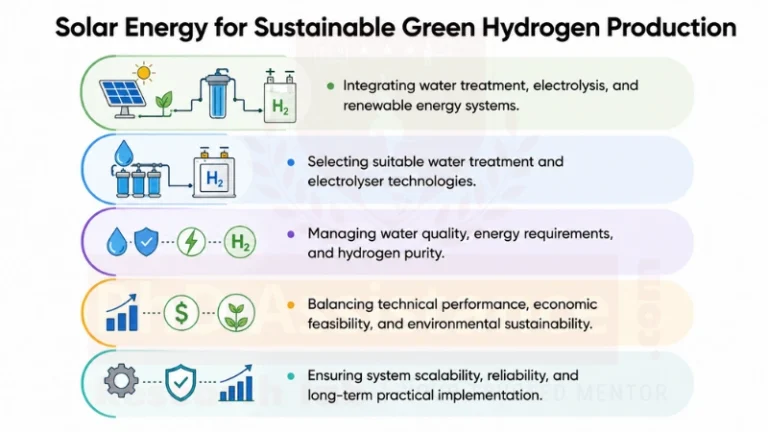
Critical Analysis of the Main Findings
1. Economic Performance
Badruzzaman et al. (2025) report approximately $110 million CAPEX for grid-based cases and up to $750 million for CSP configurations.
Interpretation: This demonstrates that improved environmental performance can involve substantial capital costs. Renewable electricity does not automatically produce the lowest-cost hydrogen system.
Limitation: The economic results depend on literature-derived CAPEX and OPEX assumptions and a specific 100-MWh system. The effects of plant scale, financing, electricity-price changes and future technology costs are not fully established.
Implication: Economic conclusions should be tested through sensitivity and probabilistic techno-economic analysis.
2. Environmental Performance
Renewable configurations achieve approximately 98.34% environmental efficiency compared with 62.59% for grid configurations, alongside an approximately 88% reduction in CO₂-equivalent emissions.
Interpretation: The findings indicate that the electricity source is a major determinant of environmental performance.
Limitation: High environmental efficiency does not translate to zero lifecycle effect. Factors such as equipment production, materials, membrane replacement, chemical usage, infrastructure, and end-of-life effects must also be considered.
Implication: Renewable electrolysis ought to be referred to as significantly environmentally friendly rather than being sustainably green.
3. Water Treatment Trade-offs
The suitability of RO and UF as methods to treat sewage effluent prior to PEM electrolysis is analysed by Badruzzaman et al. (2025). RO achieves higher contaminant removal efficiency compared to UF, which can only remove suspended particles.
Interpretation: This results in a balance between water quality and treatment. RO can supply higher-quality water to electrolysis, but it uses more energy and pressure. UF can cut down energy consumption and water treatment expenses but may require polishing to reach the necessary quality of water for PEM electrolysis
Limitation: The study does not fully assess how long-term membrane fouling, contaminant breakthrough and variations in wastewater composition could affect treatment costs and PEM durability.
Implication: Future research should evaluate RO and UF based not only on CAPEX and OPEX but also on energy consumption, water quality, fouling, electrolyser degradation and hydrogen purity.
4. PEM Selection
The PEM electrolysis process is applied to all eight configurations in this research. PEM electrolysis is ideal for renewable energy due to its fast response to changing electricity input and flexibility.
Interpretation: The selection of PEM is reasonable for integrating intermittent solar energy. However, its use does not demonstrate that PEM is the most suitable technology for the proposed system. Alkaline and AEM electrolysers may offer different cost and durability advantages under similar conditions.
Limitation: The study does not provide an equivalent comparison of PEM with alkaline, AEM or SOEC technologies. Consequently, differences in efficiency, cost, water-quality tolerance and long-term durability cannot be evaluated.
Implication: Comparative studies are needed to determine whether the operational advantages of PEM justify its material and cost requirements under wastewater-based renewable hydrogen production.
Technical Feasibility versus Economic Feasibility
A key theme across the literature is the distinction between technical and economic feasibility.The Badruzzaman et al. model demonstrates that integrated water treatment, PEM electrolysis and renewable energy can technically produce hydrogen while achieving strong environmental indicators. However, the economic evidence is less conclusive.
The study reports approximately 57% average economic sustainability and suggests that this could increase to around 90% if hydrogen production costs decline to $2.08–$2.27/kg. This indicates that economic feasibility is conditional on future cost reductions rather than demonstrated commercial competitiveness.
This finding is consistent with Muthia et al. (2024) and Al-Mahmodi et al. (2024), which also highlight the importance of renewable-energy and electrolyser costs.
Comparison with the Literature
The existing literature mostly supports the fundamental principle of Badruzzaman et al. (2025) but also points out its shortcomings.
Al-Mahmodi et al. (2024) also emphasise that the cost of renewable energy and the cost of the electrolysis process play an important role in the economics of hydrogen production.
Technical possibilities of float-PV-based proton exchange membrane (PEM) electrolysis are demonstrated by Muthia et al. (2024), although economic issues have been raised. The importance of the difference between technical possibility and commercial viability is thus reinforced.
Various renewable energy and electrolysis systems are compared by Awad et al. (2024), emphasising the importance of technology choice. This underlines the importance of the lack of electrolyser comparison in Badruzzaman et al.
Merabet et al. (2024) illustrate that wastewater composition and the demands of its purification are crucial aspects of hydrogen generation. Therefore, wastewater cannot be seen only as a cheap alternative to fresh water.
The overall literature highlights the potential of renewable energy and wastewater recycling technologies, but it does not prove that PEM technology or any renewable energy technology is optimal.
Methodology and Research Design
Methodologically, the strength of the article is in its multi-dimensional evaluation. The researchers use the mass balance approach alongside the CAPEX/OPEX approach, exergy analysis, environmental assessment, and sustainability indicators, all of which are important for evaluating solar hydrogen production efficiency.
The strength of the eight-scenario comparison is that it allows for the analysis of different combinations of water treatment processes and energy inputs. In addition, the researchers provide assumptions regarding the quality and temperature of the feed water and electrolysis.
PEM electrolysis is a reasonable choice for renewable-energy integration because of its operational flexibility. Chatenet et al. (2022), on the other hand, reveal that there are some differences between alkaline, PEM, AEM and solid oxide electrolysers, which implies that the electrolyser for green hydrogen should be well justified based on the operating conditions, costs, etc.
In this context, Awad et al. (2024) highlight the importance of the relationship between electrolyser design and renewable energy type in determining green hydrogen efficiency. The authors compare various combinations of renewable energy and electrolysis technologies.
Theoretical and Interdisciplinary Analysis
There is a definite interdisciplinarity to the research, which includes chemical engineering, electrochemistry, water treatment processes, renewable energy technology, economics, and environmental assessment.
The emphasis on Solar energy for hydrogen generation is pertinent, since the availability of renewable power affects the function and efficiency of the electrolyser process. Al-Mahmodi et al. (2024) demonstrated that both renewable energy costs and electrolyser costs affect the economic performance of hybrid PV-CSP hydrogen systems.
Another good source for comparison is provided by Muthia et al. (2024) in their conceptual evaluation of floating PV-powered PEM electrolysis. The paper shows the possibility of large-scale production of solar-powered hydrogen but also notes high costs of the production. This highlights the need to distinguish between technical feasibility and economic viability.
The way that the study addresses the treatment of wastewater introduces an additional level of multidisciplinary knowledge to the investigation. The research into electrochemical wastewater treatment for industrial facilities implies that it is possible to combine the treatment of wastewater and the generation of hydrogen, though the best option will vary depending on the composition of wastewater itself.
Still, Badruzzaman et al. (2025) could give a more in-depth comparison of various electrolyser systems and renewable energy options. This would help determine whether PEM-based approaches remain superior under different assumptions.
Practical Implementation, Policy and Environmental Considerations
The significance of the study extends beyond electrolyser performance. Availability and quality of the feed water play a critical role in combining water purification and hydrogen production, making water treatment for electrolysis an important consideration in sustainable hydrogen systems.
According to Badruzzaman et al. (2025), the use of RO and UF as pretreatment processes for sewage effluent treatment can be considered. This is also true for Merabet et al. (2024), who mention the possibilities of using wastewater for hydrogen production.
The combination of water treatment with electrolysis could reduce reliance on freshwater; however, contaminants can have an impact on the membranes, catalysts, and purity of gases. Electrochemical water treatment is another area of study in which hydrogen production is balanced with treatment efficiency.
Another factor is economic feasibility. The research reveals that renewable energy sources can decrease environmental consequences, but at the same time, solar-thermal technologies require higher investment than photovoltaic systems. Al-Mahmodi et al. (2024) note the significance of CSP and electrolysis equipment cost for the hydrogen economy. Muthia et al. (2024) similarly found that solar-driven PEM hydrogen production can be technically feasible while remaining economically challenging.
Limitations of the Study
| Limitation | Critical significance | Required improvement |
| PEM-only comparison | Cannot establish whether PEM is optimal | Compare PEM, alkaline, AEM and SOEC where appropriate |
| Literature-derived assumptions | May not reflect actual plant behaviour | Use experimental data and sensitivity analysis |
| Single system scale | Limits generalisability | Evaluate different plant sizes |
| Limited wastewater variability | Real wastewater composition varies | Test different water-quality conditions |
| No long-term validation | Fouling and degradation may be underestimated | Conduct long-duration experiments |
| Limited RO/UF assessment | Water-quality effects on durability remain unclear | Compare treatment quality, energy, fouling and purity |
| Economic uncertainty | Results depend on assumed costs | Include uncertainty and financing analysis |
Table 1. Critical Limitations of the Reviewed Study
Research Gaps from the Study
Research Gap 1: Comparative electrolyser performance
The study is only confined to PEM electrolysis technology. Further studies will need to conduct a comparative analysis between PEM, alkaline, and AEM technologies using wastewater as feedwater.
Research Gap 2: Wastewater treatment and electrolyser durability
No information is provided about the long-term impact of treated wastewater on the membrane, the catalysts, and the electrolyser. Such studies are necessary for assessing water quality, fouling, degradation, and hydrogen purity.
Research Gap 3: Wastewater treatment and electrolyser durability
The major limitation is the absence of dynamic analysis of intermittency of renewable energy sources, storage needs, cost of treatment, and replacement of electrolyser systems. The sustainability of the entire integrated process over a period thus remains unclear.
Overall Critical Appraisal
Badruzzaman et al. (2025) made an important contribution to research with the integration of water purification, renewable energy, and the PEM electrolysis process. Renewable systems attain an environmental efficiency level of about 98.34%, whereas the grid system gets an efficiency level of 62.59%, with 88.
But this environmental benefit has very significant economic disadvantages. The grid layout has around $110 million CAPEX, and the CSP layout has about $750 million. Therefore, environmental and technological benefits do not guarantee economic success.
The wastewater method has potential but entails some trade-offs between water quality, cost of treatment, electrolyser lifetime and purity of hydrogen. In the same manner, PEM is ideal for use with renewable energy, but its performance is only determined in the context of alkaline, AEM and even SOEC.
Overall, the study is a strong conceptual and modelling contribution, but it does not yet provide definitive evidence of commercial-scale economic feasibility.
| Dimension | Finding | Critical judgement | Overall assessment |
| Technical feasibility | Integrated RO/UF + PEM + renewable configurations are modelled successfully | Strong conceptual demonstration, but limited experimental validation | Moderate–strong |
| Environmental performance | 98.34% average environmental efficiency and approximately 88% CO₂ reduction with renewable configurations | Strong advantage over grid electricity, but not equivalent to zero lifecycle impact | Strong |
| Economic feasibility | Grid CAPEX ≈ $110 million; CSP up to ≈ $750 million | Renewable configurations carry substantial capital penalties | Moderate |
| Water sustainability | Treated sewage effluent is used instead of conventional deionised water | Valuable water-reuse strategy, but water-quality risks require more attention | Moderate–strong |
| Electrolyser selection | PEM used in all eight configurations | Technically defensible but insufficiently compared with alternatives | Moderate |
| Generalisability | One modelled system and assumed parameters | Limited transferability to other locations and scales | Moderate–weak |
| Research contribution | Integrates water, energy, electrolysis, economics and environment | Strong systems-level contribution | Strong |
Table 2. Critical appraisal of the Reviewed Study
Conclusion
Badruzzaman et al. (2025) provide a useful systems-level assessment integrating treated wastewater, water treatment, PEM electrolysis and renewable energy. The study demonstrates strong environmental potential but also highlights significant capital requirements, particularly for CSP configurations.
The analysis shows that wastewater reuse involves trade-offs involving treatment energy, cost, water quality, electrolyser durability and hydrogen purity. Although PEM is a credible choice, the lack of comparison with alternative electrolyser technologies limits the conclusions.
The main limitation is the model’s limited generalisability due to literature-derived assumptions, a single system configuration and limited long-term validation. For future work, research should be performed on the comparative performance of electrolysis, the effects of wastewater on degradation, and techno-economic and lifecycle assessments. Generally, the results of the paper show the possibilities of an integrated water-energy-hydrogen system rather than defining an optimal solution.
These limitations also highlight the importance of rigorous literature comparison, critical evaluation and evidence-based assessment when developing research in green hydrogen.
Need Support with Your Green Hydrogen Critical Review? Get focused support with literature comparison, methodology and techno-economic assessment, environmental analysis, critical evaluation of study limitations, and evidence-based recommendations to strengthen the quality and academic rigour of your green hydrogen review.
Frequently Asked Question
The main limitations include the use of a single PEM electrolyser configuration, literature-derived assumptions, limited wastewater variability and the absence of long-term experimental validation.
Although PEM is suitable for integrating variable renewable energy, the study does not compare it with alkaline, AEM or SOEC technologies. Therefore, it cannot establish whether PEM is the most suitable option under the studied conditions.
Key gaps include comparative electrolyser performance using wastewater-derived feedwater, the long-term effects of wastewater quality on electrolyser degradation, and dynamic techno-economic and lifecycle assessment.
Wastewater quality determines the treatment required before electrolysis. Poor treatment can increase fouling, electrolyser degradation and hydrogen-purity issues, while intensive treatment increases energy and cost.
The study shows economic potential but does not confirm commercial-scale feasibility. Its results depend on assumed costs, system configuration and future reductions in hydrogen-production costs.