
Critical Review of Interplay of Surface Engineering, Quantum Transport, and Electron–Phonon Coupling in Advanced Functional Materials
Introduction
The field of Advanced Functional Components has become very important for the development of future-generation nanoelectronics, quantum devices, photonics, and energy-related technologies. As device sizes continue to decrease, material characteristics have become increasingly dependent on surface behaviour, quantum-mechanical charge transfer, and lattice interactions rather than bulk properties. This has resulted in the formation of important topics within Quantum Components and Nanomaterial Research, such as Surface Technology and Electron Coupling.
In the article titled “Interplay of Engineering, Quantum physics, and Electron Coupling in Advanced Functional Materials,” Muhammad Abubakar (2026) has introduced a model that describes the impact of engineered surface/ interface on charge carrier transport and energy dissipation in low-dimensional materials.
Summary of the article
The paper explores the interaction among Engineering, and Electron–Phonon Coupling in Functional compounds. According to the researchers, the conventional models on transport cannot suffice when material sizes enter the quantum regime, and thus an integrated approach that takes into consideration the surfaces is necessary.
Recent progress in surface engineering, such as laser surface structuring, interface engineering, thin film processing and defect control, is discussed in the paper. The discussion shows that all these have a direct impact on electron mobility, quantum coherence, phonon and thermal transport. The paper gives recent progress on low-dimensional materials and van der Waals nanowires to show the role played by engineering in efficient transport properties.
One of the important contributions of the article is the formulation of the conceptual framework that relates the concepts of surface modifications and Quantum physics, and Electron Coupling. Rather than studying these effects in isolation, the framework shows the interplay of these effects at the interface level when designing future Functional compounds. The conceptual framework diagram presented in the methodology section captures these relationships clearly.
The theory behind the design and analysis used in the study is mainly theoretical and computational in nature, with surface morphology, interface roughness, and defect density being the important parameters for transport analysis. Even though the conceptual framework has provided many important insights into the design of future Functional compounds, it is still only conceptual in nature.
Critique
Significance and contribution of the field
A strength of the article in relation to Advanced Materials is the interdisciplinary nature in which the topics are covered. The discussion of Engineering, Quantum Transport and Electron Coupling is not done in isolation but rather in an integrated fashion, whereby all these concepts work hand in hand to give an insight into how surface/interface effects affect charge transport and heat behaviour of materials.
This paper aligns with previous research on the significance of interface engineering within Quantum Components. For instance, Quan et al. (2021) have shown that electron coupling has a great effect on electrical and thermal transport in low-dimensional materials, whereas Bai et al. (2022) have found that reducing dimensions has a substantial impact on carrier-phonon coupling. Our study builds upon this knowledge through the hypothesis that surface modifications will impact both types of transport at once.
It also relates to the latest trends in the study of Nanomaterials. The results obtained by Joshy et al. (2025) in their studies of single-crystal van der Waals nanowires and those by Xu et al. (2026) in their work on interface phonon engineering at the atomic level highlight the significance of good surface and interface quality for enhancing transport efficiency. This paper helps create the concept of Functional compounds for the future.
However, the paper’s contributions are theoretical in nature. The suggested framework is validated more based on already available literature sources, rather than actual experiments or computational work carried out to prove the framework. However, the review succeeds in highlighting significant relations between engineering and transport processes.
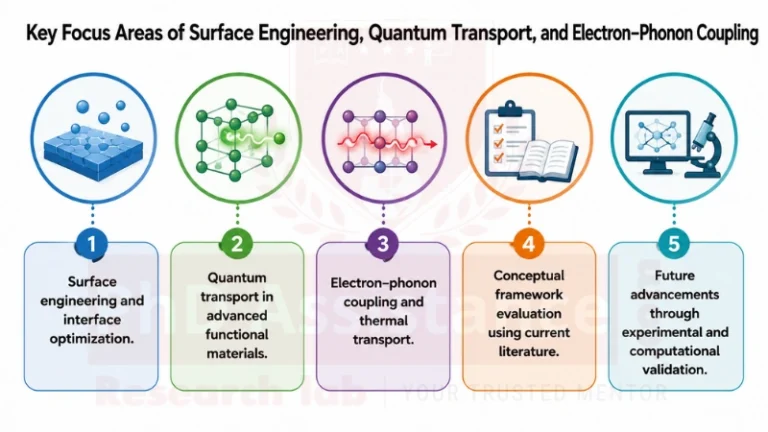
Methodology and research design
The investigation uses a theoretical and computational approach to investigate the effect of surface topology, interfacial roughness, and defect concentration on Quantum physics and Electron-Phonon Interaction in Functional Materials. The approach is systematically structured, starting with the ideal case of the surface, followed by interfacial modifications to assess their effect on transport properties.
One of the advantages of this methodology is that the approach is highly systematic and provides insight into how engineering affects carrier transport, along with phonon interactions.
However, one of the limitations of the methodology is that it has not been substantiated with any experimental work, numerics, or computations like Density Functional Theory (DFT). In contrast to most other papers in the journal Advanced Materials, the conclusions drawn from the analysis have not been proven in a quantitative manner.
Theoretical and Interdisciplinary Analysis
The paper uses an interdisciplinary approach by integrating theories from Engineering, materials science, and condensed matter physics to describe the behaviour of Functional compounds. The paper does not separate electronic transport phenomena from lattice interactions but suggests that there is a very strong connection between them via engineered surfaces and interfaces. This interdisciplinary approach mirrors the modern tendency in Quantum Components science to integrate transport theories.
The argument is in line with recent research on the importance of coupled transport processes. Zhou et al. (2022) discovered that electron-phonon coupling has a significant effect on heat transport in 2D semiconductors, whereas Wu et al. (2025) showed that roughness of interfaces affects nonequilibrium heat transport in metal-semiconductor junctions. It can be said that, by bringing together the results, the paper offers an enhanced insight into the effect of surface treatments on electrical and thermal transport processes.
Still, the theoretical discussion revolves around implementation. It has been mentioned in the paper how the Behaviour Property Graphs are created, but there is no discussion about the theoretical perspective in the context of software compliance, privacy engineering and secure software development.
But the theoretical discussion is still descriptive in nature. Though several mechanisms for transport are described, there is no critical comparison of different theoretical models in terms of their merits and demerits. The inclusion of some theoretical principles such as first principles, quantum mechanics transport equations, and density functional theory would have added to its theoretical discussion.
Ethical Considerations
The article is well written from an academic perspective, in that it outlines the nature of the article as conceptual and acknowledges that the model that is suggested does exist in literature and is not based on any experimental data. It also mentions the need to conduct reproducible computational and experimental research to further develop Functional compounds.
However, the article is a Preprints.org manuscript and is yet to undergo peer review. Even though preprints are very helpful when it comes to distributing information, the findings from such a study must be considered with great caution until proven otherwise. There is not enough discussion in the article about the reproducibility of research and validation techniques.
Writing Style and Structure
The paper follows a logical flow of ideas starting from the introduction and literature review, then moving on to the methodology, conceptual findings, discussion and finally the conclusions. The presence of clear headings and a conceptual model allows understanding the links between the notions of Engineering and Electron Coupling quite well.
The language used in the paper is clear and easy to understand by those who conduct research on Functional compounds, Quantum Components, and Nanomaterials Research. Still, there is a great deal of repetition, especially regarding the role of engineering discussed in different parts of the review. Moreover, there is more emphasis on the description of different studies done rather than critical evaluation of different approaches.
Conclusion
Abubakar’s paper (2026) provides an important conceptual framework on how Engineering, Quantum physics, and Electron Coupling together affect the effectiveness of Functional compounds. Through combining the interrelated concepts, the paper can contribute significantly towards the existing studies on Quantum Materials and Nanomaterial Research.
The study has an organised conceptual framework from current literature. Nevertheless, the results provided are only theoretical since they are not tested using experimental approaches or simulations. As the article is a Preprints.org preprint, the results should be treated carefully and only after verification through peer review and other forms of research.
Overall, the research offers a solid basis for future research related to Functional compounds. Adding experimental approaches, first-principles calculations, and case studies will make the offered framework more robust and applicable.
Reference
- Bai, Z., He, D., Fu, S., Miao, Q., Liu, S., Huang, M., & Zhang, X. (2022). Recent progress in electron–phonon interaction of two-dimensional materials. Nano Select, 3(7), 1112–1122. https://onlinelibrary.wiley.com/doi/full/10.1002/nano.202100367
- Joshy, A., Wang, F., Younus, S., et al. (2025). Scalable synthesis of millimeter-long single-crystal Ta₂Ni₃Se₈ van der Waals nanowires. Scientific Reports, 15, 19535. https://www.nature.com/articles/s41598-025-03238-7
- Quan, Y., Yue, S., & Liao, B. (2021). Impact of electron–phonon interaction on thermal transport: A review. Nanoscale and Microscale Thermophysical Engineering, 25(2), 73–90. https://www.researchgate.net/publication/349025804_Impact_of_Electron-Phonon_Interaction_on_Thermal_Transport_A_Review
- Wu, Z., Li, Y., Huang, D., & Tang, G. (2025). Electron–phonon coupled nonequilibrium thermal transport in Cu/GaN heterojunctions with fractal rough interfaces. Physical Review B, 112(3), 035306. https://link.aps.org/doi/10.1103/bbhd-4jwg
- Xu, Z., Mao, R., & Gao, P. (2026). Atomic-scale interface phonon engineering for thermal management: An electron microscopy review. Advanced Functional Materials, e26614. https://advanced.onlinelibrary.wiley.com/doi/abs/10.1002/adfm.202526614
- Zhou, Z., Yang, X., Fu, H., Wang, R., Lu, X., Wang, G., & Zhou, X. (2022). Anomalous thermal transport driven by electron–phonon coupling in two-dimensional semiconductor h-BP. Advanced Functional Materials, 32(45), 2206974. https://doi.org/10.1002/adfm.202206974?urlappend=%3Futm_source%3Dresearchgate.net%26utm_medium%3Darticle
- Abubakar, M. (2026). Interplay of Surface Engineering, Quantum Transport, and Electron–Phonon Coupling in Advanced Functional Materials. org. https://doi.org/10.20944/preprints202602.0246.v1