
Critical Review of Mengesha, W.G.’s AI-driven design of multifunctional nanomaterials in revolutionising high-temperature, high-power solutions for space technology
Introduction
Developing innovative materials suitable for the harsh conditions of outer space is an urgent problem. Spacecraft materials may encounter extreme thermal cycling, radiation, vacuum, micrometeoroid impacts and, in low-Earth orbit, atomic-oxygen exposure; thus, there is a need for light but mechanically strong and thermally stable materials capable of resisting radiation (Samareh & Siochi, 2017).
Advancements in artificial intelligence and nanotechnology have revolutionised the process of materials development due to their capability of rapidly predicting and optimising material properties. AI and nanomaterials have created new opportunities in developing materials for space technologies, especially for high-temperature and high-power applications.
This critical review evaluates Mengesha’s (2025) article on AI-driven design of multifunctional nanomaterials for technology, analysing its contributions, methodology, limitations, and future directions. The review compares the study with recent AI-driven nanomaterial design reviews and nanomaterials for space research to identify key challenges and research gaps.
Summary of the article
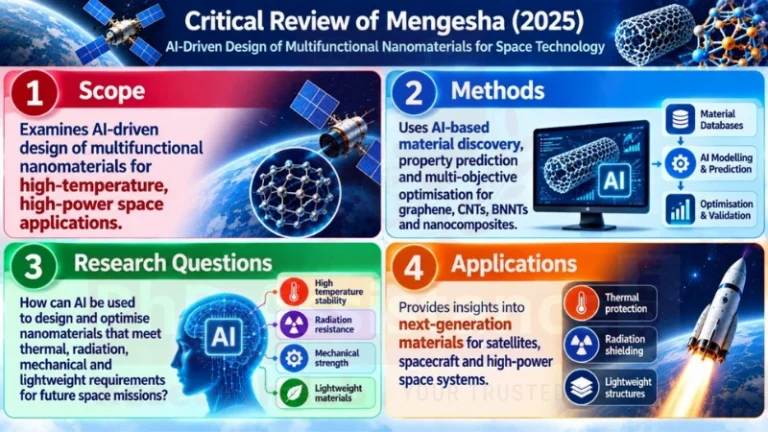
Mengesha (2025) considers the combination of AI and multifunctional nanomaterials to address the demanding material requirements of future space missions, which include thermal, radiation, mechanical, and weight constraints.
In this study, the artificial intelligence-enabled material discovery methods are examined with a specific focus on graphene, carbon nanotubes (CNT), boron nitride nanotubes (BNNT) and the development of advanced nanocomposites with potentially useful properties for space applications.
This article underscores the capabilities of AI-based frameworks in formulating high-temperature nanomaterials and next-generation materials for space technologies. Nonetheless, some of the limitations that come with this include the unavailability of data, validation and scalability.
Significance and contribution of the field
A key contribution of Mengesha (2025) is the synthesis of how AI can support the discovery and optimisation of multifunctional materials for extreme space conditions. As opposed to traditional ways of discovering new materials based on experiments, the research shows how AI prediction models can analyse material properties and help identify candidate materials with targeted properties (Saal et al., 2020).
In this regard, the research provides some useful information about the development of advanced materials for space exploration by analysing different nanomaterials like graphene, carbon nanotubes (CNT), boron nitride nanotubes (BNNT) and nanocomposites. Some of the important characteristics of these materials include high thermal conductivity, mechanical properties, radiation tolerance and lightweight structure.
AI integration with multifunctional nanomaterials that meet the various demands of engineering applications in one go is another important focus of the paper. As evident from the paper, AI-assisted optimisation has the potential for designing materials with specific properties, but further research is needed before these materials can be applied in aerospace systems.
Critical Analysis of AI-Driven Nanomaterial Design for Space Applications
The performance claims in this review are interpreted across three evidence levels: established capability, demonstrated through published computational, laboratory or experimental studies; proposed or expected capability, suggested by modelling, theoretical analysis or prospective applications; and space-qualified performance, demonstrated under relevant aerospace conditions or in validated systems. This distinction is important because computational or laboratory results alone do not establish suitability for operational space applications.
The article presents several quantitative performance claims, including thermal-interface conductivities above 200 W/m·K and reduced demagnetisation in radiation-tolerant materials. A critical assessment should distinguish whether these values derive from experimentally validated studies, simulations, literature-reported results, or conceptual projections, because the evidentiary status directly affects their relevance to space-qualified materials
AI-Based Nanomaterial Discovery and Optimisation:
The article indicates the role of AI as a paradigm shift in discovering new nanomaterials through property prediction, modelling, and multi-objective optimisation. AI techniques can analyse material databases effectively to establish structure-property relations and aid in creating more thermally stable and mechanically strong materials.
Interpretation:
AI-driven design represents a shift from traditional experimental approaches toward data-guided materials discovery. By predicting material behaviour before synthesis, AI may reduce the number of experimental iterations required and support the identification of nanomaterials with customised properties for extreme space environments.
Critical assessment:
Although AI provides significant advantages, its performance depends on reliable datasets and experimental validation. Limited information on material behaviour under extreme temperature, radiation, and long-duration space conditions remains a challenge for developing accurate AI models.
Research implication:
Future studies should integrate AI models with experimental databases and hybrid AI–physics approaches to improve prediction accuracy and accelerate next-generation material development.
1. Multifunctional Nanomaterials for Extreme Space Environments
Mengesha (2025) mentions some of the multifunctional nanomaterials, such as graphene, carbon nanotubes (CNTs), boron nitride nanotubes (BNNTs), and high-tech nanocomposites, for heat dissipation, protection from radiation, structural strengthening, space propulsion, and overall operation of spacecraft.
Interpretation:
Multifunctional nanomaterials may enable the integration of multiple performance parameters into a single material system. This could potentially reduce spacecraft weight while improving functional integration
Limitation:
Although these materials have desirable properties, their application is limited by difficulties related to large-scale synthesis, defect reduction, integration into materials, and testing for reliability in space conditions.
Research implication:
Future research should address scalability issues, better processing techniques, and environmental tests to support the application of multifunctional nanomaterials in aerospace systems.
2. High-Temperature Nanomaterials for Space Technology
In this review, “high-temperature” encompasses several distinct conditions, including high-temperature processing, structural service, thermal cycling, transient thermal loads, re-entry and propulsion environments. These conditions should not be treated as equivalent because material performance depends on temperature range, exposure duration, loading conditions and environmental factors. Therefore, claims of high-temperature capability should be linked to the specific thermal environment and validation conditions reported.
Interpretation:
AI-based material development for high-temperature applications may facilitate the discovery of nanomaterials with improved thermal stability, oxidation resistance and mechanical strength. Such an initiative can enable material scientists to develop new materials suitable for aerospace applications.
Critical assessment:
However, accurately predicting material behaviour under combined thermal stress, radiation exposure, and mechanical loading remains complex. Computational predictions require further experimental verification before practical deployment.
Research implication:
Future studies should combine AI-based prediction models with iterative experimental testing under controlled thermal, mechanical and radiation conditions to improve the reliability of advanced materials for space applications.
Comparison with the Literature
The reviewed article provides a comprehensive perspective on AI-assisted development of multifunctional nanomaterials for space applications. Recent studies have further explored AI-based materials discovery, nanocomposite development, and advanced aerospace materials, highlighting both the opportunities and limitations of integrating artificial intelligence with nanotechnology.
The appraisal reflects the strength of the evidence and practical relevance discussed in the literature; “Strong” indicates substantial support for the capability or research direction and does not imply space qualification
| Study | Main Approach | Evidence Level | Key Findings | Critical Perspective |
|---|---|---|---|---|
| Mengesha (2025) | Review and conceptual analysis of AI-driven multifunctional nanomaterials for space technology | Proposed/expected capability | Explores AI-based prediction and optimisation of graphene, CNTs, BNNTs and nanocomposites for extreme environments. | Requires experimental validation, reproducible manufacturing and space-relevant testing. |
| Cheng et al. (2026) | Review of AI-driven materials design and discovery | Established computational capability / emerging methods | Reviews forward screening, inverse design, reinforcement learning and generative AI for materials discovery. | Identifies challenges in translating computational inverse-design approaches into experimentally realised materials. |
| Butler et al. (2018) | Review of machine learning applications in molecular and materials science | Established capability | Reviews ML applications in materials prediction, design and discovery. | Does not establish space-specific or space-qualified performance. |
| Schmidt et al. (2019) | Review of machine learning in solid-state materials science | Established capability | Reviews ML for materials discovery, prediction and optimisation. | Data quality and experimental integration remain challenges. |
| Bai and Zhang (2025) | Review of AI applications across materials science | Established capability | Reviews AI for materials discovery, prediction, screening and optimisation. | Highlights data quality, model reliability and experimental integration challenges. |
| Hirankittiwong et al. (2025) | Review of engineered nanostructures for aerospace applications | Established/application evidence | Reviews graphene, CNTs and nanocomposites for aerospace applications. | Aerospace relevance does not necessarily establish space qualification. |
| Merchant et al. (2023) | Large-scale deep-learning approach to materials discovery | Established computational capability | Demonstrates deep learning for large-scale computational materials discovery. | Identified materials require synthesis and experimental validation. |
Compared with studies such as Butler et al. (2018), Schmidt et al. (2019), Bai and Zhang (2025), and Merchant et al. (2023), Mengesha (2025) puts more emphasis on artificial intelligence-based design of nanomaterials for use in extreme space conditions. Whereas the materials science literature emphasises machine learning in predicting and discovering material properties, Mengesha’s paper deals with multifunctional materials.
However, the reviewed paper is perspective-focused rather than experimentally proven, lacking any results concerning the practical realisation of the approaches under realistic conditions of space, scalability of production, and long-term stability. Thus, further experiments and calculations are required to prove the viability of such approaches.
Methodology and Research Design
The article uses a review-based and conceptual analytical approach, drawing on published examples to discuss AI-enabled nanomaterial design for high-temperature and space applications.
Material Design Framework: The research examines graphene, carbon nanotubes (CNTs), boron nitride nanotubes (BNNTs), and advanced nanocomposites with an emphasis on using AI techniques for predicting properties, simulation, and multi-objective optimisation.
AI and Nanomaterial Optimisation: The paper investigates the role of artificial intelligence in predicting structure and properties, enhancing material performance, and developing highly thermally stable, mechanically robust, and radiation-resistant nanomaterials.
Space Application Framework: The study examines the role of multifunctional nanomaterials and potential materials for space in thermal management, radiation shielding, propulsion systems, and high-temperature applications.
Evaluation: The article discusses AI-driven approaches using published examples and reported material-performance cases to examine their potential for high-temperature and space applications.
Critical Assessment: The methodology provides a broad assessment of AI-enabled nanomaterial development; however, limited experimental validation, dataset availability, and manufacturing scalability remain challenges for practical aerospace implementation.
Theoretical and Interdisciplinary Analysis
The article connects several research areas:
This interdisciplinary perspective is a major strength because the development of advanced materials for space applications requires integration of AI, materials science, computational methods, and aerospace engineering. The combination of AI-driven prediction with nanomaterial design could support the development of lightweight, durable, and multifunctional materials designed for extreme environments.
The article’s AI focus is particularly important because future space systems require materials with combined properties such as thermal stability, radiation resistance, mechanical strength, and reduced weight. AI can support materials discovery by analysing complex structure–property relationships and identifying candidates for high-performance space applications.
Practical Implementation
Controlled composition, structure, defects, and processing conditions are necessary to produce multifunctional nanomaterials in an advanced manner. Large-scale production, reproducibility, and incorporation into aerospace applications pose great engineering challenges.
AI-based material design also requires reliable datasets and validation under extreme conditions. Developing accurate models for high temperatures, radiation exposure, and mechanical stress remains challenging, requiring integration of AI prediction with experimental testing.
A robust translation pathway should progress from computational prediction to material synthesis, laboratory characterisation, controlled extreme-environment testing, component-level validation and, where applicable, flight or relevant-environment qualification.
Limitations of the Study
| Limitation | Critical Significance | Future research needed |
|---|---|---|
| Broad review-oriented approach | Individual nanomaterial systems receive limited detailed evaluation. | Conduct focused experimental investigations. |
| Limited experimental validation | AI predictions may not fully represent real-space conditions. | Perform thermal, radiation, and mechanical testing. |
| AI depends on suitable datasets | Limited extreme-environment data may affect model reliability. | Develop standardised nanomaterial databases. |
| Manufacturing scalability challenges | Laboratory performance may not translate to large-scale production. | Develop scalable synthesis approaches. |
| Limited material integration analysis | Nanomaterial properties may change within spacecraft components. | Evaluate complete material systems under realistic conditions. |
| High-temperature performance uncertainty | Combined thermal and mechanical stresses remain difficult to predict. | Develop advanced simulation and validation methods. |
Table 1. Critical Limitations of the Reviewed Study
Research Gaps from the Study
Research Gap 1: Limited AI Model Validation for Nanomaterial Discovery
According to Mengesha (2025), the use of artificial intelligence technology will facilitate faster discoveries of nanomaterials through property predictions and optimisation; however, the lack of good datasets, experimental testing, and material behaviour in extreme conditions is still a challenge. According to Butler et al. (2018) and Bai and Zhang (2025), such challenges are present in AI-based materials science.
Future research: Develop hybrid AI–experimental frameworks to improve prediction accuracy and validate AI-designed nanomaterials.
Research Gap 2: Scalable Manufacturing of AI-Designed Multifunctional Nanomaterials
Major constraints associated with scaling up nanomaterial design through AI include material scalability, defect control, and consistency (Mengesha, 2025). Recent reviews of aerospace nanomaterials also mention production scale and stability as challenges (Hirankittiwong et al., 2025).
Future research: Develop scalable synthesis methods and AI-assisted manufacturing approaches for reliable production of multifunctional nanomaterials.
Research Gap 3: Limited Space-Condition Performance Data
Limited data for modelling extreme temperatures, radiation, and extended space conditions hinders AI-based materials prediction, as mentioned by Mengesha (2025). The importance of standardised data for better AI-based modelling of materials is stressed by Schmidt et al. (2019) and Bai and Zhang (2025).
Future research: Create comprehensive databases containing thermal, mechanical, radiation, and degradation data of space-grade nanomaterials.
Overall Critical Appraisal
| Dimension | Finding | Critical Judgement |
|---|---|---|
| AI-driven nanomaterial design | Demonstrates the potential of AI for material discovery, property prediction, and optimisation of multifunctional nanomaterials. | Strong |
| Multifunctional nanomaterials | Highlights graphene, CNTs, BNNTs, and nanocomposites for thermal management, radiation shielding, and structural applications. | Strong |
| High-temperature applications | AI-assisted approaches support the development of materials with improved thermal stability for extreme space environments. | Strong |
| AI model validation | Limited datasets and experimental validation affect the reliability of AI-based material predictions. | Moderate–Strong |
| Manufacturing scalability | Large-scale production, reproducibility, and integration of nanomaterials remain major practical challenges. | Moderate |
| Space technology applications | Provides insights into advanced materials for thermal protection, propulsion systems, and lightweight spacecraft structures. | Strong |
| Future research opportunities | Identifies opportunities in AI optimisation, adaptive materials, scalable manufacturing, and experimental validation. | Strong |
Table 2. Critical appraisal of the Reviewed Study
Conclusion
The reviewed article demonstrates the increasing need for the combination of artificial intelligence technologies with nanomaterials for the creation of new-generation materials intended for space use. The application of artificial intelligence opens possibilities for the acceleration of material development and optimisation of their performance characteristics.
The use of nanomaterials in space technology, such as graphene, carbon nanotubes, boron nitride nanotubes, and nanocomposites, shows potential for applications involving thermal protection, radiation resistance, structural reinforcement, and high-temperature environments (Sales et al., 2025)
Nevertheless, issues related to experimental proof, reliable data, manufacturing scalability, and environmental durability have been seen as major hurdles.
Future studies should focus on combining AI-based prediction with experimental validation and advanced manufacturing approaches to translate computationally designed materials into practical aerospace systems. Continued progress in AI, nanotechnology, experimental validation, and scalable manufacturing could support the development of reliable, lightweight, and multifunctional materials for future space exploration.
Is your AI-driven nanomaterial research ready for space applications?
Explore the critical challenges shaping AI-based material discovery, multifunctional nanomaterials, high-temperature performance, scalability, and experimental validation with the experts at PhD Assistance Research Lab—and identify the research gaps and opportunities that can advance your work in next-generation materials for space.
Frequently Asked Question
AI supports nanomaterial design by enabling property prediction, structure–property analysis, optimisation, and accelerated identification of promising materials for specific applications.
The article discusses graphene, carbon nanotubes (CNTs), boron nitride nanotubes (BNNTs), and advanced nanocomposites for thermal management, radiation shielding, structural reinforcement, and high-temperature systems.
Multifunctional nanomaterials can combine multiple properties, such as lightweight structure, thermal stability, mechanical strength, and radiation resistance, reducing the need for multiple separate materials.
Key challenges include limited datasets, lack of experimental validation, manufacturing scalability, material integration, and uncertainty in long-term performance under extreme space conditions.
Future research should focus on hybrid AI–experimental approaches, scalable synthesis methods, explainable AI models, and validation of high-performance nanomaterials under realistic aerospace environments.
Reference
- Mengesha, W.G. AI-driven design of multifunctional nanomaterials in revolutionising high-temperature, high-power solutions for space technology: potentials, challenges and perspectives. Discover Nano 20, 220 (2025). https://doi.org/10.1186/s11671-025-04389-2
- Cheng, M., Fu, CL., Okabe, R. et al. Artificial intelligence-driven approaches for materials design and discovery. Nat. Mater. 25, 174–190 (2026). https://doi.org/10.1038/s41563-025-02403-7
- Butler, K.T., Davies, D.W., Cartwright, H. et al. Machine learning for molecular and materials science. Nature 559, 547–555 (2018). https://doi.org/10.1038/s41586-018-0337-2
- Schmidt, J., Marques, M.R.G., Botti, S. et al. Recent advances and applications of machine learning in solid-state materials science. npj Comput Mater 5, 83 (2019). https://doi.org/10.1038/s41524-019-0221-0
- Bai, X., Zhang, X. Artificial Intelligence-Powered Materials Science. Nano-Micro Lett. 17, 135 (2025). https://doi.org/10.1007/s40820-024-01634-8
- Hirankittiwong, P., Chomchok, T., Chakraborty, S., Prajongtat, P., Singh, D. P., Hongkarnjanakul, N., Channumsin, S., Ghosh, S., & Chattham, N. (2025). Advanced engineered nanostructures for aerospace technology: A review. Results in Engineering, 26, 105381. https://doi.org/10.1016/j.rineng.2025.105381
- Merchant, A., Batzner, S., Schoenholz, S.S. et al. Scaling deep learning for materials discovery. Nature 624, 80–85 (2023). https://doi.org/10.1038/s41586-023-06735-9
- Samareh, J. A., & Siochi, E. J. (2017). Systems analysis of carbon nanotubes: opportunities and challenges for space applications. Nanotechnology, 28(37), 372001. https://doi.org/10.1088/1361-6528/aa7c5a
- James E. Saal, Anton O. Oliynyk, Bryce Meredig. 2020. Machine Learning in Materials Discovery: Confirmed Predictions and Their Underlying Approaches. Annual Review of Materials Research 50:49-69. https://doi.org/10.1146/annurev-matsci-090319-010954 Sales, A. S. W., Pereira, V. Q., & Dias, A. N. C. (2025). Advances in nanomaterials for radiation protection in the aerospace industry: A systematic review. Nanotechnology, 36(10), 102002. https://doi.org/10.1088/1361-6528/ada38f