
How to use this list
Carbapenem-resistant Enterobacterales (CRE) are gram-negative bacteria that resist carbapenems, antibiotics often kept for serious infections. The World Health Organization's 2024 Bacterial Priority Pathogens List places carbapenem-resistant Enterobacterales in its critical priority group (World Health Organization, 2024). In hospitals, CRE spread mainly through patient contact, shared equipment and transfers, which is why infection prevention teams combine screening, isolation and contact tracing.
That is a different outcome from forecasting ward-level spread. The rebuilt titles keep every idea and say which they predict. Each table gives a possible research question, a likely design and why the topic matters now. For related pages see the review of machine learning for sepsis, deep learning for early sepsis detection, clinical decision support titles and the topics hub.
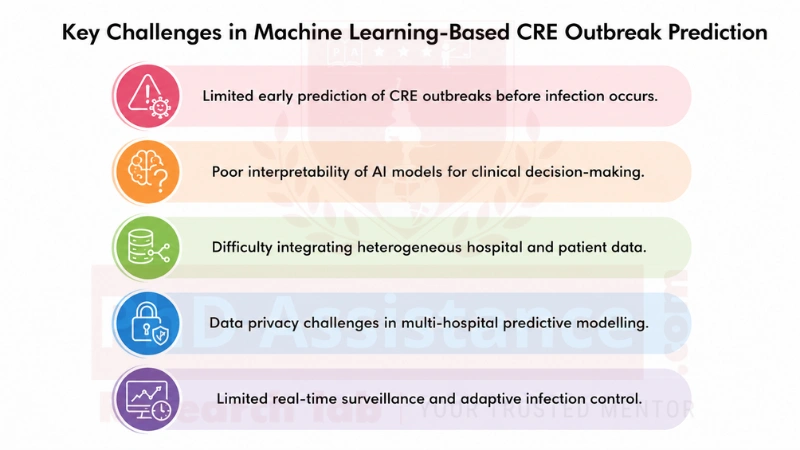
Theme 1: Patient-level risk prediction
| Dissertation title | Possible research question | Likely design and data | Why it matters now |
|---|---|---|---|
| Predicting carbapenem-resistant Enterobacterales colonisation at admission from electronic health records: transformer models versus logistic regression, with calibration and explanations | Does a transformer model of prior admissions, antibiotic exposure and transfers identify colonised patients better than a regression model, and is it well calibrated? | Retrospective cohort with screening results as outcome; temporal validation; precision-recall and calibration; reporting to TRIPOD+AI | Targeted screening depends on well-calibrated risk estimates (Collins et al., 2024; Van Calster et al., 2019) |
| Graph neural networks on patient contact and ward-transfer networks for identifying patients at risk of CRE colonisation: a retrospective single-centre study | Does information from a patient's contacts and shared wards improve risk prediction over patient-level features alone? | Retrospective cohort; contact networks built from admission, transfer and bed data; ablation of network features | Graph models of hospital contact have shown promise for multidrug-resistant Enterobacteriaceae (Gouareb et al., 2023) |
Evidence that the gap is real. Gouareb et al. (2023) used graph neural networks in a retrospective hospital study to detect patients at risk of multidrug-resistant Enterobacteriaceae, modelling patients and their interactions as a graph. Work of this kind needs replication in other hospitals, comparison with strong non-graph baselines, and careful reporting. Because colonisation is uncommon, Saito and Rehmsmeier (2015) recommend precision-recall analysis, and Riley et al. (2020) show how to check whether the number of outcome events is enough to develop a model at all.
Theme 2: Ward-level forecasting and simulation
| Dissertation title | Possible research question | Likely design and data | Why it matters now |
|---|---|---|---|
| Forecasting ward-level carbapenem-resistant Enterobacterales acquisitions from patient movement and screening data: spatiotemporal deep learning versus count time-series models | Do spatiotemporal models using patient movement forecast weekly new acquisitions per ward better than count time-series baselines? | Retrospective multi-year data from one hospital or network; rolling-origin evaluation; comparison with Poisson or negative binomial models | Ward-level forecasts could guide where to screen, but acquisition counts are small and noisy |
| Simulating infection-control interventions for carbapenem-resistant Enterobacterales with a hospital agent-based model calibrated to surveillance data | Which combinations of admission screening, isolation and cohorting most reduce simulated acquisitions under realistic staffing and bed constraints? | Agent-based model of wards, patients and staff; calibration to local surveillance data; sensitivity and scenario analysis | Health digital twins are at an early stage, so calibrated simulation is the realistic step (Katsoulakis et al., 2024) |
Evidence that the gap is real. A "digital twin" for real-time outbreak control is sometimes proposed. A scoping review of digital twins in health found the field active but still at an early stage of adoption (Katsoulakis et al., 2024). A doctorate can make a sound contribution by building a transparent simulation, calibrating it to local data and testing interventions in silico, leaving prospective use to later work.
Theme 3: Multi-site learning
| Dissertation title | Possible research question | Likely design and data | Why it matters now |
|---|---|---|---|
| Federated learning across hospitals for carbapenem-resistant Enterobacterales colonisation prediction: performance under differing screening policies | How close does a federated model come to a pooled-data model when hospitals differ in prevalence and screening practice, and does it transfer to a hospital that did not take part? | Multi-site retrospective data or a realistic simulation partitioned by site; federated averaging; site-level calibration and external validation | Federated learning is increasingly proposed for clinical data that cannot leave hospitals (McMahan et al., 2017; Teo et al., 2024) |
Evidence that the gap is real. McMahan et al. (2017) introduced federated averaging, which trains a shared model while raw data stay at each site. Teo et al. (2024) reviewed federated learning in healthcare and describe the clinical applications and technical architectures in use. For CRE, sites differ in who they screen and how often, so labels mean slightly different things in each hospital; testing how this affects a federated model, and checking calibration at each site (Van Calster et al., 2019), is a useful contribution.
How to test a title before you commit
Use the general method in how to choose a PhD topic and how to select a PhD topic, or our topic selection support, and screen each idea with the FINER criteria (Hulley et al., 2013). In this field, check the following.
- Outcome: define colonisation, infection or acquisition from screening and laboratory data, and how often patients are screened.
- Events: count positive cases per year; rare outcomes may need several years or sites (Riley et al., 2020).
- Access: agree data access, ethics approval and information governance with the hospital early.
- Reporting: plan to report to TRIPOD+AI from the start (Collins et al., 2024).
Worked example (illustrative). A student starts from the live title on an "explainable transformer framework for early CRE risk stratification". The partner hospital screens high-risk admissions, records about a hundred positive screens a year and keeps five years of data. She defines the outcome as a positive screen within 48 hours of admission, checks the sample size, compares a transformer with logistic regression on later years, and reports calibration and precision-recall curves. The title now promises an answer her data can support.
Common mistakes
- Calling patient-level risk prediction "outbreak prediction".
- Ignoring screening policy, so that "negative" patients include many who were never tested.
- Reporting ROC AUC alone for a rare outcome.
- Developing a model with too few outcome events.
- Promising real-time control or deployment without a prospective evaluation plan.
Key takeaways
- Carbapenem-resistant Enterobacterales are a critical priority pathogen group for WHO (World Health Organization, 2024).
- Graph models of hospital contact are promising but need replication and strong baselines (Gouareb et al., 2023).
- Rare outcomes call for precision-recall analysis, calibration and a sample size check (Saito & Rehmsmeier, 2015; Van Calster et al., 2019; Riley et al., 2020).
- Federated titles must test how site differences affect performance (Teo et al., 2024).
- Screen every shortlisted title for feasibility, novelty, ethics and relevance (Hulley et al., 2013).