- / Title
Transformer-Based Clinical Decision Support in Neurodegenerative Disorders DissertationTitles | phdassistance.com
Info: Transformer-Based Clinical Decision Support in Neurodegenerative Disorders DissertationTitles | phdassistance.com
Published: 08th June 2026 in Transformer-Based Clinical Decision Support in Neurodegenerative Disorders DissertationTitles | phdassistance.com
Share this:
Related Services
Introduction
Artificial intelligence and machine learning technologies have had a substantial impact on health care, while neurodegenerative diseases, particularly Parkinson’s disease and Alzheimer’s disease, have seen substantial developments in both diagnosis and care, as a result of recent technological advancements. Existing clinical practices often utilise separate analysis of the neuroimaging, genomic and clinical data, which hinders diagnosis at an early and accurate level. In this context, Clinical Decision Support Research Help plays a vital role in advancements; transformer architectures, multimodal learning and explainable AI have allowed the integration of different types of medical data in a more efficient manner, leading to increased accuracy in diagnosis and clinical decision-making.
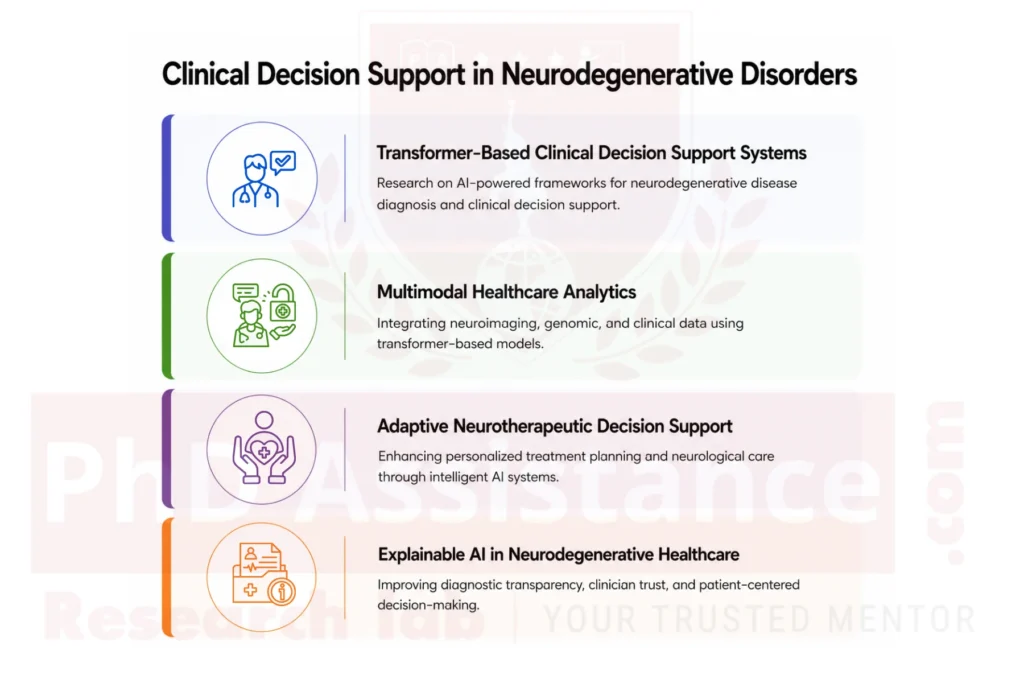
Proposed PhD Title 1: Transformer-Based Multimodal Clinical Decision Support Frameworks for Neurodegenerative Disorders: Integrating Neuroimaging, Genomics, and Explainable AI
Transformer architectures have recently gained momentum to improve multimodal data analysis in healthcare systems. More recently, the integration of neuroimaging and genetic information through cross-attention mechanisms in transformer architectures has enhanced the ability to detect Alzheimer’s and other brain diseases early. In a multimodal fusion transformer model, this approach allows for discovery of hidden relationships between genotype and phenotype and boosts diagnostic accuracy and explainability. As it has been pointed out by Omran et al. (2025), transformer-based fusion approaches may enable great opportunities to achieve advancements in disease prediction and monitoring of disease progression in neurodegenerative diseases; as shown in Transformer-Based Healthcare Research, many works focus on the development of smart and explainable clinical decision support systems.
Problem Statement:
Traditional clinical decision support systems in this field mostly process neuroimaging data and genetic data separately, which hinders the capture of complex gene-disease interactions and accurate early diagnosis. Existing systems are mostly not capable of giving transparent and acceptable decision recommendations to clinical professionals to check and believe. Because of the multiple biological and neurological factors involved in neurodegenerative diseases, the need for smart multi-modal frameworks that can simultaneously integrate multi-modal data and increase diagnosis clarity.
Research Gap:
Despite the good performance of multi-modal transformer architectures for diagnosis, there is a lack of research on integrating explainable AI, disease progression prediction and clinical decision support for physicians in a single framework. This is an opportunity for Neurodegenerative Disorders Research Help with respect to clinical deployment.
Research Question:
Can Transformer-based multimodal fusion frameworks improve accuracy, explainability and clinical decision-making in neurodegenerative diseases?
Outcome:
This project should result in a multimodal transformer framework that is explainable, increases the accuracy of diagnosis at an early stage and helps to make intelligent recommendations using artificial intelligence in Clinical Decision Support Systems.
Reference:
Omran, S. P., Raji, M. A., Sharifi, F., & Malek, Z. (2025). Transformer-Based Multimodal Fusion for Alzheimer’s Disease: A Systematic Review of Neuroimaging-Genomics Integration. InfoScience Trends, 2(8), 24–43.
Proposed PhD Title 2. Adaptive Transformer Architectures for Intelligent Neurotherapeutic Decision Support in Neurodegenerative Disorders: A Context-Aware Clinical Frameworks
Neurological healthcare has been reshaped by AI in several key ways: sophisticated EEG analysis, accurate brain mapping and intelligent treatment planning. High-dimensional neurological data is becoming more widely available, offering chances for adaptive learning algorithms that are capable of adapting to patients’ individual conditions dynamically. Adaptive transformer models can represent long-term and spatial dependencies of neurological signals and apply to personalised neurotherapy and clinical decision-making.As Nemade et al. (2025) conclude, the effective adaptive attention mechanisms are capable of significantly enhancing the interpretability of EEG and recommendations of neurotherapies through detection of salient neurological patterns. Hence, such developments underscore the growing value of Healthcare AI Research Assistance in designing intelligent systems that assist clinicians during the diagnostic, monitoring and therapeutic stages.
Problem Statement:
With most neurotherapeutic assistance systems, adaptive learning capabilities and recommendations tailored to the changing neurological profiles of patients are nonexistent. Current approaches only focus on a fixed analysis of neurological data and generally ignore real-time alterations in brain patterns. This can result in difficult treatment plan selection for clinicians, indicating the need for adaptive transformer frameworks to aid the neurotherapeutic decision-making processes in a dynamic and patient-centric manner.
Research Gap:
Current literature is mainly concerned with the areas of disease detection and classification. The area of adaptive transformer-based frameworks for decision support of personalised neurotherapeutics and treatment optimisation is still sparse.
Research question:
In what ways do adaptive transformer-based frameworks for decision support and personalisation of neurotherapeutics for neurodegenerative patients work?
Result:
This study will present an adaptive context-aware transformer for neurotherapeutic recommendation.
Reference:
Omran, S. P., Raji, M. A., Sharifi, F., & Malek, Z. (2025). Transformer-Based Multimodal Fusion for Alzheimer’s Disease: A Systematic Review of Neuroimaging-Genomics Integration. InfoScience Trends, 2(8), 24–43.
Proposed PhD Title 3. Hybrid CNN-Transformer Clinical Decision Support Systems for Early Detection of Neurodegenerative Disorders Using Multimodal Neuroimaging Data
The recent rapid growth of MRI, EEG, and multimodal neurological data has paved the way for the deployment of deep learning in neurological diagnosis. The combination of CNN and Transformer-also known as the Hybrid CNN-Transformer architecture-has emerged as an effective approach, as it utilises the advantages of CNN in capturing local spatial features and those of Transformer in learning global contextual information. This can enable efficient detection of subtle abnormalities corresponding to neurodegenerative diseases. As reported by Paul (2025), hybrid systems provide improved diagnostic accuracy, sensitivity, and detect disease at an earlier stage compared to their individual systems. These improvements have increased the scope of the field for Clinical Research Writing Services and the development of better AI models for use by medical professionals.
Problem Statement:
Current AI diagnostic methods have shortcomings for encoding both localised and long-range patterns required for accurate early-stage diagnosis. Isolated deep learning systems tend to be weak in feature representation, interpretability and clinic-based application on large-scale neuroimaging datasets. Thus, there is a demand for sophisticated hybrid frameworks with improved performance.
Research Gap:
Despite showing improved detection capabilities, there is scarce work on the application of CNN-Transformer hybrid models in real-time AI in Clinical Decision Support Systems (CDSS) for neurodegenerative disease treatment and management.
Research Question:
Can Hybrid CNN-Transformer models contribute to better diagnosis and clinical decision-making in neurodegenerative diseases in early stages using multimodal neuroimaging information?
Outcome:
This research work intends to devise a hybrid clinical decision support framework that can achieve better diagnostic, interpretive and intervention capabilities in early stages.
Reference:
Paul, A. L. (2025). AI-Driven Early Detection of Neurological Disorders: A Comparative Analysis of Hybrid CNN-Transformer Architectures.
Proposed PhD Title 4. Self-Supervised Transformer Models for Explainable Clinical Decision Support in Alzheimer’s Disease and Neurodegenerative Disorder Diagnosis
The development of self-supervised learning has allowed transformer models to acquire rich representations with small or incompletely labelled medical datasets, which is critical when diagnosing neurodegenerative disorders because the quantity of labelled data that can be acquired for diagnosis is limited. In this regard, we have demonstrated that self-supervised transformer frameworks offer significant gains in terms of feature extraction, classification and generalisation performance. Explainability methods like SHAP analysis also help the clinician in knowing what causes the outcome of a diagnosis. All these contribute greatly to Transformer-Based Research in designing reliable, interpretable and trustworthy AI for neurological health.
Problem Statement:
The black-box nature of a lot of AI diagnostic tools may limit their trust among clinicians and therefore affect their uptake in clinical settings. Despite achieving great diagnostic accuracy, transformer-based models tend to output poor explainability for their predictions, which hinders the process of clinical verification. Lack of explainability in diagnosis can be a barrier in the process of diagnosing neurodegenerative diseases and providing clinical decisions for patients.
Research Gap:
There is very little work on combining vision transformers and large language models in a unified clinical decision support system framework for neurodegenerative diseases.
Research Question:
In the field of neurodegenerative healthcare, how can integrated vision transformer and large language model frameworks advance diagnostic accuracy and explainable decision support?
Outcome:
The research aims to create a multimodal clinical decision support system to enhance accurate and explainable neurological diagnosis by leveraging both imaging intelligence and language reasoning capabilities.
Reference:
Priyadharshini, M., Murugesh, V., & Rybin, O. (2026). Enhancing Alzheimer’s disease classification with a transformer-based model using self-supervised learning. Scientific Reports, 16, 3798.
Proposed PhD Title 5. Vision Transformer and Large Language Model Integration for Explainable Clinical Decision Support in Neurodegenerative Disorders
Vision transformers and large language models have emerged recently, providing fresh perspectives toward multimodal healthcare intelligence and clinical decision support. Healthcare systems are producing a vast amount of variety of information, including neuroimages, EMRs, clinical notes, and patients’ stories. Vision transformers can achieve unprecedented performance on medical images, and large language models can unlock comprehensive and informative representations from unstructured clinical text. These technologies have also proven beneficial in detecting disease, evaluating cognition and planning early treatment of neurological diseases. This avenue of research is pushing the frontier of novel AI applications for clinical decision support systems to advance accuracy, interpretability and clinician decision-making in neurodegenerative care settings.
Problem Statement:
Most existing clinical support systems are limited to analysis of text-based or imaging-based patient data. Analysing such data individually might restrict a complete clinical view and subsequent decision-making process. Healthcare providers may not be leveraging potential beneficial knowledge within the multimodal healthcare data in such a scattered manner.
Research Gap:
The present literature emphasises the implementation of AI services and their effects in terms of personalisation, but very little has been written on the use of explainable AI techniques that increase trust and engagement in adaptive digital services.
Research Question:
How would the use of explainable AI personalisation techniques enhance users’ trust, engagement, and overall satisfaction levels in intelligent digital service platforms?
Outcome:
The expected output would be the formation of an explainable AI personalisation model that utilises ethics and adaptive UX design.
Reference:
Ray, S. (2025). Artificial Intelligence for Clinical Decision Support, Diagnosis of Neurological Disorders, Infectious Disease Surveillance, and Early Intervention (Doctoral dissertation, Johns Hopkins University).
Need assistance finalising your dissertation topic? Selecting a strong, researchable topic can be challenging — but you don’t have to do it alone.
Our research consultants can help refine your ideas, identify literature gaps, and guide you toward a topic that aligns with current academic trends and your programme requirements.
Contact us to begin one-on-one topic development and refinement with PhdAssistance.com Research Lab.
Share this:
Cite this work
PhDAssistance. (n.d.). Virtual Influencers Dissertation Titles Retrieved 30th January 2026, from https://phdassistance.com/title/virtual-influencers/
“Virtual Influencers Dissertation Titles, https://phdassistance.com/title/virtual-influencers/
“Virtual Influencers Dissertation Titles” PhDAssistance, PhDAssistance, Tuesday, January 30th,2026.
PhDAssistance, n.d. Virtual Influencers Dissertation Titles[Online]. Available at: https://phdassistance.com/title/virtual-influencers/ [Accessed January 30th, 2026].
PhDAssistance. Virtual Influencers Dissertation Titles[Internet]. PhDAssistance; [cited 2026 January 30th]. Available from: https://phdassistance.com/title/virtual-influencers/
PhDAssistance (n.d.).
Virtual Influencers Dissertation Titles. Retrieved January 30th, 2026, from https://phdassistance.com/title/virtual-influencers/
PhDAssistance, Virtual Influencers Dissertation Titles(PhDAssistance, n.d. January 30th accessed 2026.
Study Resources
Free resources to assist you with your university studies!