
- / Title
Machine Learning Prediction of Carbapenem-Resistant Enterobacteriaceae Outbreaks in Hospital Settings
Info: Machine Learning Prediction of Carbapenem-Resistant Enterobacteriaceae Outbreaks in Hospital Settings | phdassistance.com
Published: 28th July 2026 in Machine Learning Prediction of Carbapenem-Resistant Enterobacteriaceae Outbreaks in Hospital Settings | phdassistance.com
Share this:
Related Services
Introduction
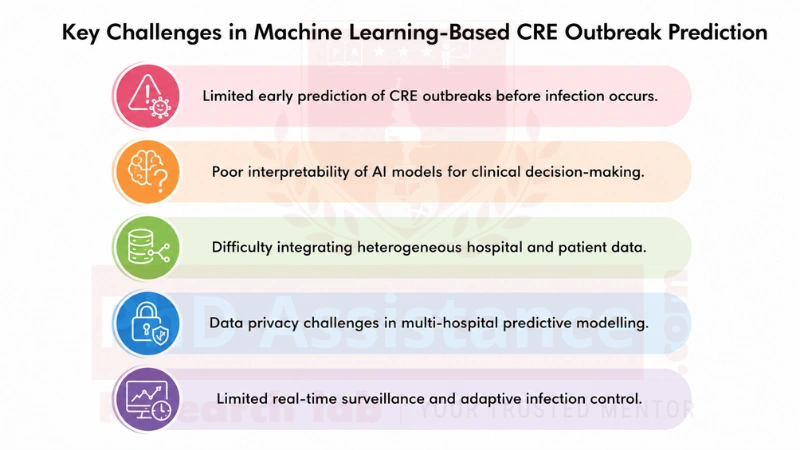
Healthcare data growth, advances in the field of artificial intelligence, and digital health have created a revolution in the surveillance and control of infections associated with the healthcare settings, particularly the infection outbreaks caused by the bacteria Carbapenem-Resistant Enterobacteriaceae (CRE). This has led to the development of Machine Learning for CRE Outbreak Prediction, which helps healthcare experts detect the risk of an outbreak, analyse clinical data and help in making preventive measures against such infections. Even though these techniques have proven to be promising, there are still several limitations associated with their successful implementation in predicting outbreaks, making models interpretable, incorporating heterogeneous hospital data and providing decision support.
Proposed PhD Title 1: Explainable Transformer-Based Clinical Intelligence Framework for Early Carbapenem-Resistant Enterobacteriaceae Risk Stratification and Decision Support in Hospital Settings
Infections caused by antimicrobial-resistant organisms are the most significant problems in healthcare due to both clinical and economic reasons. Thanks to developments in Machine Learning, it has become possible to develop efficient prediction models that can work with electronic health records, laboratory tests, and other patient-related data to provide timely intervention. In this case, transformer-based neural networks proved to be highly effective tools for dealing with complicated clinical data because of their ability to capture long-term dependencies and heterogeneous relationships. Besides, explainable artificial intelligence makes prediction models more understandable, which improves the level of clinicians’ confidence. Black et al. (2021) showed the ability of machine learning to predict the results of treatment of resistant bacterial infections based on clinical and genomic data.
Problem Statement:
Current prediction models mainly deal with the prediction of antibiotic resistance or the treatment outcome following confirmation of infection, which is not very helpful for taking preemptive action from the clinical perspective. Although transformer models have shown good predictive power, they largely function as black-box algorithms, and as such are not very interpretable. Thus, medical professionals find it difficult to identify CRE infection at an early stage.
Research Gap:
Despite transformer-based prediction models showing potential in the analysis of complicated clinical data, current literature mostly revolves around the use of such models for diagnostics or therapeutic purposes. There has been little use of explainable transformer-based systems in the CRE Outbreak Prediction context, which limits their application to offer transparent and proactive decision-making in hospitals.
Research Question:
How might explainable transformer frameworks be created that will increase accuracy, interpretation, and relevance of CRE Outbreak Prediction in hospital infection control?
Outcome:
This study will design an explainable transformer-based system that is able to predict the emergence of carbapenem-resistant enterobacteriaceae (CRE) infections using multiple levels of data. This will enhance Infection Prediction, Outbreak Prediction, and recommendations for improving AI for Infection Control.
Reference:
Black, C. A., Aguilar, S., Bandy, S., et al. (2021). Machine Learning Approaches to Predicting Treatment Outcomes for Carbapenem-Resistant Enterobacterales in a Region with High Prevalence of Non-Carbapenemase Producers.
Proposed PhD Title 2. Graph Neural Network-Driven Contact Network Analytics for Transmission Pathway Discovery and Hospital Infection Surveillance of Carbapenem-Resistant Enterobacteriaceae
Advanced computer algorithms are being employed by healthcare organisations in order to learn about the dynamics of pathogen spread with antibiotic resistance. Network-based artificial intelligence is becoming popular as it enables modelling complex interrelationships between patients, health care personnel, hospital wards, and other environmental variables that affect the spread of diseases. One such approach is Graph Neural Networks (GNN), which have proven to be effective at learning latent patterns from the connected healthcare data. According to Atkinson et al. (2023), it was possible to use machine learning combined with graph theory to advance outbreak investigations through the reconstruction of transmission networks and epidemiological connections inside hospitals. Although this method increased retrospective analysis capabilities and contact tracing, it did not have sufficient potential to predict transmission events and conduct proactive surveillance. Thus, intelligent frameworks based on graphs are required to improve infection prevention practices and intervene in a timely.
Problem Statement:
Current techniques of outbreak investigation through graphs mostly involve the reconstruction of transmission routes following the occurrence of infection cases. Moreover, most models that currently exist cannot take full advantage of the predictive power of dynamic health networks to better predict and therefore reduce disease transmission.
Research Gap:
Earlier studies have proven that the use of graph-based approaches may aid in the process of outbreak investigations by constructing the transmission pathway and analysing epidemiological connections. Nevertheless, few studies have attempted to incorporate Graph Neural Networks into the construction of predictive surveillance systems that will facilitate prediction of CRE transmission and emergence of infections.
Research question:
How could a transparent transformer-based prediction model enhance early detection of high-risk patients while contributing to better Infection Prediction?
Outcome:
It is anticipated that the recommended research will result in the development of an open framework for transformer-based prediction that will facilitate early risk evaluation and enhance decision-making and AI for Hospital Infection Control.
Reference:
Atkinson, B., et al. (2023). Extending Outbreak Investigation with Machine Learning and Graph Theory: Benefits of New Tools with Application to a Nosocomial Outbreak of a Multidrug-Resistant Organism.
Proposed PhD Title 3. Spatiotemporal Deep Learning Framework for Forecasting Carbapenem-Resistant Enterobacteriaceae Outbreak Dynamics Using Electronic Health Records and Hospital Mobility Data
The growing incidence of antimicrobial-resistant pathogens has called for the development of predictive models that would enable the identification of outbreak trends before they become widespread. With the help of Machine Learning in Healthcare, it is now possible to incorporate electronic health records, patient mobility data, laboratory results, and temporal data to increase the efficiency of infectious disease surveillance. Spatiotemporal learning is especially useful since it considers spatial dependencies along with temporal dynamics, which makes it possible to get a better understanding of the outbreak trend. As was shown by Gouareb et al. (2023), it is possible to use Graph Neural Networks to model the interaction network in the healthcare sector and analyse the transmission of multidrug-resistant pathogens. Nevertheless, the work by researchers did not pay much attention to temporal outbreak trend analysis and dynamic patient mobility.
Problem Statement:
The currently available high-resolution EMG systems offer sophisticated analysis of muscle coordination but are difficult to use in rehabilitation practice due to their complicated technical apparatus. Moreover, existing sEMG techniques and wearable sensors lack the capacity to transform muscle synergy data into practical monitoring devices that could be used in real-life rehabilitation settings.
Research Gap:
Even though there has been an enhancement in the explainability of AI systems in recent times, current literature on the topic has been generated based on datasets obtained from individual hospitals. There is limited literature on federated learning algorithms for predicting hospital infections, which hinders the creation of multi-centre collaborations securely.
Research Question:
How does a spatiotemporal learning approach enhance the accuracy of Hospital Infection Prediction by considering the movements of the patients as well as disease progression?
Outcome:
This research will be instrumental in developing a reliable predictive framework using spatio-temporal health care data to facilitate early prediction of outbreaks.
Reference:
Gouareb, R., Bornet, A., Proios, D., Pereira, S. G., & Teodoro, D. (2023). Detection of patients at risk of multidrug-resistant Enterobacteriaceae infection using graph neural networks: A retrospective study. Health Data Science, 3, Article 0099. https://doi.org/10.34133/hds.0099.
Proposed PhD Title 4. Federated Machine Learning Architecture for Privacy-Preserving Multi-Hospital Prediction of Carbapenem-Resistant Enterobacteriaceae Transmission and Healthcare-Associated Infections
Increased amounts of healthcare data have facilitated the increased use of artificial intelligence technology for the prediction of infectious diseases and the improvement of clinical decision-making. Some of the new techniques include federated learning, which involves the development of predictive models among several healthcare facilities without revealing personal data about patients, thus ensuring privacy while at the same time increasing the model’s generalizability. The combination of federated models and explainable artificial intelligence allows for making predictions that are understandable and hence facilitates clinical decisions. Li et al. (2024) showed that explainable machine learning techniques could help predict resistant infections by highlighting important clinical factors and improving model interpretability. The problem is that their work used data from one healthcare facility only and therefore lacks generalizability due to the geographic diversity of different hospitals and healthcare facilities. Thus, there is still a need for privacy-preserving predictive frameworks that can provide infection intelligence across institutions.
Problem Statement:
However, most of the existing predictive models are designed based on isolated data from different healthcare organisations, which makes their applicability quite limited to other healthcare settings. Data privacy laws also pose restrictions on the collaborative development of models, posing major issues in correctly assessing the risks of transmissions and Infection Prediction.
Research Gap:
While explainable AI has enhanced the explainability of predictive models, most of the currently available literature is based on data collected from healthcare organisations separately. There has been very little research carried out on the federated learning framework for Infection Prediction that enables collaborative learning among multiple centres in a secure environment.
Research Question:
How can federated learning assist with collaborative disease surveillance and help in CRE Prediction among hospitals located in different geographical regions?
Outcome:
The research project is anticipated to contribute toward the development of an advanced federated learning approach that will result in increased efficiency of prediction in multiple healthcare organisations as well as Machine Learning overall.
Reference:
Li, X., et al. (2024). Explainable Machine Learning for Predicting Antimicrobial-Resistant Infections.
Proposed PhD Title 5. Digital Twin-Enabled Artificial Intelligence Platform for Real-Time Hospital Infection Prediction and Adaptive Control of Carbapenem-Resistant Enterobacteriaceae Outbreaks
The fast development of intelligent healthcare technologies has offered new possibilities in monitoring infections and implementing proactive clinical interventions. Among such innovations, digital twin technology offers a simulation of healthcare environments through continuous input of clinical, operational, and epidemiological data in real time. Digital twins augmented with artificial intelligence can simulate the course of the disease, assess intervention measures, and optimise resource management for prevention of infections. In particular, Fang and Shi (2026) have created a machine learning model to predict carbapenem-resistant organism infections among hospitalised patients and have proved the efficacy of the proposed approach through explainable analytics. Still, the work has been largely devoted to predicting the risks of infection for individual patients but has not included dynamic hospital-wide simulations of disease spread and evaluation of interventions.
Problem Statement:
The current prediction models estimate the infection risk on an individual patient’s basis and offer little ability to model the progression of disease in a network of health care facilities. Without simulation and constant surveillance, health care workers get less chances to predict the outbreak of CRE, assess control strategies of control and optimise the prevention of infection.
Research Gap:
Existing works have been successful in the application of automated machine learning for the prediction of risks of infections at an individual level; however, there is limited literature that has used the concept of digital twins along with intelligent predictive models to aid Infection Prediction.
Research Question:
In what ways can a framework based on digital twin artificial intelligence be used to enhance CRE Prediction through simulation and assessment of intervention strategies?
Outcome:
The outcome of this research is likely to produce an intelligent digital twin framework that will be able to simulate the progress of an outbreak and help to plan interventions using evidence and machine learning in hospitals.
Reference:
Frontiers in Neurology. (2024). Emerging wearable technologies and future perspectives for post-stroke upper limb rehabilitation. Frontiers in Neurology, 15, 1470759.
Need assistance finalising your dissertation topic in “Machine Learning Prediction of Carbapenem-Resistant Enterobacteriaceae Outbreaks”? Selecting a strong, researchable topic can be challenging — but you don’t have to do it alone.
Our research consultants can help refine your ideas, identify literature gaps, and guide you toward a topic that aligns with current academic trends and your programme requirements.
Contact us to begin one-on-one topic development and refinement with PhdAssistance.com Research Lab.
Share this:
Cite this work
PhDAssistance. (n.d.). Virtual Influencers Dissertation Titles Retrieved 30th January 2026, from https://phdassistance.com/title/virtual-influencers/
“Virtual Influencers Dissertation Titles, https://phdassistance.com/title/virtual-influencers/
“Virtual Influencers Dissertation Titles” PhDAssistance, PhDAssistance, Tuesday, January 30th,2026.
PhDAssistance, n.d. Virtual Influencers Dissertation Titles[Online]. Available at: https://phdassistance.com/title/virtual-influencers/ [Accessed January 30th, 2026].
PhDAssistance. Virtual Influencers Dissertation Titles[Internet]. PhDAssistance; [cited 2026 January 30th]. Available from: https://phdassistance.com/title/virtual-influencers/
PhDAssistance (n.d.).
Virtual Influencers Dissertation Titles. Retrieved January 30th, 2026, from https://phdassistance.com/title/virtual-influencers/
PhDAssistance, Virtual Influencers Dissertation Titles(PhDAssistance, n.d. January 30th accessed 2026.
Study Resources
Free resources to assist you with your university studies!