
The source and why it matters
Sepsis is defined in the Sepsis-3 consensus as life-threatening organ dysfunction caused by a dysregulated host response to infection, with organ dysfunction identified by an acute rise of two points or more in the Sequential Organ Failure Assessment (SOFA) score (Singer et al., 2016). A global burden analysis estimated about 11 million sepsis-related deaths in 2017 (Rudd et al., 2020). Because outcomes worsen with delay, predicting sepsis before it is recognised clinically is a long-standing goal of machine learning in hospitals.
The paper under review is Thiboud et al. (2025), "Development and validation of a machine learning model for early prediction of sepsis onset in hospital inpatients from all departments", published open access in Diagnostics (volume 15, issue 3, article 302) in January 2025. Its distinctive feature is scope: most sepsis models have been built and tested in intensive care, whereas this one covers inpatients in every department of the Centre Hospitalier de Valenciennes in France.
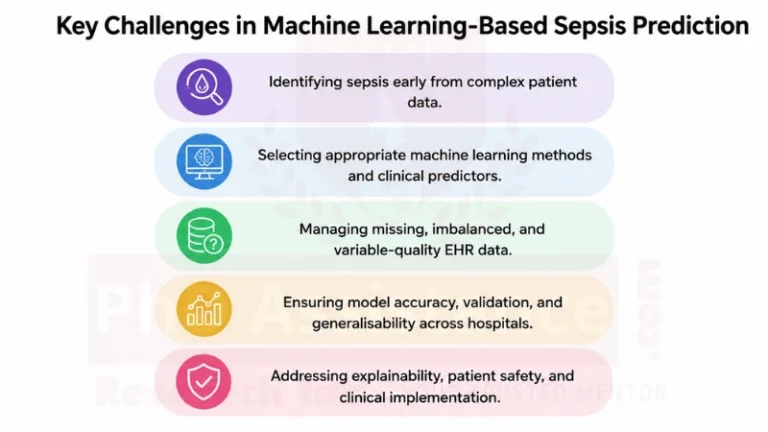
What the study did and found
The authors developed the SEPSI Score, a gradient-boosted tree classifier (XGBoost), from 15 routinely collected predictors: vital signs, laboratory values such as creatinine, lactate, white cell count, platelets and bilirubin, urine output, oxygenation, the Glasgow Coma Scale, comorbidities, age, sex and month of admission. Data were extracted through an HL7 FHIR server linked to the hospital record. Sepsis cases were identified from ICD-10 codes confirmed by an expert physician, and onset was timed by a two-point rise in SOFA (Thiboud et al., 2025).
The training cohort (February 2020 to July 2021) contained 26,652 eligible encounters, 4.9% with sepsis; the validation cohort (August to November 2021) contained 5,270 encounters, 2.3% with sepsis (121 cases). Predictions were made on three-hour windows. The table reproduces the validation results at sepsis onset.
| Measure | SEPSI Score | SOFA | qSOFA | SIRS | MEWS |
|---|---|---|---|---|---|
| AUROC | 0.992 | 0.944 | 0.537 | 0.628 | 0.617 |
| AUPRC | 0.738 | 0.174 | 0.036 | 0.041 | 0.048 |
| Sensitivity | 0.845 | 1.000 | 0.083 | 0.372 | 0.289 |
| Specificity | 0.987 | 0.889 | 0.991 | 0.884 | 0.944 |
| PPV | 0.610 | 0.174 | 0.175 | 0.070 | 0.108 |
Three hours before onset, the SEPSI Score's AUROC was 0.74, against 0.46 for SOFA, 0.52 for qSOFA, 0.59 for SIRS and 0.56 for MEWS. Among 44 encounters in which sepsis was diagnosed during the stay, 21 were flagged at least 48 hours before the medically confirmed onset. The authors acknowledge that the study is retrospective and single-centre and call for prospective multicentre validation (Thiboud et al., 2025).
Strengths
- A whole-hospital population. Including all departments addresses a real gap, since sepsis often begins on general wards where monitoring is less intensive than in intensive care.
- Routine data and a standard interface. Using common variables extracted through HL7 FHIR makes the model more portable in principle than one depending on bespoke data feeds.
- Appropriate metrics for rare outcomes. Reporting AUPRC and PPV alongside AUROC is good practice when only a few per cent of cases are positive.
- Temporal separation. Validating on a later period from the same hospital is a stronger test than a random split of the same records.
- Candid limitations and disclosures. The authors state the single-centre design, the favourable sampling of time windows, and their commercial interests.
Appraisal through TRIPOD+AI and PROBAST+AI
TRIPOD+AI sets out what a report of a prediction model using regression or machine learning should contain (Collins et al., 2024). PROBAST+AI assesses quality, risk of bias and applicability, with separate sections for model development and model evaluation, each organised in four domains: participants and data sources, predictors, outcome, and analysis (Moons et al., 2025). The table applies those domains as a reading lens; it is our appraisal, not a formal scored assessment.
| Domain | What the study did | Concern for a reader |
|---|---|---|
| Participants and data | All inpatients at one French hospital, 2020 to 2021 | One site, partly during the COVID-19 period; applicability elsewhere unknown |
| Predictors | 15 routine variables, forward-filled when missing | Several are SOFA components, which also define the outcome |
| Outcome | ICD-10 codes confirmed by an expert; onset at a 2-point SOFA rise | Coding-based labels and a SOFA-defined onset make SOFA comparisons partly circular |
| Analysis | XGBoost; temporal validation with 121 sepsis cases | Calibration not reported; small number of events; windows sampled favourably |
Circularity in the comparison with SOFA
The most important methodological point concerns the outcome. Onset was defined by a two-point SOFA rise, and several SOFA components, such as creatinine, bilirubin, platelets, oxygenation and the Glasgow Coma Scale, are model inputs. At the moment of onset, a model that sees these values is partly recognising the definition itself, which helps explain an AUROC of 0.992 and SOFA's sensitivity of 1.000. The informative result is the one before onset, where the AUROC of 0.74 is useful but modest.
Sampling, calibration and sample size
Sepsis encounters were sampled at onset while non-sepsis encounters were sampled at random times, a choice the authors describe as favourable. In real deployment, a model scores every patient continuously, so the alert burden may be higher than these figures suggest. Calibration, the agreement between predicted risks and observed rates, was not reported, although it matters most when prevalence changes, as it did here from 4.9% to 2.3% (Van Calster et al., 2019). With 121 validation events and 44 in the early-detection analysis, estimates are imprecise; planning sample size for development and validation is now expected practice (Riley et al., 2020). Finally, no decision curve or other utility analysis shows whether acting on the alerts would do more good than harm (Vickers & Elkin, 2006).
Reading the 48-hour result with care
The finding that 21 of 44 in-stay sepsis cases were flagged at least 48 hours early is striking, but it needs two qualifications. First, onset in these cases was the time recorded or estimated by clinicians, so an "early" flag partly measures delay in recognition rather than the model's foresight. Second, the analysis counts true early flags without reporting how many patients without sepsis were flagged over the same horizon. Without that denominator, a reader cannot judge the precision of early alerts, which is what determines whether ward staff would act on them.
Implementation and ethical considerations
A model that runs across a whole hospital raises practical questions that a development study cannot answer. Who receives the alert, in what form and with what expected response? How will staff on busy wards avoid alarm fatigue if, as with the proprietary model studied by Wong et al. (2021), alerts fire for a large share of patients? The TREWS studies show that adoption depends on how clinicians perceive and evaluate alerts, not only on accuracy (Henry et al., 2022).
- Accountability. The clinical team remains responsible for decisions, so the alert must be interpretable enough to be checked against the patient.
- Fairness. Performance should be reported by age, sex and other relevant groups, because a single pooled figure can hide weaker performance for some patients; TRIPOD+AI asks authors to address this (Collins et al., 2024).
- Monitoring. Case mix, coding and laboratory practice change over time, so performance and calibration need monitoring after deployment.
- Independence. Because the developers are the evaluators here, independent external validation is especially valuable.
How the study sits in the wider literature
A meta-analysis of machine learning for sepsis prediction found high reported accuracy but marked heterogeneity in populations, sepsis definitions and validation, with most studies retrospective (Fleuren et al., 2020). The SEPSI Score fits that pattern. The risks of skipping external validation are well documented: when Wong et al. (2021) evaluated a widely used proprietary sepsis model in 38,455 hospitalisations, its area under the curve was 0.63, it missed 67% of patients who developed sepsis and it alerted on 18% of all patients. Across four intensive care databases from three countries, Moor et al. (2023) found that a deep learning model's AUROC fell from 0.846 internally to 0.761 at new sites, recovering to 0.807 after fine-tuning.
Evidence of benefit requires deployment. Building on the earlier TREWScore for septic shock (Henry et al., 2015), the TREWS system was studied prospectively in five hospitals: providers evaluated 89% of alerts, and confirming an alert within three hours was associated with a 1.85-hour reduction in median time to first antibiotic order (Henry et al., 2022) and an adjusted 18.7% relative reduction in in-hospital mortality (Adams et al., 2022). These were observational comparisons rather than randomised trials, but they show the kind of evidence a model needs before adoption. Randomised evaluation of an intensive care algorithm has also been reported (Persson et al., 2024).
What it means for doctoral researchers
Worked example: how prevalence changes PPV (illustrative)
Using the paper's sensitivity (0.845) and specificity (0.987) at onset, PPV equals sensitivity multiplied by prevalence, divided by that product plus (1 minus specificity) multiplied by (1 minus prevalence). At the validation prevalence of 2.3%, this gives about 0.60, close to the reported 0.610. If the same sensitivity and specificity held where only 1% of scored windows were septic, PPV would fall to about 0.40, meaning roughly three false alerts for every two true ones; at 0.5% it would be about 0.25. The prevalence values other than 2.3% are illustrative, but the lesson is general: report predictive values at the prevalence where the model will be used, and plan alert handling accordingly.
For a doctoral study, the paper suggests clear next steps: external validation in other hospitals, continuous scoring of all patient-time rather than sampled windows, predictors that exclude the components of the outcome definition (or an outcome defined independently), calibration and decision curve analysis, subgroup performance, and a prospective study of alert burden and clinical response. For broader context on appraising AI evidence, see the deep learning in medicine review and the guide to reporting regression analysis.
Common mistakes in sepsis prediction studies
- Using predictors that form part of the outcome definition, then reporting near-perfect discrimination.
- Calling a temporal split in the same hospital "external validation".
- Reporting AUROC alone when the outcome is rare, without AUPRC, PPV and calibration.
- Sampling outcome-positive and outcome-negative time windows differently from how the model will run.
- Comparing against scores designed for other purposes and presenting the gap as clinical superiority.
- Omitting conflicts of interest or the developer's role in data analysis.
Key takeaways
- Thiboud et al. (2025) built a whole-hospital sepsis model from 15 routine predictors and validated it on a later cohort from the same hospital.
- Its near-perfect AUROC at onset is partly circular because SOFA defines the outcome; the 3-hour AUROC of 0.74 is the informative result.
- TRIPOD+AI and PROBAST+AI give a structured way to judge reporting, bias and applicability (Collins et al., 2024; Moons et al., 2025).
- External validation often lowers performance, and benefit needs prospective evidence (Wong et al., 2021; Moor et al., 2023; Adams et al., 2022).
- Report calibration and predictive values at the prevalence of intended use (Van Calster et al., 2019).