
Critical Review of Deep learning in medicine: advancing healthcare with intelligent solutions and the future of holography imaging in early diagnosis
Introduction
Deep learning uses data-driven intelligent technology to improve disease diagnosis, medical imaging, new drug discovery, new therapies and personalised medicine. Holographic Imaging in healthcare, as well as diagnostic systems, is a part of these developing applications that will help in early diagnosis of disease and clinical decisions.
However, most of the researchers find it hard to critique a research paper, particularly in terms of critiquing the article in addition to summarising the paper and comparing the findings presented in the paper with other research works. The paper titled “Deep Learning in Medicine: Enhancing Healthcare Using Intelligent Solutions and The Future of Holography Imaging in Early Diagnosis” by Nazir et al. (2025), for instance, gives a comprehensive review of recent advancements in Deep Learning.
Summary of the article
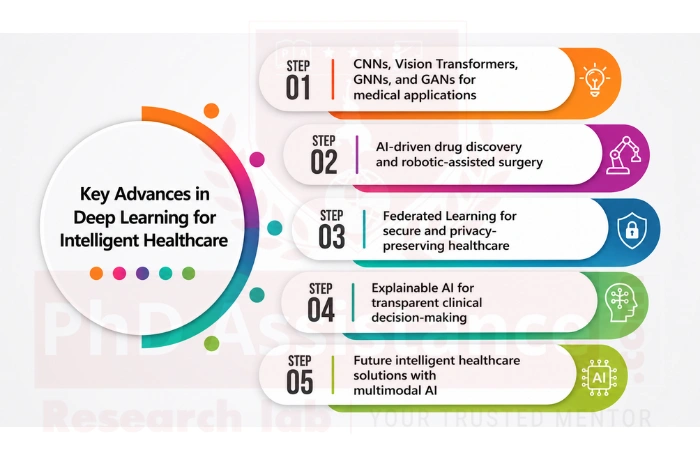
Nazir et al. (2025) rezview the use of Deep Learning in the context of improving healthcare with intelligent computing systems. This systematic review, which was conducted based on the PRISMA framework, resulted in selecting 218 studies out of 500 articles published to assess the latest trends in artificial intelligence. It includes some of the most popular deep learning architectures like CNN, RNN, vision transformers, GNN, and GANs.
Besides these features, applications of deep learning in healthcare can be seen in many clinical domains like radiology, pathology, Cardiology, Dermatology, Ophthalmology, genomics, EHR, and many others. This is because deep learning has allowed more precise and faster diagnosis from images than any other traditional practice in the diagnosis using imaging tools like MRIs, CT scans, PET scans, ultrasound, mammograms, OCT, X-rays, and many others.
One significant thing that comes from the review is the application of the emerging technology called Holographic Imaging, which is meant for early disease detection. Besides, the authors explore the use of deep learning in other domains like drug discovery, robotic surgery, precision medicine, Federated Learning (FL), and Explainable Artificial Intelligence (XAI).
Challenges that can be addressed by future research work include annotated dataset limitations, computational complexity, explainability, privacy issues, and regulations. The research suggests further research on explainable AI, multimodal learning, privacy-preserving systems, and clinically tested Intelligent Solutions in order to make personalised healthcare possible.
Critique
Significance and contribution of the field
One of the significant advantages of this review is its broad coverage of the application of Deep Learning in various healthcare domains. Unlike the initial literature, which heavily emphasised the applications of DL in imaging or disease diagnosis alone, Nazir et al (2025) discuss and extend this scope by discussing the application of DL in medical imaging, robot surgery, Drug Discovery, FL, XAI and Holography Imaging in healthcare, thereby clearly indicating how the contemporary ‘Intelligent Solutions’ are shaping clinical practice.
These results match those reported by Esteva et al. (2017), who reported that deep learning algorithms can accurately predict skin cancer classification similar to Dermatologists; the use of deep learning in health is very broad.
Another aspect brought out by the review is the emerging technology such as holographic imaging and attention-based deep learning models. This finding corroborates the work done by Topol (2019), where he states that artificial intelligence has revolutionised the healthcare sector due to increased diagnostic precision and personalisation of treatments.
Although the authors present a survey and description of various models and concepts in advanced Diagnostic systems and outline several applications of deep learning models in practice, many relevant clinical questions such as generalisability or external validation were barely considered, in contrast to recent concerns expressed by Kaissis et al. (2020). Overall, the authors describe the current research state regarding advanced diagnostic systems accurately, but a more critical consideration with regard to implementation would enhance the impact.
Methodology and research design
The systematically conducted review methodology is one of the key features of this publication and increases the reliability and clarity of the data collection. For example, from the search strategy, there were 500 initial papers found, among which 300 articles were screened, and 218 are considered in this manuscript; they are all peer-reviewed. This structured design methodology significantly minimises the selection of irrelevant literature. Because it goes beyond narrative reviews, it can give an overview of the most recent advances in Deep Learning and how this field evolves with the example of real health applications.
The review is also enhanced by the fact that various approaches in the application of AI, such as Convolutional Neural Networks, Vision Transformers, Federated Learning, and Explainable AI, are included, giving an all-encompassing view of Deep Learning. But in terms of the inclusion of quality assessments of the selected studies, this review lacks this information. In previous systematic reviews, for instance, Page et al. (2021), the importance of quality assessment has been noted to enhance the reliability of the evidence synthesis.
Though the PRISMA framework enhances transparency of the review, the central element of the article is only summing up published studies without comparing performance in numerical values between algorithms. As such, we got a broad and rather wide overview of the results, without solid proof of which model among deep learning techniques outperforms others in clinical practice.
Theoretical and Interdisciplinary Analysis
This paper creates an interdisciplinary base of knowledge by integrating several fields, such as artificial intelligence, bioengineering, clinical medicine, genomics, and medical imaging. It showcases the use of deep learning for medical care, rather than algorithm design, but instead explains the application of deep learning for areas such as precision medicine, robotic-assisted surgery, drug discovery, and early disease detection.
This interdisciplinary view helps us see a wide range of collaborative approaches across computer scientists, healthcare providers, and medical researchers. A remarkable insight comes from the paper on Holography Imaging, which explores a novel and yet understudied research frontier, according to prior review works.
The coupling of holographic imaging and deep learning shows bright prospects for early detection and upcoming Intelligent Diagnostic Systems. Another significant consideration highlighted is the rising importance of Explainable AI and Federated Learning in healthcare systems to bolster confidence and privacy in AI applications. Even with these areas of strength, the theoretical discussion was mostly descriptive. A discussion of several applications is included and, in most cases, describes individual technologies rather than comparing opposing AI models or clinical theoretical approaches.
If an argument to consider implementation science and innovation/adoption theories in healthcare, along with regulatory aspects of AI adoption, there was potential for an enhanced multidisciplinary perspective, offering insight into how best to bridge the gap between development and deployment.
Ethical Considerations
We identify many challenges in the context of Deep Learning: patients’ data privacy, transparency of algorithms, the safety of medical datasets, just to cite some of them. However, the references to Federated Learning and Explainable AI are indicative of how aware the author team is of novel solutions which promote the safety of medical data, and at the same time they encourage a greater acceptance of AI among the doctors (the XAI component). Hence, the work can be seen as a step in the direction of satisfying the current ethical constraints about the usage of “intelligent medical tools”.
While these have been briefly acknowledged, there is a dearth of coverage regarding algorithmic bias, equitable deployment of systems in various patient demographics, or the regulatory mechanisms that oversee the use of AI-driven healthcare. More recent contributions, like Kaissis et al. (2020), maintain that equitable AI requires more stringent governance, independent validation, and persistent vigilance of algorithm performance to ensure it adheres to ethical principles.
Writing Style and Structure
The article is neatly organised and presented with clear segments and clear progression from the concept to future applications. Also, headings, tables, graphs, and flow charts have helped the readers understand the concepts more clearly by adding an efficient framework, which helped the reviewers quickly absorb the overall framework and concepts discussed in the review article. The graph representing the PRISMA flow diagram has enriched the review by explaining the process clearly.
While the authors managed to maintain an accessible yet academic tone that would serve as a medium connecting health-related researchers and computer scientists, there were extensive passages dedicated to discussing the architecture of various deep learning models without providing much information about their strengths and weaknesses relative to the others. The addition of clinical/in vivo data to this excellent review would enhance it even further.
Conclusion
Overall, the article by Nazir et al. (2025) is of great importance in offering an in-depth review and summary of the latest research progress made in Deep Learning for Medical and its considerable impact in the health sector. It also clearly identifies prospects for implementing research findings within smart health systems such as those discussed but goes beyond what might seem obvious by integrating topics like machine learning into robotics, drug discovery and medical imaging.
While the survey is comprehensive about technologies, the authors might have provided an in-depth critical assessment concerning their methodological rigour, algorithm performance characteristics, governing frameworks, and their integration in clinical settings. Nonetheless, the paper contributes significantly to the literature of “Deep Learning for Healthcare” and offers valuable guidelines for researchers for the development of trustworthy, transparent, and useful Intelligent Healthcare solutions in clinical settings.
“Are you facing challenges in writing a high-quality critical review for your research? The PhD Assistance Research Lab offers specialised guidance tailored to doctoral scholars and early-career researchers.”
Reference
- Esteva, A., Kuprel, B., Novoa, R. A., Ko, J., Swetter, S. M., Blau, H. M., & Thrun, S. (2017). Dermatologist-level classification of skin cancer with deep neural networks. Nature, 542(7639), 115–118. https://doi.org/10.1038/nature21056
- Kaissis, G. A., Makowski, M. R., Rückert, D., & Braren, R. F. (2020). Secure, privacy-preserving and federated machine learning in medical imaging. Nature Machine Intelligence, 2(6), 305–311. https://doi.org/10.1038/s42256-020-0186-1
- Nazir, A., Hussain, A., Singh, M., & Assad, A. (2025). Deep learning in medicine: Advancing healthcare with intelligent solutions and the future of holography imaging in early diagnosis. Multimedia Tools and Applications, 84, 17677–17740. https://doi.org/10.1007/s11042-024-19694-8
- Page, M. J., McKenzie, J. E., Bossuyt, P. M., Boutron, I., Hoffmann, T. C., Mulrow, C. D., Shamseer, L., Tetzlaff, J. M., Akl, E. A., Brennan, S. E., Chou, R., Glanville, J., Grimshaw, J. M., Hróbjartsson, A., Lalu, M. M., Li, T., Loder, E. W., Mayo-Wilson, E., McDonald, S., … Moher, D. (2021). The PRISMA 2020 statement: An updated guideline for reporting systematic reviews. BMJ, 372, n71. https://doi.org/10.1136/bmj.n71
- Topol, E. (2019). High-performance medicine: The convergence of human and artificial intelligence. Nature Medicine, 25(1), 44–56. https://doi.org/10.1038/s41591-018-0300-7