
How to use this list
This page is for doctoral researchers in computer science, cybersecurity and networking who want to work on privacy-preserving computation at the edge. Each title below names the workload, the setting and the cost that will be evaluated.
Post-quantum migration is covered on the quantum-secure computing topics and post-quantum cryptography titles pages; blockchain and IoT security on the blockchain IoT security topics page; and clinical edge systems on the edge computing in healthcare topics page. The topics hub links every subject.
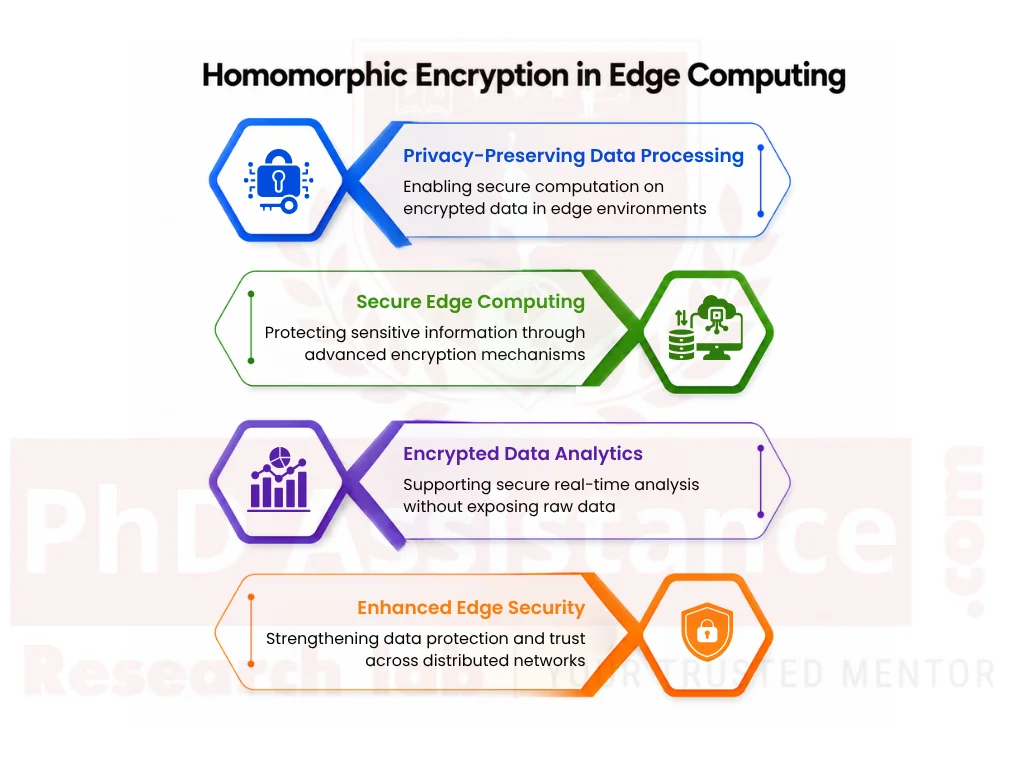
What homomorphic encryption can and cannot do
Homomorphic encryption (HE) allows computation on encrypted data, so a server can process values it cannot read. Partially homomorphic schemes support one operation, such as addition; fully homomorphic schemes support arbitrary computation but at a high cost in time, memory and ciphertext size (Acar et al., 2018). Modern scheme families differ in what they compute well: exact integer arithmetic, approximate arithmetic on real numbers (useful for machine learning), or fast evaluation of Boolean circuits. A doctoral title should say which kind of computation it needs, because that choice drives everything else.
Edge settings make the cost matter. Edge servers have less capacity than cloud data centres, and IoT devices far less again. The research question is rarely "can HE be used?" and usually "for which workload is the overhead acceptable, and what does it buy?"
Theme 1: Encrypted learning and detection at the edge
Federated learning keeps raw data on devices, but it is not private by default: white-box inference attacks can recover information about training data from model parameters and updates (Nasr et al., 2019). Secure aggregation protocols let a server combine updates without seeing individual ones (Bonawitz et al., 2017), and HE is one way to build them. In medical imaging, combining federated learning with encryption and differential privacy has been proposed as a layered defence (Kaissis et al., 2020; Dwork & Roth, 2014).
| Dissertation title | Possible research question | Likely design and data | Why it matters now |
|---|---|---|---|
| Homomorphic-encryption-based secure aggregation for federated learning across edge nodes: accuracy, overhead and leakage | How do HE-based and mask-based secure aggregation compare in latency, bandwidth and model accuracy, and how much do they reduce leakage from updates? | Testbed of edge devices (for example single-board computers) with an open HE library; membership inference attacks as the leakage test | Updates leak information unless aggregation is protected (Nasr et al., 2019; Bonawitz et al., 2017) |
| Encrypted inference for intrusion detection on IoT edge gateways: accuracy, latency and what can be explained | Can a compact intrusion detection model run on encrypted traffic features at a latency suitable for a gateway, and what explanation can be released without revealing the inputs? | Public IoT intrusion dataset such as ToN_IoT; plaintext and encrypted models compared; per-sample latency measured | Federated and on-device detection are active choices for IoT security (Rahman et al., 2020; Agrawal et al., 2022; Booij et al., 2022) |
Use a public dataset whose limitations are documented. Booij et al. (2022) show that IoT intrusion datasets differ in features and attack labels, which affects how far results generalise.
Theme 2: Making encrypted computation affordable
Performance claims are where HE theses are most often challenged. Runtime depends on the implementation, library version, parameters and hardware as much as on the algorithm, so comparisons must hold these constant (Kriegel et al., 2017).
| Dissertation title | Possible research question | Likely design and data | Why it matters now |
|---|---|---|---|
| Benchmarking homomorphic encryption schemes for edge-server analytics on IoT sensor streams | For aggregation and simple statistics over sensor streams, which scheme and parameter set meets a stated latency budget on edge hardware, and at what security level? | Controlled benchmarks on two or three edge platforms; devices only encrypt; repeated runs with variance reported | Practical deployment of HE remains limited by cost (Acar et al., 2018; Kriegel et al., 2017) |
Theme 3: Trust management and policy in zero-trust edge networks
Zero trust treats no device or network location as trusted by default and verifies every request. HE does not provide that; it protects data while it is processed. Titles in this theme study how the two fit together: who may request an encrypted computation, how that decision is recorded, and when the cost of encryption is justified by the risk.
| Dissertation title | Possible research question | Likely design and data | Why it matters now |
|---|---|---|---|
| Blockchain-anchored access control with encrypted computation for zero-trust IoT edge networks | Does recording access decisions on a permissioned ledger, combined with encrypted computation, improve auditability without unacceptable latency? | Prototype on a permissioned ledger; latency and throughput under load; security analysis against a stated adversary | Decentralised trust and privacy-preserving computation are often proposed together but rarely measured (Acar et al., 2018) |
| Risk-adaptive selection of privacy-preserving computation in a zero-trust edge policy engine: a simulation study | Can a policy engine that chooses between plaintext, secure aggregation and HE by request risk keep overhead low while meeting privacy requirements? | Discrete-event simulation with cost models from Theme 2 benchmarks; sensitivity analysis on risk thresholds | Uniform use of the most expensive protection wastes scarce edge capacity (Kriegel et al., 2017) |
The two rows suit different strengths. The first needs systems building and careful load testing; the second needs modelling skill and depends on credible cost figures, so it pairs well with a Theme 2 benchmark done first. In either case, state what an attacker gains if a policy decision is wrong, and test that case explicitly rather than only the expected path. A security argument that covers only well-behaved requests will not satisfy examiners.
How to test a title before you commit
Use the FINER criteria: feasible, interesting, novel, ethical and relevant (Hulley et al., 2013). Here feasibility means a working HE library, edge hardware you can benchmark, and a dataset with known limitations. Write the threat model in one paragraph before anything else: who is the adversary, what can they see, and what must stay secret. If you cannot, the title is not ready.
For the wider process, see how to choose a PhD topic, how to select a PhD topic and PhD topic selection support. Related titles are on the zero-trust smart grid security and cybersecurity topics pages.
Common mistakes
- Claiming that federated learning alone makes training private.
- Treating homomorphic encryption as a zero-trust architecture.
- Proposing fully homomorphic evaluation on microcontroller-class devices.
- Reporting runtimes without library versions, parameters, hardware and repeated runs.
- Leaving the threat model implicit.
Key takeaways
- Homomorphic encryption protects data in use but carries a large performance cost (Acar et al., 2018).
- Federated learning needs protected aggregation because updates leak information (Nasr et al., 2019; Bonawitz et al., 2017).
- Layered privacy defences combine encryption, federation and differential privacy (Kaissis et al., 2020; Dwork & Roth, 2014).
- Fair benchmarking controls implementation, parameters and hardware (Kriegel et al., 2017).
- A stated threat model and accessible hardware are the first feasibility tests (Hulley et al., 2013).