
Blockchain-Enabled Authentication Protocols for Securing IoT Devices in Water Treatment Facilities
Info: Blockchain-Enabled Authentication Protocols for Securing IoT Devices in Water Treatment Facilities Topics I phdassistance.com
Published: 1st September in Blockchain-Enabled Authentication Protocols for Securing IoT Devices in Water Treatment Facilities Topics I phdassistance.com
Share this:
Related Services
Our academic writing and marking services can help you
Introduction
The exponential growth in connected devices and intelligent infrastructures has increased the need for secure and effective Internet of Things (IoT) systems within industrial, medical, utility, and smart city settings. Using blockchain technology to enhance IoT security has become increasingly important for addressing unauthorised access, data tampering, device authentication, privacy issues, and single points of failure in traditional IoT architectures. However, research in the field is scattered between areas of blockchain, cybersecurity, authentication protocols, lightweight cryptography, and IoT applications, calling for a systematic review of present trends and research gaps. Blockchain IoT Security Dissertation Topics can provide a starting point for exploring new approaches in IoT security, assessing blockchain-based authentication and security techniques, and find ways to develop new solutions.
Proposed PhD Topic 1: Decentralised Device Identity and Lifecycle Management for Secure Water Treatment IoT Networks
Background Context:
Water treatment plants now rely heavily on a significant number of interconnected sensors, controllers, gateways, and monitoring devices for their continuous monitoring and decision-making process. With the addition of such devices, or updates, replacements, and potential compromise of the devices, there is a need for effective management of reliable device identities, which poses one of the greatest cybersecurity concerns. Conventional centralised authentication systems can create problems such as single points of failure, and managing authentication for an increasing number of IoT devices becomes challenging. Identity information can be disseminated using blockchain technology to ensure the maintenance of tamper-proof data on device registration, authentication, permissions, and revocation. Smart contracts are also capable of automating security policies without relying fully on a central authority. However, current research still encounters problems associated with scalability, computing power, interoperability, energy efficiency, and adaptability. Hence, there is an avenue to explore decentralised identity management within critical water treatment infrastructure in the form of blockchain security dissertation topics.
PhD-Level Verification:
Previous studies carried out by Iswarya and Vennila (2026) show the application of the blockchain concept in decentralised authentication, data integrity, trust, and IoT data security, but challenges remain in scalability, resource management, and the management of heterogeneous devices. This highlights a gap in the existing literature regarding the implementation of the whole device identity life cycle in water treatment IoT networks.
Research Questions:
Contributions at the PhD-Level:
Suggested Readings:
Iswarya, G., & Vennila, C. (2026). A secure and scalable blockchain-assisted authentication framework for decentralised IoT data management.
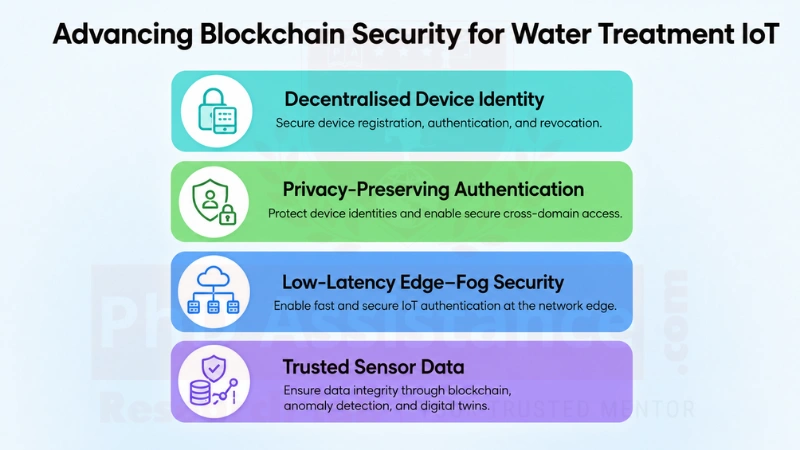
Proposed PhD Topic 2: Privacy-Preserving Cross-Domain Access Control for Interconnected Water Treatment IoT Systems
Background Context:
Large water treatment organisations could have several geographically dispersed treatment plants, pumping stations, labs, storage facilities, and monitoring systems. IoT devices across these separate domains may need to exchange data while ensuring that device identities, data, and communication credentials are adequately protected. Centralised forms of authentication could rely heavily on a central authority. Privacy disclosure, restricted cross-domain access, untraceable malicious actions, and the need for trust in a third party were noted by Xie & Ding (2025) as some of the main challenges associated with the current IoT authentication process. The findings from the above study show that the use of blockchain and smart contracts will be useful in decentralised authentication processes and enhance privacy protection. These technologies have, however, only been investigated within the healthcare sector but not within the critical water treatment infrastructure.
PhD-Level Verification:
Xie and Ding (2025) show how blockchain technology can provide decentralisation and privacy of authentication while minimising the reliance on trusted third parties; however, privacy, cross-domain access, and user identification in the presence of a malicious user still pose significant problems. These areas have not been thoroughly examined for interconnected water treatment Internet-of-Things networks, thus providing a scope for researching a privacy-preserving authentication framework.
Research Questions:
PhD-Level Contributions:
Suggested Readings:
Xie, Q., & Ding, Z. (2025). Provably secure and lightweight blockchain-based cross-hospital authentication scheme for IoMT-based healthcare.
Proposed Dissertation topic 3: Edge-Fog Security Architecture for Real-Time Authentication of Water Treatment IoT Devices
Background Context:
Water treatment is a time-critical cyber-physical system in which data collected by sensors and information controlling the process might require quick processing and authentication. Communication takes place between IoT devices and gateways, edge devices, control systems, and cloud computing systems all the time, thus making many entry points for possible access and manipulation of messages by unauthorised individuals. Sending the requests for authentication to remote cloud servers might also delay the process of communication and increase the load on the network. Fog computing might solve some of these issues. According to Kim et al. (2025), fog computing technology could be able to facilitate near computing resources, data locality, and fast reaction times in IoT application scenarios. In their work, the researchers highlighted that several security weaknesses were identified in the current fog-IoT authentication schemes, such as insider attacks, denial-of-service attacks, stolen verifier attacks, authentication problems, and untraceability challenges. Therefore, one possible dissertation research area could include developing fog-based blockchain authentication protocols, particularly for water treatment applications.
PhD Level Verification:
Kim et al. (2025) presented the application of blockchain to secure authentication in fog-assisted IoT and revealed the weaknesses of some existing protocols, such as DoS attacks, insider attacks, stolen-verifier attacks, and authentication attacks. Yet there is limited research on solutions specifically designed for water-treatment environments that provide high resistance to attacks and low latency of authentication simultaneously. Thus, there is a gap in developing a secure authentication protocol in fog-assisted water treatment IoT devices.
Research Questions:
PhD-Level Contributions:
Suggested Readings:
Kim, T., Kwon, D., Park, Y., & Park, Y. (2025). Blockchain-Based Secure Authentication Protocol for Fog-Enabled IoT Environments.
Proposed Dissertation Topic 4: Trustworthy Digital Twins for Water Treatment Through Blockchain-Based Sensor Provenance and Anomaly Validation
Background Context:
The growing relevance of digital twin technology in water infrastructure stems from its ability to enable real-time monitoring, detection of leaks, forecasting demand, anomaly detection, predictive maintenance, and operational decision-making. However, the accuracy of a digital twin is largely dependent on the integrity of the data coming from sensors to the virtual world. When an adversary falsifies sensor readings, the digital twin can provide wrong forecasts or make operational decisions based on inaccurate information. Homaei, Gonzalez Morales, Mogollon Gutierrez, Molano Gomez, and Caro (2025) have established a holistic approach comprising LoRaWAN-based data gathering, machine learning-based intrusion detection, blockchain technology, and a digital twin to enhance water security. In this system, anomaly detection is carried out before any validated information is gathered using blockchain technology and embedded in a digital twin. However, they also acknowledge that water digital twins are vulnerable to cybersecurity threats due to the possibility of manipulation of the data before it reaches the digital twin model. This presents an opportunity for the development of a robust trusted data pipeline that involves authentication of IoT devices, validation of sensor data, detection of anomalous behaviour, and finally inclusion of trusted data in the digital twin.
PhD-Level Verification:
Homaei et al. (2025) incorporated artificial intelligence intrusion detection, blockchain, and digital twins into water management and showed how essential it is to validate the sensor data before it becomes part of the digital twin. Nevertheless, further research is needed to strengthen the robust incorporation of device authentication, data provenance, and anomaly validation. In this regard, PhD research could create a reliable authentication layer for IoT devices and their data.
Research Questions:
Contributions at the PhD-Level:
Suggested Readings:
Homaei, M., Gonzalez Morales, V., Mogollon Gutierrez, O., Molano Gomez, R., & Caro, A. (2025). Smart Water Security with AI and Blockchain-Enhanced Digital Twins
Proposed Dissertation Topic 5: Energy-Aware Cryptographic Protection for Resource-Constrained Sensors in Water Treatment Facilities
Background Context:
IoT devices used in water treatment and distribution systems often have limited processing power, memory, energy capacity, and communication resources. These constraints make it challenging to implement complex security mechanisms while still ensuring real-time monitoring and efficient communication of the information. Any security measures that are implemented should keep the sensors’ information secure without increasing energy use. Indeed, Raphael, Sarukkalige, Narasimhan, and Agrawal (2025) carried out specific research into lightweight cryptographic solutions for water and utilities management, noting the significance of providing security in the case of IoT hardware with limited resources. In their work, the researchers compared various lightweight algorithms with the help of Arduino and LoRa technologies and found some discrepancies in terms of execution time, data transmission performance, and memory use. However, lightweight cryptography primarily addresses data security and does not solve the problem of decentralisation of device identification, authentication, and keys. Therefore, future research could develop a solution for IoT water treatment sensor security based on blockchain technology and lightweight cryptography.
PhD-Level Verification:
The significance of lightweight cryptography in water management IoTs has been highlighted by Raphael et al. (2025), and simultaneously, the research on blockchain-IoTs keeps highlighting the shortcomings in terms of computation, energy, latency, and scalability. Hence, there is a research gap in doctoral-level research in this context.
Research Questions:
PhD-Level Contributions:
Suggested Readings:
Raphael, R., Sarukkalige, R., Narasimhan, S., & Agrawal, H. (2025). Performance Evaluation of ChaosFortress Lightweight Cryptographic Algorithm for Data Security in Water and Other Utility Management.
Need assistance finalising your IoT security dissertation topics? Developing a strong, researchable topic can be challenging — but you don’t have to do it alone.
Our research consultants can help refine your ideas, identify literature gaps, and guide you toward a topic that aligns with current academic trends and your programme requirements.
Contact us to begin one-on-one topic development and refinement with PhdAssistance.com Research Lab.
FAQs:
- What are the latest blockchain IoT security research topics?
Current research focuses on decentralised authentication, privacy-preserving access control, device identity management, lightweight cryptography, and blockchain-enabled digital twins. - How can blockchain secure IoT devices in water treatment facilities?
Blockchain can provide decentralised device authentication, tamper-resistant data records, secure access control, and trusted communication between sensors, gateways, and control systems. - What is blockchain-based IoT authentication?
It is a security approach that uses blockchain to verify IoT device identities and manage authentication without relying entirely on a central authority. - How does blockchain improve IoT security?
Blockchain can improve IoT security through decentralised trust, immutable records, cryptographic verification, smart-contract-based access control, and improved data integrity. - What are the challenges of using blockchain for IoT security?
Key challenges include computational and energy constraints, scalability, authentication latency, interoperability, privacy, and the complexity of deploying blockchain on resource-constrained IoT devices.
Share this:
Cite this work
PhD Assistance. (n.d.). Blockchain-enabled authentication protocols for securing IoT devices in water treatment facilities. Retrieved September 1, 2026, from PhD Assistance
PhD Assistance (n.d.) Blockchain-Enabled Authentication Protocols for Securing IoT Devices in Water Treatment Facilities. Available at: https://www.phdassistance.com/topic/blockchain-iot-security-dissertation-topics/ (Accessed: 1 September 2026).
PhD Assistance. Blockchain-Enabled Authentication Protocols for Securing IoT Devices in Water Treatment Facilities [Internet]. [cited 2026 Sep 1]. Available from: https://www.phdassistance.com/topic/blockchain-iot-security-dissertation-topics/
PhD Assistance. “Blockchain-Enabled Authentication Protocols for Securing IoT Devices in Water Treatment Facilities.” PhD Assistance. Retrieved September 1, 2026, from https://www.phdassistance.com/topic/blockchain-iot-security-dissertation-topics/
PhD Assistance, ‘Blockchain-Enabled Authentication Protocols for Securing IoT Devices in Water Treatment Facilities’ (PhD Assistance, n.d.) https://www.phdassistance.com/topic/blockchain-iot-security-dissertation-topics/ accessed 1 September 2026.
Study Resources
Free resources to assist you with your university studies!