
Topic listResearch writingMedicine & healthcare

Transformer-based clinical decision support in neurodegenerative disorders: dissertation titles on multimodal prediction, early detection and explainable support

Five doctoral titles on transformer models for Alzheimer's and Parkinson's disease, framed as studies with a defined clinical task, a cohort and a validation plan that meets current reporting guidelines.

What you will learn

  • Identify three researchable themes in transformer-based decision support for neurodegenerative disorders
  • Turn a "framework" title into a prediction or evaluation study with a defined clinical task
  • Choose the reporting guideline that fits a prediction, diagnostic accuracy or early clinical evaluation study
  • Explain why external validation and comparison with simpler baselines are essential
  • Test a title against data access, ethics and clinical relevance before committing

What you will unlearn

  • A transformer that scores well on a public dataset is a clinical decision support system.A model becomes decision support only after external validation, integration into workflow and evaluation with clinicians and patients.
  • Deep learning already outperforms clinicians at diagnosis.Systematic reviews found few prospective or externally validated studies and frequent overclaiming.
  • Adding an explanation makes a model safe to use.Explanation methods vary in faithfulness, and a plausible explanation of a wrong prediction can mislead.

Skills you will practise

  • Title scoping
  • Clinical prediction modelling
  • External validation
  • TRIPOD+AI and STARD-AI reporting
  • Risk-of-bias appraisal
  • Clinician-centred evaluation

How to use this list

This page is for doctoral researchers in health informatics, biomedical engineering, computer science and clinical neuroscience who want to apply transformer models to Alzheimer's disease, Parkinson's disease and related disorders. Each title below names a clinical task, a data source and a comparison.

Broader ideas on imaging biomarkers, explainability and neuromorphic EEG are on the AI in brain disorder diagnosis topics page; this page stays with transformer-based decision support. Generative AI in clinical decision-making is covered on the generative AI titles page, and the topics hub links every subject.
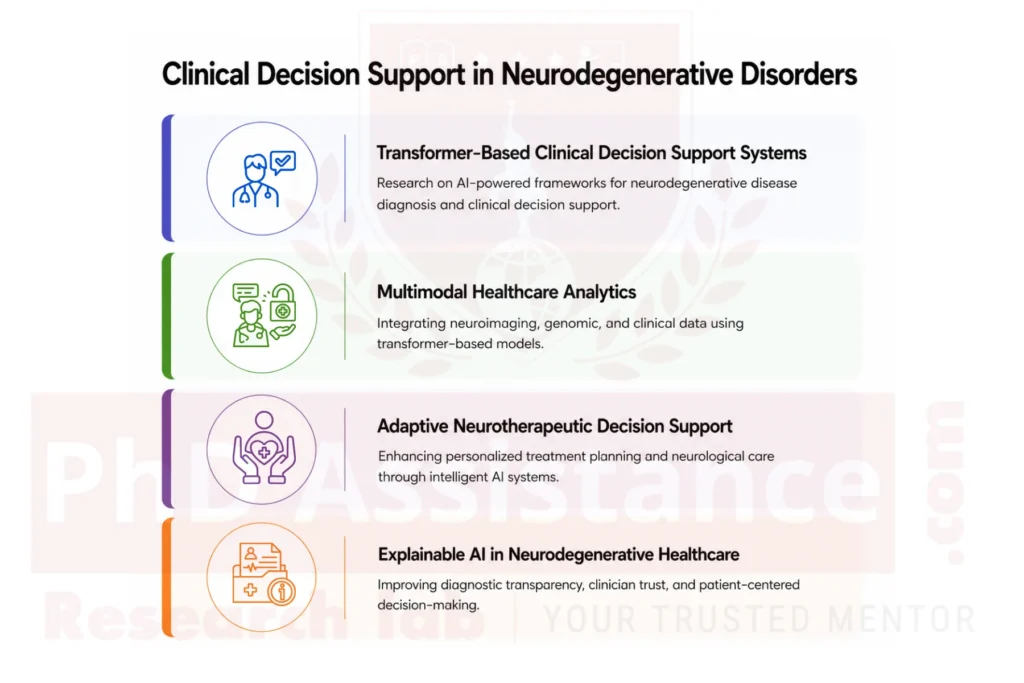
Clinical decision support research titles
Figure 1. Clinical decision support research titles.

Why this area, and why caution

Transformers use attention to model relationships across a whole input sequence (Vaswani et al., 2017), which suits long clinical histories and, in vision transformers, image patches. Interest in early detection has grown since an antibody trial in early Alzheimer's disease reported reduced amyloid and moderately less clinical decline over 18 months, alongside adverse events that need monitoring (van Dyck et al., 2023). Earlier and more accurate identification of eligible patients has become a practical question.

The evidence base for AI in medicine also carries warnings. A systematic review of deep learning in medical imaging found that few studies validated models externally and reporting was often poor (Liu et al., 2019), and a review of studies comparing AI with clinicians found few randomised trials, high risk of bias and frequent overclaiming (Nagendran et al., 2020). Build those lessons into the title.

Theme 1: Multimodal prediction of progression

Combining imaging, genetics and clinical scores is attractive because each captures a different part of the disease process. The risk is a model that fits one cohort very well and fails elsewhere. TRIPOD+AI sets out what a prediction model study must report (Collins et al., 2024), and PROBAST+AI gives the criteria examiners and reviewers will use to judge risk of bias (Moons et al., 2025).

Theme 1 titles: multimodal and longitudinal prediction
Dissertation titlePossible research questionLikely design and dataWhy it matters now
Transformer-based fusion of MRI, genetic and cognitive data to predict progression from mild cognitive impairment to Alzheimer's dementia: development and external validationDoes multimodal fusion predict three-year progression better than imaging alone or a regression model using the same clinical variables?Retrospective cohort from a research database such as ADNI for development; a second cohort for external validation; discrimination and calibration reportedEarly identification matters more now that disease-modifying treatment is available (van Dyck et al., 2023)
Predicting medication response in Parkinson's disease from longitudinal clinical records with transformer sequence modelsCan a sequence model of visits, medications and motor scores predict response to dose changes better than a simpler model?Retrospective cohort from a movement disorders clinic or registry; temporal validation; clinician review of error casesTreatment decisions in Parkinson's disease rest on repeated visits that sequence models can represent (Vaswani et al., 2017)

Always include a simple baseline. If a well-specified regression model performs as well, that is a finding, and it changes what a clinic should adopt.

Theme 2: Early detection from neuroimaging

Imaging titles are the most feasible because public datasets exist, but they are also the most crowded. A contribution usually comes from a clear comparison, a hard test set or a label-efficient method. Diagnostic accuracy studies should follow STARD-AI (Sounderajah et al., 2025).

Theme 2 titles: imaging-based detection
Dissertation titlePossible research questionLikely design and dataWhy it matters now
Hybrid CNN-transformer models for early detection of Alzheimer's disease on structural MRI: a comparison with convolutional baselines on an external test setDoes a hybrid architecture improve sensitivity at a fixed specificity over a CNN baseline when tested on scans from a different scanner population?Public MRI datasets for training; an independent cohort for testing; subject-level splits to prevent leakageFew imaging AI studies test models externally (Liu et al., 2019)
Self-supervised pre-training of vision transformers for Alzheimer's disease classification with limited labelled MRIHow much labelled data does self-supervised pre-training save to reach the accuracy of a fully supervised model?Learning-curve experiments at several label fractions; repeated runs with confidence intervalsExpert labels are costly, so label efficiency is a practical contribution (Sounderajah et al., 2025)

Two design details decide whether an imaging result will survive examination. First, split by patient, not by scan or slice: when images from the same person appear in both training and test sets, accuracy is inflated. Second, describe how the test population differs from the training one (scanner, site, age and disease stage), because a model that has only seen research-grade scans may behave differently on routine clinical images. Report sensitivity and specificity with confidence intervals at a threshold chosen before testing.

Theme 3: From model to decision support

A model only becomes decision support when clinicians use it. DECIDE-AI describes how to report the early clinical evaluation of AI decision support, including human factors and how users interact with the system (Vasey et al., 2022). Explanations are part of that interaction, but explanation methods differ in what they show and how faithful they are (Chaddad et al., 2023).

Theme 3 title: decision support in use
Dissertation titlePossible research questionLikely design and dataWhy it matters now
Clinician evaluation of reports generated by a vision transformer and large language model pipeline for dementia imagingDo neurologists and radiologists judge generated explanatory reports accurate and useful, and do the reports change their confidence or decisions on test cases?Reader study with clinicians on a curated case set; error analysis of generated text; DECIDE-AI reportingHuman factors decide whether decision support is used safely (Vasey et al., 2022)

How to test a title before you commit

Use the FINER criteria: feasible, interesting, novel, ethical and relevant (Hulley et al., 2013). In this field feasibility turns on data. Public cohorts require an application and have use conditions; clinical records need ethics approval and data governance agreements, which can take months. Decide which reporting guideline applies (TRIPOD+AI for prediction, STARD-AI for diagnostic accuracy, DECIDE-AI for early clinical evaluation) and plan your analysis to meet it.

For the wider process, see how to choose a PhD topic, how to select a PhD topic and PhD topic selection support. Other clinical AI titles are on the early sepsis detection titles page.

Common mistakes

  • Calling a classifier trained on one public dataset a clinical decision support system.
  • Splitting scans rather than patients between training and test sets, which leaks information.
  • Reporting accuracy without calibration, confidence intervals or an external test set.
  • Comparing a transformer only with weak baselines.
  • Treating an attention map or generated text as a verified explanation.

Key takeaways

Your next step

Want to apply this to your own study?

  1. 1Tell us your topic, data and deadline
  2. 2A subject mentor reviews your work with you
  3. 3You get a plan and a quote
PhD topic selection

References

  1. Chaddad, A., Peng, J., Xu, J., & Bouridane, A. (2023). Survey of explainable AI techniques in healthcare. Sensors, 23(2), 634. https://doi.org/10.3390/s23020634
  2. Collins, G. S., Moons, K. G. M., Dhiman, P., Riley, R. D., Beam, A. L., Van Calster, B., Ghassemi, M., Liu, X., Reitsma, J. B., van Smeden, M., Boulesteix, A.-L., Camaradou, J. C., Celi, L. A., Denaxas, S., Denniston, A. K., Glocker, B., Golub, R. M., Harvey, H., Heinze, G., . . . Logullo, P. (2024). TRIPOD+AI statement: Updated guidance for reporting clinical prediction models that use regression or machine learning methods. BMJ, 385, e078378. https://doi.org/10.1136/bmj-2023-078378
  3. Hulley, S. B., Cummings, S. R., Browner, W. S., Grady, D. G., & Newman, T. B. (2013). Designing clinical research (4th ed.). Wolters Kluwer Health/Lippincott Williams & Wilkins. https://search.worldcat.org/title/830019201
  4. Liu, X., Faes, L., Kale, A. U., Wagner, S. K., Fu, D. J., Bruynseels, A., Mahendiran, T., Moraes, G., Shamdas, M., Kern, C., Ledsam, J. R., Schmid, M. K., Balaskas, K., Topol, E. J., Bachmann, L. M., Keane, P. A., & Denniston, A. K. (2019). A comparison of deep learning performance against health-care professionals in detecting diseases from medical imaging: A systematic review and meta-analysis. The Lancet Digital Health, 1(6), e271–e297. https://doi.org/10.1016/S2589-7500(19)30123-2
  5. Moons, K. G. M., Damen, J. A. A., Kaul, T., Hooft, L., Andaur Navarro, C., Dhiman, P., Beam, A. L., Van Calster, B., Celi, L. A., Denaxas, S., Denniston, A. K., Ghassemi, M., Heinze, G., Kengne, A. P., Maier-Hein, L., Liu, X., Logullo, P., McCradden, M. D., Liu, N., . . . van Smeden, M. (2025). PROBAST+AI: An updated quality, risk of bias, and applicability assessment tool for prediction models using regression or artificial intelligence methods. BMJ, 388, e082505. https://doi.org/10.1136/bmj-2024-082505
  6. Nagendran, M., Chen, Y., Lovejoy, C. A., Gordon, A. C., Komorowski, M., Harvey, H., Topol, E. J., Ioannidis, J. P. A., Collins, G. S., & Maruthappu, M. (2020). Artificial intelligence versus clinicians: Systematic review of design, reporting standards, and claims of deep learning studies. BMJ, 368, m689. https://doi.org/10.1136/bmj.m689
  7. Sounderajah, V., Guni, A., Liu, X., Collins, G. S., Karthikesalingam, A., Markar, S. R., . . . Ashrafian, H. (2025). The STARD-AI reporting guideline for diagnostic accuracy studies using artificial intelligence. Nature Medicine, 31(10), 3283–3289. https://doi.org/10.1038/s41591-025-03953-8
  8. van Dyck, C. H., Swanson, C. J., Aisen, P., Bateman, R. J., Chen, C., Gee, M., Kanekiyo, M., Li, D., Reyderman, L., Cohen, S., Froelich, L., Katayama, S., Sabbagh, M., Vellas, B., Watson, D., Dhadda, S., Irizarry, M., Kramer, L. D., & Iwatsubo, T. (2023). Lecanemab in early Alzheimer's disease. New England Journal of Medicine, 388(1), 9–21. https://doi.org/10.1056/NEJMoa2212948
  9. Vasey, B., Nagendran, M., Campbell, B., Clifton, D. A., Collins, G. S., Denaxas, S., . . . DECIDE-AI expert group. (2022). Reporting guideline for the early-stage clinical evaluation of decision support systems driven by artificial intelligence: DECIDE-AI. Nature Medicine, 28, 924–933. https://doi.org/10.1038/s41591-022-01772-9
  10. Vaswani, A., Shazeer, N., Parmar, N., Uszkoreit, J., Jones, L., Gomez, A. N., Kaiser, Ł., & Polosukhin, I. (2017). Attention is all you need. In Advances in Neural Information Processing Systems 30 (pp. 5998–6008). Curran Associates. https://proceedings.neurips.cc/paper_files/paper/2017/file/3f5ee243547dee91fbd053c1c4a845aa-Paper.pdf

How to cite this article

Choose your referencing style, then copy. Check your university's or journal's guide for local variations.

PhD Research Lab Academy. (2026, June 8). Transformer-based clinical decision support in neurodegenerative disorders: dissertation titles on multimodal prediction, early detection and explainable support. PhD Research Lab. https://www.phdassistance.com/title/clinical-decision-support-research-help/

PhD Research Lab Academy. “Transformer-based Clinical Decision Support in Neurodegenerative Disorders: Dissertation Titles on Multimodal Prediction, Early Detection and Explainable Support.” PhD Research Lab, 8 June 2026, www.phdassistance.com/title/clinical-decision-support-research-help. Accessed [access date].

PhD Research Lab Academy (2026) Transformer-based clinical decision support in neurodegenerative disorders: dissertation titles on multimodal prediction, early detection and explainable support. PhD Research Lab. Available at: https://www.phdassistance.com/title/clinical-decision-support-research-help/ (Accessed: [access date]).

PhD Research Lab Academy. “Transformer-based Clinical Decision Support in Neurodegenerative Disorders: Dissertation Titles on Multimodal Prediction, Early Detection and Explainable Support.” PhD Research Lab. June 8, 2026. https://www.phdassistance.com/title/clinical-decision-support-research-help.

PhD Research Lab Academy, ‘Transformer-based Clinical Decision Support in Neurodegenerative Disorders: Dissertation Titles on Multimodal Prediction, Early Detection and Explainable Support’ (PhD Research Lab, 8 June 2026) <https://www.phdassistance.com/title/clinical-decision-support-research-help> accessed [access date].

PhD Research Lab Academy. Transformer-based clinical decision support in neurodegenerative disorders: dissertation titles on multimodal prediction, early detection and explainable support [Internet]. PhD Research Lab; 2026 Jun 8 [cited [access date]]. Available from: https://www.phdassistance.com/title/clinical-decision-support-research-help/

PhD Research Lab Academy, “Transformer-based clinical decision support in neurodegenerative disorders: dissertation titles on multimodal prediction, early detection and explainable support,” PhD Research Lab, June 8, 2026. [Online]. Available: https://www.phdassistance.com/title/clinical-decision-support-research-help. [Accessed: [access date]].

@online{clinical_decision_support_research_help_2026,
  author = {{PhD Research Lab Academy}},
  title = {{Transformer-based clinical decision support in neurodegenerative disorders: dissertation titles on multimodal prediction, early detection and explainable support}},
  organization = {PhD Research Lab},
  date = {2026-06-08},
  url = {https://www.phdassistance.com/title/clinical-decision-support-research-help},
  urldate = {[access date]}
}

This article is for learning. Use it to understand the method and cite the original sources above in your own work; do not copy or submit it as your own.

Transformer-based clinical decision support in neurodegenerative disordersNeed help applying it to your study?
PhD topic selection