
- / Title
Generative Artificial Intelligence and Clinical Decision Intelligence in Healthcare Transformation DissertationTitles | phdassistance.com
Info: Generative Artificial Intelligence and Clinical Decision Intelligence in Healthcare Transformation DissertationTitles | phdassistance.com
Published: 01 th July 2026 in Generative Artificial Intelligence and Clinical Decision Intelligence in Healthcare Transformation DissertationTitles | phdassistance.com
Share this:
Related Services
Introduction
There have been impressive developments in the field of healthcare over the last couple of years, such as the application of AI in healthcare, intelligent data analytics, and prediction techniques that have led to changes in the diagnosis process, treatment plan development, and healthcare management. There have been impressive developments in healthcare over the recent period, including AI in healthcare, intelligent data analytics, and predictions that have changed the diagnosis process, treatment plans, and healthcare management. However, more recently, the concept of Generative Artificial Intelligence has developed, which allows generating contextually aware clinical insights, documenting in medicine, and providing personalised patient care using advanced learning models. However, there are some challenges related to the use of Artificial Intelligence that should be addressed to develop a computational framework.
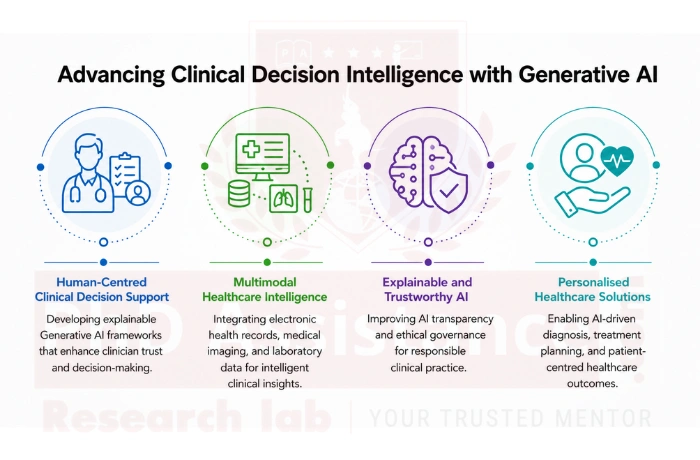
Proposed PhD Title 1: Human-Centered Clinical Decision Intelligence Frameworks Using Generative AI in Healthcare
The fast pace of development of Generative AI is changing how healthcare practitioners interpret information about patients and make decisions about their care. Progress in developing large language models, foundation models, and intelligent clinical assistants allows healthcare organisations to increase the effectiveness of diagnostics, patient monitoring, and work process efficiency. In contrast to traditional Clinical Decision Support Systems (CDSS), the use of generative AI makes it possible to analyse structured and unstructured clinical data at the same time, making recommendations contextually appropriate and thus contributing to better decision-making. Moreover, combining CDI with explainability of AI facilitates the understanding and use of recommendations by healthcare professionals. According to Alruwaili et al. (2025), although generative AI offers much in terms of helping neonatal nurses and improving AI in healthcare Practice, its successful application is possible only through trustworthy and explainable approaches focused on people.
Problem Statement:
Most current Generative AI in Healthcare systems are biased towards optimising predictive performance rather than improving clinician-interaction, trust, and workflow integration. The systems are intelligent at predicting outcomes, but they offer recommendations with insufficient explanation and without understanding clinician expertise, which has poor transparency, acceptance and uptake into clinical practice.
Research Gap:
Few approaches exist in the literature in an integrated format that has brought together explainable AI, trust between clinicians, adaptive support systems, and optimised workflow across an entire health ecosystem.
Research Question:
Is Generative AI able to improve clinical decision-making and physicians’ trust in the medical system?
Outcome:
This research study is intended to propose an explainable and human-centred Clinical Decision Intelligence framework to boost clinical trust, support workflow-centric adoption, encourage responsible and transparent decision-making, and provide intelligent medicinal solutions.
Reference:
Alruwaili, A. N., Alshammari, A. M., Alhaiti, A., Elsharkawy, N. B., Ali, S. I., & Ramadan, O. M. E. (2025). Neonatal nurses’ experiences with generative AI in clinical decision-making: A qualitative exploration in high-risk NICUs. BMC Nursing, 24, 386.
Proposed PhD Title 2. Dynamic Graph Neural Networks with Explainable AI for Real-Time Multimodal Data Analytics in Healthcare Systems
The recent developments in Generative AI have made substantial improvements to CDSS by allowing clinicians to access context-aware recommendations through LLMs. The intelligent systems help healthcare practitioners in analysing complex information of the patient, predicting clinical risks, and making evidence-based decisions on treatment. Additionally, the development of Conversational AI and Explainable Machine Learning has made clinical decision-making even more advanced and allows physicians to communicate with AI in the form of natural language and improve decision transparency. Nevertheless, for effective utilisation of AI in healthcare Practice, healthcare practitioners should be able to understand, trust, and integrate AI recommendations into their workflow. As mentioned in the study by Rajashekar (2025), even though clinical decision support using LLMs shows high promise in terms of diagnosis, there are still several challenges with usability, trust, transparency, workflow integration, and human-AI interaction that hinder clinical implementation of AI.
Problem Statement:
Present LLM-based CDSSs focus more on the accuracy of predictions without much contribution to explainability, interaction with clinicians, and adaptability in the workflow. Clinicians have often faced challenges in comprehending the recommendations made by AI tools.
Research Gap:
However, current research very seldom brings all these components together to form a single clinical decision-making paradigm that can be applied in real healthcare practice.
Research question:
Can an explainable Generative AI improve Clinical Decision-making and physicians’ decision-making?
Outcome:
The proposed research will formulate a Physician-Centric Clinical Decision-making system that facilitates better cooperation between humans and AI, builds clinicians’ trust, promotes transparency in clinical decision-making and provides Reliable Intelligent Healthcare Solutions.
Reference:
Rajashekar, N. (2025). Generative Artificial Intelligence in Clinical Decision Support – Quantitative and Qualitative Analyses. Yale University School of Medicine.
Proposed PhD Title 3. Multimodal Generative AI Frameworks for Clinical Decision Intelligence and Intelligent Healthcare Solutions
The latest developments in Generative AI have revolutionised the way Clinical Decision Support Systems work through the inclusion of multimodal data from healthcare such as electronic health records, medical images, laboratory results, and genomics. The development of RAG (Retrieval Augmented Generation), Digital Twins, and multimodal large language models has enhanced the capability of the intelligent systems. These developments are transforming Clinical Decision-Making by aiding clinicians in diagnosis, personalised treatment planning, and healthcare analytics. According to Bapatla (2025), despite having excellent capabilities of multimodal Generative AI in AI for Clinical Practice, healthcare systems have difficulties with the integration of diverse types of clinical data, interoperability, and the provision of intelligent recommendations in line with clinical practice.
Problem Statement:
Existing Generative AI require separate multimodal Healthcare data inputs in isolated models. These do not facilitate broader clinical decision-making. Also, these cannot deliver seamless interoperability, clinical workflow, or an intelligent search through a knowledge repository.
Research Gap:
There has been limited research in the development of a single Clinical Decision-making framework that combines all three: Retrieval-Augmented Generation, Digital Twins, and intelligent clinical workflow optimization in a single healthcare environment.
Research Question:
Can multimodal Generative AI improve Clinical Decision-making in healthcare?
Outcome:
The proposed research will provide the development of a multimodal Clinical Decision-making paradigm for integration of various healthcare data, improvement of personalisation of the clinical decision-making process, optimisation of workflow, and creation of intelligent solutions.
Reference:
Bapatla, S. K. S. (2025). Generative AI in Clinical Decision Support: From Diagnosis to Personalized Care Pathways. Sarcouncil Journal of Engineering and Computer Sciences, 4(7), 194–203.
Proposed PhD Title 4. Interpretable Graph-Based Machine Learning Frameworks for Multimodal Clinical Outcome Prediction Using Explainable AI
The fast pace of advancement of Generative AI in medicine is bringing about a paradigm shift in clinical practice through personalisation in treatment planning, predictions, medical imaging, and intelligent clinical decision support. Foundation models and large language models have contributed towards the improvement of healthcare by recommending patient-centric strategies, predicting diseases, and documenting clinical cases. These advancements have improved Clinical intelligence, which is helping healthcare practitioners make faster and evidence-based decisions with reduced administrative tasks. According to Bhuyan et al. (2025), despite the immense potential offered by Generative AI in the healthcare industry, there have been shortcomings. They have seen these technologies being implemented in a piecemeal manner without any consideration for creating adaptive structures for Intelligent Solutions for AI in Clinical Practice.
Problem Statement:
Existing Generative AI in medicine systems focuses on singular clinical workflows for tasks like clinical decision, notes generation or treatment generation; it can’t enable personalisation of care, learning and Clinical Intelligence in complex health settings.
Research Gap:
Current studies fail to incorporate an adaptive model for Clinical Decision Intelligence that will integrate personalised treatment suggestions, predictive analytics, continuous learning, and intelligent workflow optimisation in one healthcare platform.
Research Question:
Can adaptive Generative AI improve personalised Clinical Intelligence?
Outcome:
This research will create an intelligent decision framework that will support personalised medicine, predictive medicine, clinical learning and intelligent solutions to improve patient outcomes and enhance healthcare delivery.
Reference:
Bhuyan, S. S., Sateesh, V., Mukul, N., Galvankar, A., Mahmood, A., Nauman, M., Rai, A., Bordoloi, K., Basu, U., & Samuel, J. (2025). Generative Artificial Intelligence Use in Healthcare: Opportunities for Clinical Excellence and Administrative Efficiency. Journal of Medical Systems, 49(10).
Proposed PhD Title 5. Scalable Explainable Graph Transformer Architectures for Complex Multimodal Data Analytics and Knowledge Integration
Generative AI in medicine is increasing use in Clinical Practice is bringing about transformation in decision-making using intelligent analysis of electronic health records, medical imaging, disease prediction, personalised treatment planning, and drug discovery. Recent developments in Large Language Models and Generative Learning approaches have further improved Clinical Intelligence through the provision of evidence-based and predictive assistance to clinicians. In addition to that, explainable AI and privacy-preserving mechanisms are becoming increasingly necessary for achieving increased transparency in Clinical Practice, while ensuring that sensitive patient data is protected from breaches. As pointed out by Ruan et al. (2025), despite the potential of Generative AI applications, issues surrounding explainability, data privacy, bias, ethical governance, and clinical reliability remain hindrances to its adoption in healthcare systems.
Problem Statement:
Present-day Generative AI in the healthcare system provides highly accurate results, but at the same time, it lacks transparency, privacy, and explainability, which limits its practical use and raises numerous ethical concerns.
Research Gap:
No prior literature presents a consolidated approach to clinical decision-making to incorporate explainable AI, privacy-preserving learning, ethical governance, and trustworthy clinical decision support.
Research Question:
Can explainable Generative AI improve secure Clinical Decision-making?
Outcome:
The suggested research involves the development of an explainable and privacy-preserving Clinical Intelligence framework that would improve transparency, protect the patient’s data, promote ethical use of artificial intelligence, and provide trustworthy Intelligent Solutions.
Reference:
Ruan, X., Deng, Y., Xu, J., Zhang, G., Zhao, J., & Qin, R. (2025). Generative AI Empowering Clinical Decision-Making: A Review of Research from Medical Record Analysis to Treatment Optimisation. Artificial Intelligence and Medicine, 1(1), 40–49.
Need assistance finalising your dissertation topic? Selecting a strong, researchable topic can be challenging — but you don’t have to do it alone.
Our research consultants can help refine your ideas, identify literature gaps, and guide you toward a topic that aligns with current academic trends and your programme requirements.
Contact us to begin one-on-one topic development and refinement with PhdAssistance.com Research Lab.
Share this:
Cite this work
PhDAssistance. (n.d.). Virtual Influencers Dissertation Titles Retrieved 30th January 2026, from https://phdassistance.com/title/virtual-influencers/
“Virtual Influencers Dissertation Titles, https://phdassistance.com/title/virtual-influencers/
“Virtual Influencers Dissertation Titles” PhDAssistance, PhDAssistance, Tuesday, January 30th,2026.
PhDAssistance, n.d. Virtual Influencers Dissertation Titles[Online]. Available at: https://phdassistance.com/title/virtual-influencers/ [Accessed January 30th, 2026].
PhDAssistance. Virtual Influencers Dissertation Titles[Internet]. PhDAssistance; [cited 2026 January 30th]. Available from: https://phdassistance.com/title/virtual-influencers/
PhDAssistance (n.d.).
Virtual Influencers Dissertation Titles. Retrieved January 30th, 2026, from https://phdassistance.com/title/virtual-influencers/
PhDAssistance, Virtual Influencers Dissertation Titles(PhDAssistance, n.d. January 30th accessed 2026.
Study Resources
Free resources to assist you with your university studies!