
Neuromorphic Computing and AI-Powered Brain Disorder Diagnostics Dissertation Topics I phdassistance.com
Info: Neuromorphic Computing and AI-Powered Brain Disorder Diagnostics Dissertation Topics I phdassistance.com
Published: 24th june in Neuromorphic Computing and AI-Powered Brain Disorder Diagnostics Dissertation Topics I phdassistance.com
Share this:
Related Services
Our academic writing and marking services can help you
Introduction
Neuromorphic computing is gaining interest in the field of neurohealthcare as computer architectures based on biological neural networks can analyse the vast quantity of complex brain data in an efficient and effective manner. Today, there is immense interest for AI in Brain Disorder Diagnosis as we continue to gain a better understanding of neural networks for neuroimaging, EEG signal analysis, analysis of biomarkers and of clinical data and electronic records to allow accurate analysis and interpretation of patient data that can ultimately aid in early diagnosis and monitoring of neurological disorders like Alzheimer’s, Parkinson’s disease, epilepsy and various cognitive deficits. However, not many of the works have addressed issues such as their successful integration into clinical practices, scalability issues in real-world diagnostics, as well as issues of interpretation and clinical validation, etc. With more healthcare becoming data-driven, frameworks for enabling large-scale neuromorphic AI applications for its successful clinical adoption are needed.
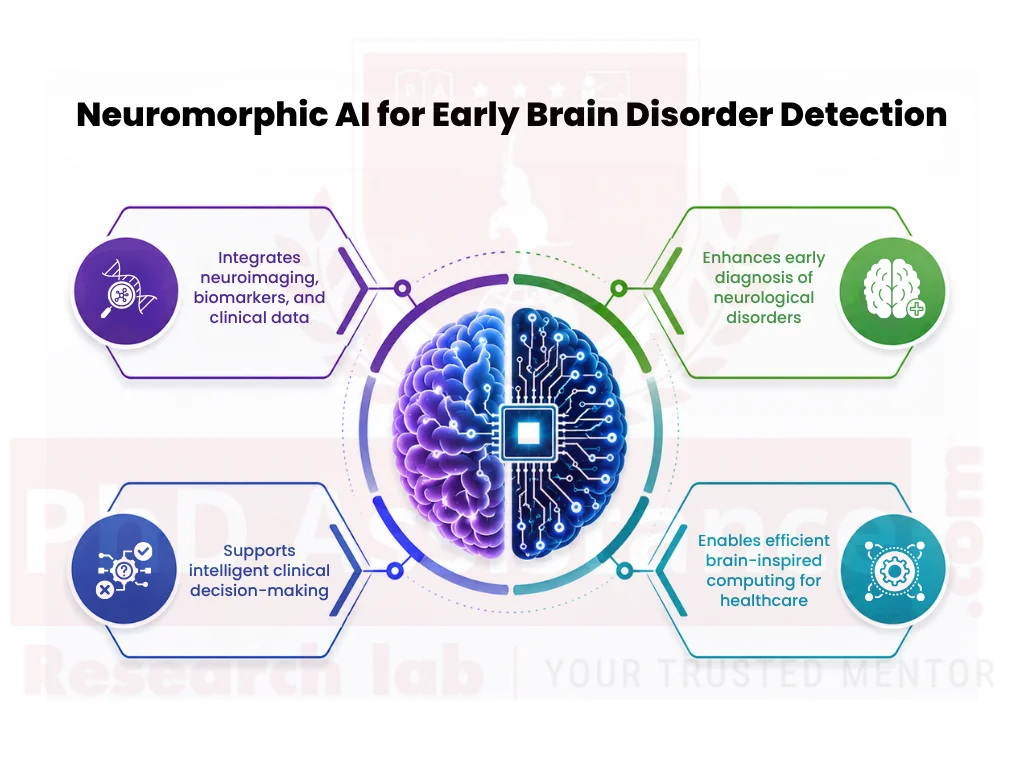
Proposed PhD Topic 1: Neuromorphic AI Frameworks for Early Brain Disorder Detection Through Multimodal Neuroimaging and Biomarker Fusion
Background Context:
Neuromorphic and Disorder Detection Using AI: The Role of Emerging Technologies. The growth has accelerated, and the tools to provide new treatments and diagnose neurological and neurodegenerative diseases based on neuroimaging, biomarker and clinical data are becoming easier (Huang & Shu, 2025). With growing concerns about integrating multimodal imaging such as MRI, PET and EEG and using Artificial Intelligence, there is increased precision, accurate diagnosis and individualised diagnosis. The existing AI tools use conventional deep learning, which consumes excessive time, space, and data. But Neuromorphic AI Systems are one of the latest developments in AI for Healthcare, which can provide many solutions for this and is based on the biological processes happening in the human brain. Integrating them can lead to better methods for the detection of the disease at earlier stages, can help discover markers for a disease and enable intelligent clinical decision-making.
PhD-Level Verification:
Existing works focus on multimodal imaging and AI diagnostics separately, and research on integrating neuromorphic computing architectures, multimodal neuroimaging, biomarker analytics, and clinical decision support into a single diagnostic paradigm is sparse. Existing neuromorphic systems’ validation in real-world scenarios for the early detection of neurological diseases is lacking.
Research Questions:
- In what ways do Neuromorphic AI methods outclass conventional deep learning models in Neuromorphic AI for Detecting Neurological Disorder Using AI?
- In what ways does the integration of multimodal neuroimaging and biomarkers allow us to better diagnose neurological disorders?
- Can we employ neuromorphic architectural concepts to implement fast diagnostic decision-making on clinical cases of neurological disease?
PhD-Level Contributions:
Suggested Readings:
Zhou, J., et al. (2025). Artificial intelligence-driven transformative applications in disease diagnosis technology.
Proposed PhD Topic 2: Quantum Decision-Support Frameworks for Autonomous Aerospace Navigation and Mission Optimisation
Background Context:
As neurological disorders are becoming ever more complicated, the demand for smart, customised treatment methods has never been higher. According to the experts in Artificial Intelligence in Healthcare at Butola et al (2026), AI is being successfully implemented for analysis of neuroimaging, interpretation of EEG and the prediction of seizures and treatment plan generation. However, at present, most of the neuromodulation approaches are driven by static treatment protocols, and these fail to adjust to changes as and when they occur within patients’ neurological condition. Here’s where there is a real breakthrough, since these systems learn in real-time from neural data and adjust interventions as and when required by brain response. Integrating Neuromorphic Computing into Machine Learning for Brain Disorders can enable smart treatment delivery in real-time, customised neurological support as well as more efficient chronic treatment management strategies.
PhD-Level Verification:
Existing literature examines AI-driven neuromodulation and neurological rehabilitation separately. There is limited research investigating how neuromorphic computing can continuously adapt stimulation parameters based on real-time neural feedback. Moreover, explainable and clinically validated adaptive frameworks remain underdeveloped.
Research Questions:
PhD-Level Contributions:
Suggested Readings:
Calderone, A., et al. (2025). Artificial Intelligence-Driven Neuromodulation in Neurodegenerative Disease.
Proposed Dissertation topic 3: Explainable Neuromorphic AI for Precision Brain Disorder Detection Using Multimodal Neuroimaging Data
Background Context:
Machine Learning in Brain Disorders has recently helped clinicians interpret mass-scale neuroimaging data for prognosis of neurological illness at the earliest stage. “As the research progresses to developing optimal diagnostic techniques in this field, the multimodal imaging methods, i.e., using EEG, PET, MRI, and functional images, can demonstrate enhanced performance compared to a single-modal approach, for both predictive modelling and individualised treatments,” according to Huang and Shu (2025). However, the systems that employ Brain Disorder Detection using AI often are difficult for people to understand because the black-box manner makes their use for clinical purposes not feasible. In this paper, we explore explainable neuromorphic systems that mimic the biologic architectures to process complex information on the neurologic datasets to improve interpretability and computational efficiency compared with standard deep learning architectures. Explainable neuromorphic computing combined with analysis of the multimodality of neuroimaging datasets may assist in more precise and understandable system design for neurologic care.
PhD Level Verification:
A lot of research is concentrating on multimodal AI predictive models and ignores explainability, interpretability and the clinician’s trusting abilities. There is an urgent need for explainable neuromorphic frameworks that enable integration of different neuroimaging modalities with transparent decision support.
Research Questions:
PhD-Level Contributions:
Suggested Readings:
Huang, W., & Shu, N. (2025). AI-powered integration of multimodal imaging in precision medicine for neuropsychiatric disorders.
Proposed Dissertation Topic 4: Energy-Efficient Neuromorphic Deep Learning Architectures for Real-Time Brain Disorder Detection and Prognostic Modelling
Background Context:
Increased incidence of neurological diseases drives the development of smart diagnostic systems for supporting clinical real-time decisions. Butola et al. (2026) report that AI-powered real-time decision-making support in clinical care is gaining ground with applications to identify cognitive impairment, dementia, Parkinson’s disease, and epilepsy based on real-time neurological data. Traditional AI models perform well in detection but require a significant amount of computational power, making them unsuitable for mobile health care systems or systems for remote healthcare. Neuromorphic AI methods, by imitating biological nervous system computation functions, may allow for energy-efficient and high-performance computations. Combining Machine Learning and Neuromorphic computing in Brain Disorders can potentially be a powerful means of identifying disorders, forecasting progression, and creating predictive models at scale.
PhD-Level Verification:
Studies so far focus only on their diagnostic performance, while neglecting their computational efficiency, scalability, and real-time deployment. There are few studies concentrating on the combination of neuromorphic computing with prognostic models and the time course of neurological changes.
Research Questions:
Contributions at the PhD-Level:
Suggested Readings:
Butola, M., et al. (2026). Artificial Intelligence as an Emerging Technique in the Contemporary Management of Neurological Disorders.
Proposed Dissertation Topic 5: Neuromorphic Machine Learning Frameworks for Early Neurodegenerative Disease Biomarker Discovery and Diagnosis
Background Context:
The impact of neurodegenerative diseases-including Alzheimer disease, Parkinson disease, and the like-on individual outcomes highlights the importance of early diagnosis and treatment. Researchers by Pal et al (2025) note that AI in Health Care has made advances in its applications across a spectrum of analysis domains (e.g., neuroimaging, genomic, biomarker, patient-history data) and can facilitate earlier diagnosis. Machine learning applied to brain disorder research has increased biomarker discovery efforts, yet there remain questions about biomarker performance characteristics (e.g., reliability, generalizability, clinical verification). However, Neuromorphic AI methods offer a biologically inspired approach to computation, which, given their potential for efficiently modelling the intricate networks of the nervous system, could augment biomarker analyses, potentially leading to robust discovery efforts that inform effective use of AI for brain disorder detection.
PhD-Level Verification:
Few of these studies deal with either biomarker discovery alone or AI-based diagnostic methods alone. Little literature deals with the discovery of biomarkers and the use of neuromorphic technology for early detection of neurodegenerative disorders.
Research Questions:
PhD-Level Contributions:
Suggested Readings:
Pal, S., et al. (2025). Revolutionizing Early Diagnosis: The Role of Artificial Intelligence in Neurodegenerative Disorders.
Need assistance finalising your dissertation topic? Selecting a strong, researchable topic can be challenging — but you don’t have to do it alone.
Our research consultants can help refine your ideas, identify literature gaps, and guide you toward a topic that aligns with current academic trends and your programme requirements.
Contact us to begin one-on-one topic development and refinement with PhdAssistance.com Research Lab.
Share this:
Cite this work
PhDAssistance. (n.d.). Cybersecurity in business Dissertation Topics Retrieved January 28th, from https://phdassistance.com/topic/cybersecurity-business/
Jalolova, M., and Musawwir, M. “Cybersecurity in business Dissertation Topics for PhD Scholars.” PhDAssistance, https://phdassistance.com/topic/cybersecurity-business/ Accessed 28th January 2026.
Jalolova, M., and Musawwir, M., n.d. Cybersecurity in business Dissertation Topics for PhD scholars. [online] Available at: https://phdassistance.com/topic/cybersecurity-business/ [Accessed 28th January 2026].
Jalolova M., Musawwir M. Cybersecurity in business Dissertation Topics for PhD scholars [Internet]. PhDAssistance; [cited 2026 28th January]. Available from: https://phdassistance.com/topic/cybersecurity-business/
Jalolova, M., and Musawwir, M. (n.d.). Cybersecurity in business Dissertation Topics for PhD scholars. Retrieved 28th January 2026, from https://phdassistance.com/topic/cybersecurity-business/
Jalolova, M., and Musawwir, M., Cybersecurity in business Dissertation Topics (n.d.) https://phdassistance.com/topic/cybersecurity-business/ accessed 28th January 2026.
Study Resources
Free resources to assist you with your university studies!