

Critical Review: Supervisor Support and Academic Performance in the PhD Journey
March 4, 2026
Critical Review: Perceptions of effectiveness and ethical use of AI tools in academic writing: A study among PhD scholars in India
March 5, 2026How Big Data Analytics is Transforming Financial Research and Decision-Making for Finance PhD Scholars in Switzerland
- March 5, 2026
- Data Analytics
Introduction
The modern financial research landscape uses two criteria of computational power and data handling capacity to evaluate research methods. Switzerland establishes itself as a worldwide banking center which drives fintech progress and wealth management, and capital market operations to create a challenging academic atmosphere for PhD finance students.
The PhD big data analytics support in finance Switzerland has become essential for doctoral candidates who need to create research papers that meet empirical standards and academic publication requirements. PhD Assistance delivers specialised research frameworks that help Swiss finance doctoral candidates to merge extensive financial data with econometric methods and machine learning techniques for their academic work.
Modern research increasingly relies on high-frequency transaction data, cross-border capital flows, derivatives pricing datasets and macroeconomic panel structures. The Big Data Analytics platform enables researchers to use scalable computational frameworks that operate on these datasets to achieve better statistical results and stronger predictive capabilities.
Finance Dissertation Data Analytics Switzerland: Computational Big Data Architectures in Empirical Financial Modelling
Financial research in Switzerland requires advanced computing systems that can process large volumes of data that comes in high-speed and diverse formats. The combination of distributed computing systems with data mining techniques enables doctoral students to create more accurate models of financial markets, which demonstrate volatility clustering, liquidity shocks, systemic contagion and asset price co-movements.
Dissertation research becomes more reproducible through the implementation of scalable analytics pipelines, which also enhance research strength and research findings transparency. Our PhD Big Data Analytics for Finance Switzerland provides a structured workflow implementation, which includes data preprocessing, normalisation, dimensionality reduction and model validation throughout an empirical framework that meets Swiss academic requirements.
Example:
Study: Barunik, J., & Krehlik, T. (2018)
Barunik and Krehlik (2018) present an econometric framework that operates in the frequency domain to assess how financial markets are linked and how systemic market risks develop.
The research uses advanced time-series decomposition techniques to analyse extensive financial data, which demonstrates the operation of spillover effects across three different time periods.
The researchers show their method by using spectral analysis to discover unknown patterns of systemic contagion and market volatility between securities in high-dimensional datasets.
Get the pricing details for the structured big data analytics support at the PhD Assistance, designed to support PhD research scholars in UAE.
Advanced Econometric Integration and Large-Scale Financial Dataset Optimisation
The finance dissertation needs to prove its econometric analysis through essential data processing, which requires exceptional data processing standards. The doctoral committees in Switzerland require researchers to provide explicit information about their model selection process and statistical methods used to estimate parameters, together with all tests conducted for model stability.
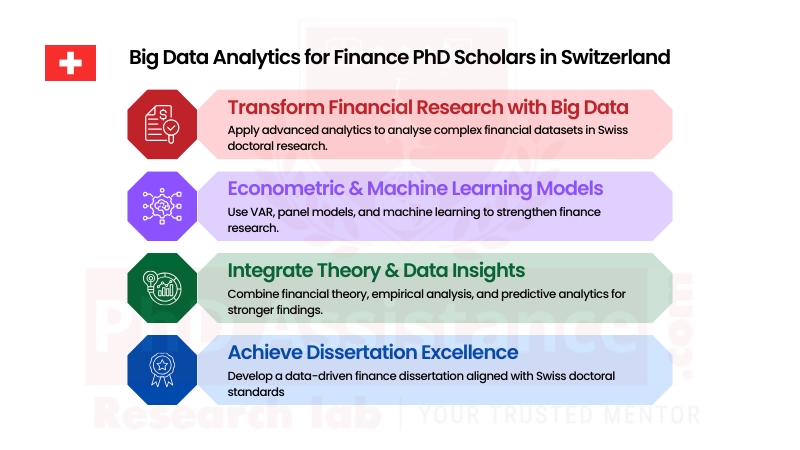
The Finance dissertation data analytics Switzerland support enables scholars to apply advanced econometric techniques, which include vector autoregression (VAR), generalised method of moments (GMM) and fixed and random effects panel modelling and Monte Carlo simulations through their big data systems.
We solve dataset architecture issues, which include heteroskedasticity, autocorrelation, multicollinearity and endogeneity problems, to establish empirical validity, which enables results to be replicated. The structured integration process improves both theoretical connections and the accuracy of quantitative measurements.
High-Dimensional Financial Data Structuring and Statistical Inference Validation
The current financial datasets require analysis because they contain numerous dimensions, and their data points demonstrate multiple patterns of behaviour, which include both sudden changes and permanent structural transformations. Researchers encounter difficulties when they try to create stable models that can handle the unpredictable nature of market movements.
The Financial data analysis support Switzerland team in building analytical systems that achieve statistical coherence and match established theoretical frameworks. Our team helps researchers test their hypotheses through maximum likelihood estimation, bootstrapping, cross-validation and sensitivity analysis methods.
The research methodology requires diagnostic testing, residual analysis and goodness-of-fit evaluation to achieve full research integrity. The research hypothesis provides the framework that guides all empirical outcomes to connect econometric models with their theoretical explanations.
Machine Learning-Driven Predictive Analytics in Quantitative Finance
The field of predictive analytics establishes a new research method that surpasses the capabilities of explanatory econometrics. The field of quantitative finance research uses predictive modelling to improve its ability to forecast future events and develop financial forecasts.
We provide support to doctoral researchers in predictive analytics in finance Switzerland through the implementation of supervised and unsupervised learning methods, which include random forests and gradient boosting machines, support vector regression and deep neural networks.
The models enable market participants to forecast both market volatility and credit default probability and asset return distributions, and macroeconomic shocks with higher accuracy. The integration of algorithmic learning methods enables scholars to showcase their computational skills while creating research innovations that meet international finance research standards.
Example:
Study: Study: Gu, S., Kelly, B., & Xiu, D. (2020)
The researchers show through their study that machine learning methods achieve superior outcomes for asset price predictions compared to standard linear factor models.
The authors use random forests, neural networks and boosting methods to predict cross-sectional stock returns by analysing large-scale U.S. equity datasets.
The research shows that machine learning methods achieve superior results compared to traditional econometric methods when they need to detect nonlinear relationships and handle multiple predictor variables.
Empirical Validation Frameworks for Data-Driven Financial Research
The foundation of modern economics and finance academic research depends on empirical credibility as its essential element. Data-driven financial research in Switzerland needs validation systems that establish connections between theoretical claims and quantitative proof.
- Professional Financial data analysis support Switzerland
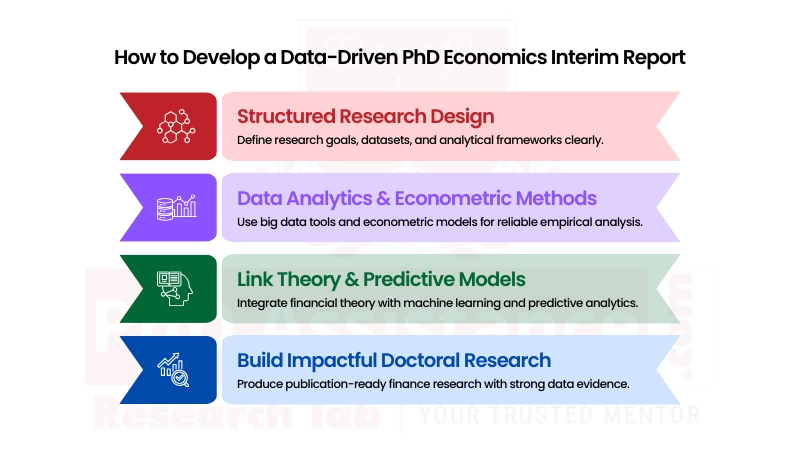
The process requires developing data pipelines that can be reproduced and testing different model versions, conducting tests with new data and making the parameter estimation process accessible to others.
At PhD Assistance, we assist scholars in translating complex statistical findings into academically structured interpretations that align directly with research objectives. The combination of theoretical foundations with methodological approaches and empirical proof establishes stronger support for dissertation defence and publication processes.
Strategic Relevance of Big Data Methodologies in Swiss Doctoral Finance Programs
Swiss universities maintain their research programs through developing new research methods, using quantitative research techniques, and building international research capabilities. Doctoral scholars are expected to demonstrate proficiency in computational finance, advanced econometrics, and scalable analytics frameworks.
The Big Data methodologies offer essential components that enable researchers to conduct precise financial analysis of large datasets. Dissertations that incorporate scalable data architectures together with predictive modelling tools enable scholars to achieve better academic evaluation results and higher chances of international publication. Our specialised PhD Big Data Analytics Support in Switzerland ensures scholars meet these expectations with technical rigour and structured guidance.
Comprehensive Analytical and Dissertation Structuring Support
PhD Assistance delivers research-driven, confidential, and technically advanced support tailored to finance scholars in Switzerland. Our expertise covers the complete range of big data architecture development, econometric model optimization and predictive analytics integration, which we deliver through our structured dissertation drafting and journal-ready formatting services.
We guide researchers through every stage, starting from dataset acquisition through preprocessing model specification and validation diagnostics to their interpretation of econometric outputs and academic presentation. Our approach maintains compliance with Swiss institutional requirements while demonstrating adherence to international research standards.
Conclusion
The integration of computational analytics into financial research has established new methodological standards that finance PhD scholars in Switzerland must follow. Big Data Analytics improves analytical strength and prediction accuracy in academic research through its use in extensive econometric studies and machine learning-enabled forecasting methods.
Scholars use financial dissertation data analytics from Switzerland to build empirical foundations, which they use to test their theoretical models with quantitative data while establishing their research presence in international academic standards. The development of predictive modelling combined with scalable analytics will determine the future of Data-driven financial research Switzerland.
Book a Free Consultation for expert Big Data Analytics Support in Finance, Switzerland and transform complex financial datasets into high-impact, publication-ready research.
References
- Barunik, J., & Krehlik, T. (2018). Measuring the frequency dynamics of financial connectedness and systemic risk. Journal of Financial Econometrics, 16(2), 271–296. Measuring the Frequency Dynamics of Financial Connectedness and Systemic Risk* | Journal of Financial Econometrics | Oxford Academic
- Gu, S., Kelly, B., & Xiu, D. (2020). Empirical asset pricing via machine learning. The Review of Financial Studies, 33(5), 2223–2273. Empirical Asset Pricing via Machine Learning | The Review of Financial Studies | Oxford Academic
