
Critical review of Bridging biology and technology: the rise of 3D bioprinting advancements in infection research
Introduction
Writing a critical assessment becomes difficult for research scholars because they need to analyse multiple research papers to discover both their strengths and weaknesses, which make up essential components for a precise assessment. The combination of extensive literature management with citation requirements and academic standards creates additional pressure.
The article “Bridging biology and technology: the rise of 3D bioprinting advancements in infection research” shows that new biofabrication methods are creating major changes in biomedical research. The research demonstrates that 3D bioprinting functions as an essential method for infection research because it provides solutions to the drawbacks found in standard 2D cell culture systems and animal testing procedures. The laboratory platforms, which require innovative functions, function as scientific instruments to assist researchers in studying host–pathogen interactions, evaluating novel drug therapies and accelerating vaccine research.
The review examines 3D Bioprinting in Infection Research that benefits biomedical research for both precision medicine and tissue engineering for translational microbiology purposes. The authors successfully connect engineering innovations with pressing global health needs.
Our experts at PhD Assistance Research Lab offer expert support in writing a comprehensive critical review for your research that effectively analyses the methodology, findings, research gap, and significance of the study.
Summary of the article
The paper investigates 3D bioprinting through its fundamental principles and material usage, and its operational methods, which include extrusion-based, inkjet-based and laser-assisted bioprinting techniques. The systems demonstrate their ability to produce biologically relevant tissue structures through their use of living cells, biomaterials and bioactive molecules.
This uses advanced research techniques to establish that 3D bioprinting for infectious disease modelling serves as a research tool for studying infectious diseases. The authors explain that researchers can use 3D bioprinting technology to produce skin, lung and gut and other organ-like tissues, which create more accurate models of infection than traditional cell culture methods. The researchers use the models to study bacterial colony formation while they examine viral attacks and the body’s defence mechanisms, and antibiotic resistance development.
Critique
Significance and contribution of the field
The research demonstrates that bioprinting technology has advanced from its testing phase to become a functional research instrument used in microbiology studies. The study shows that bioprinting technology in microbiology research functions as a research tool for infectious disease studies which go beyond its applications in regenerative medicine.
Key contributions include:
- Demonstrating alternatives to ethically challenging animal testing models
- Improving physiological relevance compared with flat 2D cultures
- Supporting rapid antimicrobial and antiviral drug screening
- Enabling patient-specific disease models
- Advancing tissue engineering for infection research through customizable organ constructs
The paper demonstrates its most important value to readers who work in multiple scientific fields of study, including biotechnology, microbiology, pharmacology and biomedical engineering.
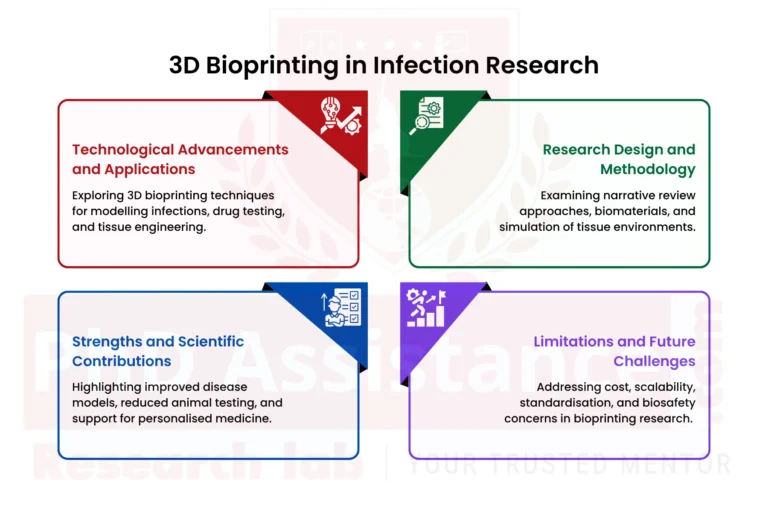
Methodology and research design
The research study examines existing literature through its narrative review method without presenting any new experimental results. The emerging subject matter that requires study from different academic fields needs this format for its examination. The authors successfully organise information into logical themes, which include printing technologies, biomaterials and disease modelling and therapeutic applications.
The article structure enables readers to learn technical concepts at their own speed. The content successfully demonstrates engineering elements that connect to biological uses through which interdisciplinary research faces difficulties.
However, some methodological limitations are noticeable:
Argumentation and Use of Evidence
The authors build their argument that conventional infection models do not accurately simulate human tissue complexity through their research work. The authors demonstrate their research results through printed tissues which accurately replicate extracellular matrix structures, multicellular environments and physiological gradients.
The discussion on the role of 3D bioprinting in infection studies shows convincing proof because it connects existing technological capabilities with actual research problems that scientists need to solve.
The article effectively uses current examples to show that bioprinting is not only theoretical but already influencing experimental design.
The results needed to demonstrate direct links to international university systems because this would enhance their worldwide use.
Ethical considerations and omissions
Weaknesses of this research:
1. Limited Discussion of Cost and Accessibility
The advanced bioprinting systems need skilled personnel to operate their systems because they come with high costs. The review should enhance its examination of challenges that smaller laboratories encounter.
2. Regulatory and Standardisation Challenges
The article presents a brief summary of developments, but it fails to properly handle essential scientific matters, which include reproducibility, quality control and standardisation that affect clinical research.
3. Scalability Issues
The scientific community faces an ongoing challenge to develop tissue constructs that maintain their blood vessel networks and all their structural characteristics over extended time periods. The issue needs complete scientific research.
4. Ethical and Biosafety Considerations
The biosafety requirements of printed tissues used in infectious disease models with pathogenic organisms need further explanation.
Writing Style and Structure
This displays all technical engineering vocabulary that requires advanced academic knowledge, as easily understandable material for readers. The connection between the fundamental knowledge base and practical application, together with future investigation opportunities, shows a logical development pattern.
The content requires more figures and examples because these elements assist readers in understanding the process of comparing different printing technologies and infection models.
Conclusion
The review article “Bridging biology and technology: the rise of 3D bioprinting advancements in infection research” demonstrates how 3D bioprinting will transform the field of infection research through its review of emerging technologies. The study shows that 3D bioprinting advancements in biomedical research enable scientists to create new methods for disease modelling, therapeutic testing and personalised medicine development.
The main strength of the research shows that 3D bioprinting technology creates disease models that connect basic laboratory systems with complex human biological systems. The article needs additional information about its costs, standardisation, and scalability to increase its academic value, although it already makes a major research contribution.
The 3D bioprinting research will expand because scientists require improved techniques for infection research, while showing that tissue engineering will become a crucial research method for infection studies in the upcoming years.
“Are you facing challenges in writing a high-quality critical review for your research? The PhD Assistance Research Lab offers specialised guidance tailored to doctoral scholars and early-career researchers.”
Reference
Mohammadi, S., Unger, W. W. J., Ferrari, A., Sanchini, C., Ruocco, G., & D’Alessandro, S. (2026). Bridging biology and technology: the rise of 3D bioprinting advancements in infection research. Frontiers in bioengineering and biotechnology, 14, 1764653. https://doi.org/10.3389/fbioe.2026.176