
Digital Therapeutics and Intelligent Patient Monitoring in Connected Healthcare Systems
Info:
Digital Therapeutics and Intelligent Patient Monitoring in Connected Healthcare Systems Topics I phdassistance.com
Published: 10th July in
Digital Therapeutics and Intelligent Patient Monitoring in Connected Healthcare Systems Topics I phdassistance.com
Share this:
Related Services
Our academic writing and marking services can help you
Introduction
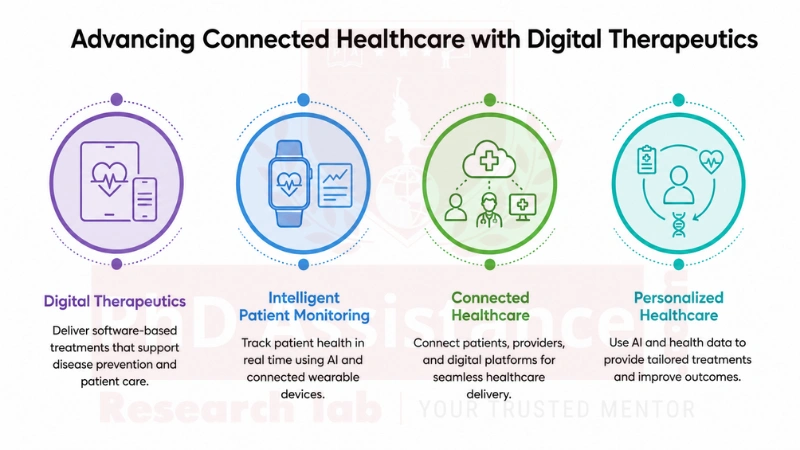
The fast development of digital health technology is changing the modern healthcare industry through the provision of personalised, accessible and data-driven medical services. Many healthcare practitioners are increasingly embracing intelligent digital technologies to facilitate disease management, patient involvement and informed clinical decisions within various healthcare settings. Digital Therapeutics in Connected Healthcare is playing an important role in providing evidence-based interventions, continuity in healthcare, and greater access to healthcare through digital technology. However, there are many challenges related to the research area, including interoperability challenges, concerns about data privacy, regulatory challenges, and integrating the use of digital health technology within the current healthcare system. The current literature on this topic highlights the significance of coming up with an overall framework that would integrate the intelligent use of healthcare technology, data security and patient-centeredness.
Proposed PhD Topic 1: AI-Powered Patient Monitoring for Digital Therapeutics in Connected Healthcare Systems
Background Context:
Digital therapeutics are revolutionising healthcare in terms of the provision of evidence-based interventions through software applications, wearables, and intelligent clinical technology. Digital therapeutics allow for continuous patient monitoring and personalised treatments, and deliver proactive healthcare services that go beyond traditional clinical environments. Ghadi et al. (2025) note that wearable technologies have greatly improved healthcare services through real-time monitoring and remote support capabilities. Yet problems associated with interoperability, data security issues, digital literacy, and lack of healthcare infrastructure prevent the implementation of digital therapeutics to a greater extent. Development of Intelligent Patient Monitoring solutions combining digital therapeutics and modern healthcare infrastructures would enhance collaboration between patients, caregivers, and clinicians. It is essential to develop such systems to build a secure, scalable, and efficient Connected Healthcare System.
PhD-Level Verification:
Current research is exploring Wearable Health Technologies and Digital Therapeutics separately without much consideration of AI-powered Monitoring, intelligent decision-making assistance, interoperability, and privacy protection within a combined framework. In addition, there is little empirical evidence related to scalable models for Healthcare Systems, which makes it an attractive area for doctoral study.
Research Questions:
Contributions at the PhD-Level:
Suggested Readings:
Ghadi, T., et al. (2025). Wearable Technology for Digital Health: Challenges, Opportunities, and Future Directions. Journal of Cloud Computing.
Proposed PhD Topic 2: Intelligent Digital Therapeutics Frameworks for AI-Powered Patient Monitoring in Chronic Disease Management
Background Context:
The utilisation of digital therapeutics is on the rise with the view of managing chronic diseases via personalised therapy, continuous health monitoring and evidence-based clinical decision-making. The combination of artificial intelligence with digital therapeutics has enabled better personalisation of the treatment process and increased patient involvement, allowing for a proactive provision of healthcare services. According to Majeed et al. (2026), the application of AI technologies is changing digital therapeutics as far as predictive analytics, clinical decision-making, and individualised treatment planning are concerned. However, the challenges in clinical validation, data privacy and protection, regulation and technology adoption still restrict further application. Creating AI-Powered Patient Monitoring Solutions combined with intelligent digital therapeutics can increase the efficiency of the treatment process and improve healthcare services.
PhD-Level Verification:
There is inadequate scholarly work that takes into consideration all aspects of Patient Monitoring along with other areas such as clinical decision support, regulatory compliance, and patient personalisation within the healthcare system framework. There is therefore great scope for pursuing doctoral studies in this field.
Research Questions:
PhD-Level Contributions:
Suggested Readings:
Majeed, A., et al. (2026). Artificial Intelligence in Digital Therapeutics for Optimized Healthcare.
Proposed Dissertation topic 3: Remote Patient Monitoring for Personalized Digital Therapeutics in Connected Healthcare Systems
Background Context:
The use of digital therapeutics has changed the landscape of the healthcare industry as it allows patients to receive continuous care. Digital therapeutics enables healthcare practitioners to deliver personalised therapy for their clients, including the monitoring of their health conditions through advanced technologies such as wearable devices, mobile health applications, and cloud computing technology. According to Hussain et al. (2025), digital therapeutics can be used to enhance treatment adherence, engagement, and healthcare access. However, the fragmented healthcare infrastructure, lack of interoperability, inconsistencies in patient data, and privacy and clinical reliability issues remain barriers in the effective adoption of digital therapeutics. It is critical to develop Remote Patient Monitoring solutions that can be integrated into Healthcare Systems.
PhD Level Verification:
The current literature largely focuses on assessing digital therapeutic solutions and telemedicine separately without adequate exploration of AI-Powered Monitoring together with customised therapy approaches and healthcare infrastructure integration. In addition to that, there is not enough empirical verification of the scalability of such monitoring systems for managing chronic diseases.
Research Questions:
PhD-Level Contributions:
Suggested Readings:
Hussain, A., et al. (2025). Toward Data-Driven Digital Therapeutics Analytics: Literature Review and Research Directions. Journal of Medical Internet Research (JMIR).
Proposed Dissertation Topic 4: Intelligent Patient Monitoring Frameworks for Data-Driven Digital Therapeutics in Connected Healthcare Systems
Background Context:
Rising popularity of digital therapeutics will revolutionise the healthcare sector since they allow for constant patient care with the help of intelligent technologies and wearable devices. The development will help to personalise treatments, engage patients and make evidence-based decisions. Kim et al. (2025) state that even though data-driven digital therapeutics have shown great potential, there are still problems with data integration, interoperability, clinical validation and real-time analytics that prevent their implementation. With healthcare moving into a digital world, Intelligent Monitoring that will analyse different kinds of healthcare data becomes a necessity. This development can be helpful for Healthcare Systems in terms of effective and timely healthcare delivery.
PhD-Level Verification:
Currently, studies are largely centred on analytics and digital therapeutics alone, and there is little work that combines the areas of AI-powered monitoring, intelligent analytics, and real-time clinical decision support systems together in one study. In addition, the validation of such a system on a large scale has not been done yet.
Research Questions:
Contributions at the PhD-Level:
Suggested Readings:
Kim, J., et al. (2025). Toward Data-Driven Digital Therapeutics Analytics: Literature Review and Research Directions. Journal of Medical Internet Research (JMIR).
Proposed Dissertation Topic 5: AI-Powered Patient Monitoring for Personalized Digital Therapeutics in Intelligent Healthcare Ecosystems
Background Context:
Digital therapeutics are revolutionising the delivery of healthcare through the application of artificial intelligence, wearables, and data-driven innovations for improving the quality of care provided to patients through avenues other than clinical settings. The technologies help in monitoring, treating, and managing patients’ diseases while enhancing efficiency in the delivery of healthcare services. West et al. (2025) argue that the use of digital health technologies relies on patient engagement, collaboration of stakeholders, usability, and trust within the healthcare system. Although there has been technological advancement, issues concerning patient acceptance, interoperability, implementation approaches, and healthcare integration hinder the use of digital health technologies. Development of AI-Powered Monitoring systems that incorporate digital therapeutics into patient-focused care will enhance access to healthcare and strengthen Healthcare Systems.
PhD-Level Verification:
Current literature focuses mainly on the study of stakeholder expectations and digital health adoption separately, without much literature exploring the combination of Remote Monitoring, patient engagement, implementation readiness, and intelligent clinical decision support. In addition, there is a lack of evidence-based validation of patient-focused digital therapy ecosystems, offering ample room for doctoral-level investigation.
Research Questions:
PhD-Level Contributions:
Suggested Readings:
West, E., et al. (2025). Digital Health Technologies: Learnings and Perspectives From a Patient Engagement Stakeholder Expectations Matrix Study. Journal of Medical Internet Research (JMIR).
Need assistance finalising your dissertation topic? Selecting a strong, researchable topic can be challenging — but you don’t have to do it alone.
Our research consultants can help refine your ideas, identify literature gaps, and guide you toward a topic that aligns with current academic trends and your programme requirements.
Contact us to begin one on-one topic development and refinement with PhdAssistance.com Research Lab.
Share this:
Cite this work
PhDAssistance. (n.d.). Cybersecurity in business Dissertation Topics Retrieved January 28th, from https://phdassistance.com/topic/cybersecurity-business/
Jalolova, M., and Musawwir, M. “Cybersecurity in business Dissertation Topics for PhD Scholars.” PhDAssistance, https://phdassistance.com/topic/cybersecurity-business/ Accessed 28th January 2026.
Jalolova, M., and Musawwir, M. “Cybersecurity in business Dissertation Topics for PhD Scholars.” PhDAssistance, PhDAssistance, Web. 28th January 2026.
Jalolova, M., and Musawwir, M., n.d. Cybersecurity in business Dissertation Topics for PhD scholars. [online] Available at: https://phdassistance.com/topic/cybersecurity-business/ [Accessed 28th January 2026].
Jalolova M., Musawwir M. Cybersecurity in business Dissertation Topics for PhD scholars [Internet]. PhDAssistance; [cited 2026 28th January]. Available from: https://phdassistance.com/topic/cybersecurity-business/
Jalolova, M., and Musawwir, M. (n.d.). Cybersecurity in business Dissertation Topics for PhD scholars. Retrieved 28th January 2026, from https://phdassistance.com/topic/cybersecurity-business/
Jalolova, M., and Musawwir, M., Cybersecurity in business Dissertation Topics (n.d.) https://phdassistance.com/topic/cybersecurity-business/ accessed 28th January 2026.
Study Resources
Free resources to assist you with your university studies!