
Who this list is for
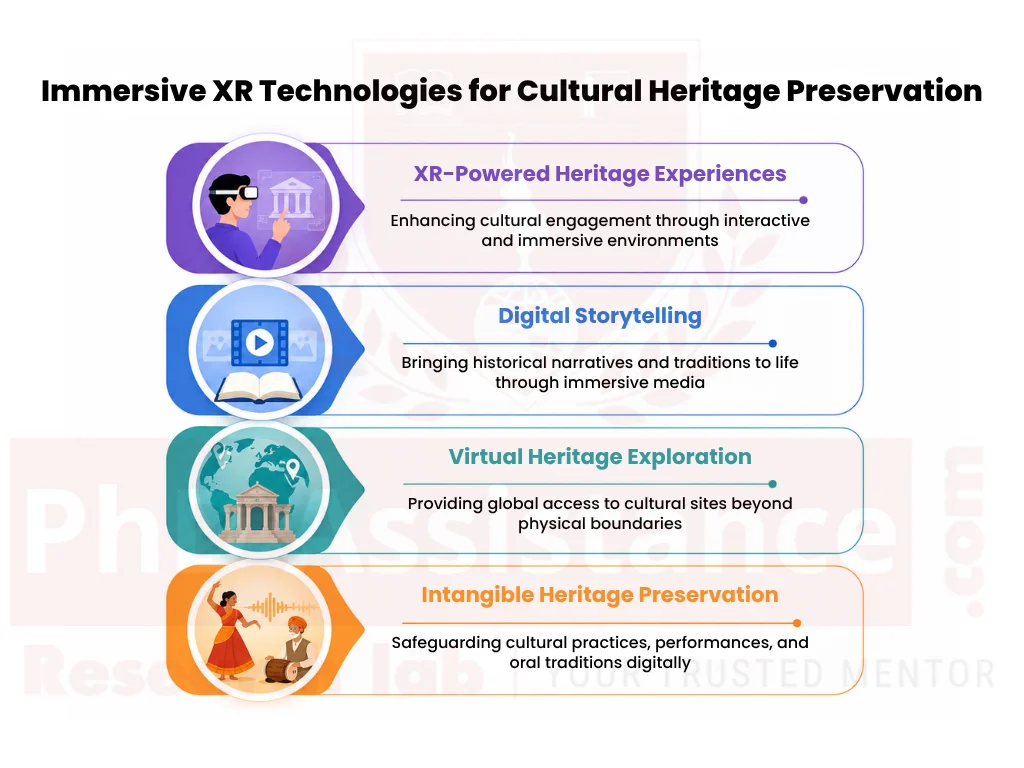
Heritage professionals now record, interpret and share heritage with 3D capture, virtual reconstruction, extended reality (XR) and digital storytelling. These tools can widen access and help transmit practices that are at risk, but they also raise preservation questions of their own: who decides how heritage is represented, whether the digital record will last, and how to tell whether a project achieved anything for the heritage or its communities. Schofield (2024) argues for treating heritage as a transformative practice that engages with present-day problems, which is a useful lens for these questions.
This list is for doctoral researchers in heritage studies, museum studies, archaeology and digital humanities. Because a separate list covers XR design and user experience, this list takes the preservation side of each idea.
How to use this list
Choose a heritage object or practice and a community first, then the medium. If your main interest is how to design or evaluate an immersive application, see extended reality in cultural heritage dissertation topics. Related lists: archaeology dissertation topics and digitising colonial-era manuscripts. If you are still choosing an area, start with how to choose a PhD topic.
Theme 1: Intangible heritage and digital storytelling
Most immersive heritage work has focused on buildings and objects. In a review of 60 studies of emotional design in XR for heritage from 2021 to 2024, Lin et al. (2025) found that only 12 concerned intangible heritage such as crafts, rituals and performance. Storytelling is a natural route for transmitting such practices, and multisensory systems that add sound, touch or smell to visual reconstructions are being developed (Muñoz et al., 2025).
| Topic | Possible research question | Likely design and data | Why it matters now |
|---|---|---|---|
| Co-designed immersive storytelling for transmitting an intangible practice | Does a storytelling experience co-designed with practitioners of one craft or ritual help younger community members learn and value the practice, compared with conventional recorded media? | Participatory design with the community, then a comparative evaluation with interviews, observation and simple knowledge measures | Intangible heritage is a small share of immersive heritage studies (Lin et al., 2025) |
| Narrative structure in guided interpretation of heritage sites | Does a narrative, character-led guide improve visitors' understanding and recall of a site's history compared with an information-led guide in the same medium? | Randomised field experiment at one site, delayed recall test, short interviews | Evidence for immersive learning comes mostly from other fields and depends on how media are used (Yang et al., 2024) |
A meta-analysis of virtual reality in science and engineering education found a moderate positive effect on practical skills, strongest when VR was combined with conventional teaching (Yang et al., 2024). Heritage learning is different, so a heritage study should test rather than assume such benefits.
Theme 2: Preserving digital heritage itself
Digital reconstructions and XR experiences depend on file formats, engines and headsets that change quickly, so they need preservation in their own right. The FAIR principles ask that data be findable, accessible, interoperable and reusable (Wilkinson et al., 2016), and digital humanities increasingly expects digital outputs to be reproducible and their methods explainable (Ries et al., 2024). Representation is a second issue: Beelen et al. (2023) showed that a digitised newspaper collection over- and under-represented particular kinds of titles when compared with an external reference.
| Topic | Possible research question | Likely design and data | Why it matters now |
|---|---|---|---|
| Preserving immersive heritage experiences over time: documentation and sustainability | What must be documented and kept (models, code, interaction design, context of use) for an XR heritage experience to remain usable and interpretable in ten years, and how well do current projects do this? | Survey and audit of completed projects, interviews with developers and curators, test migration of one experience | Digital outputs need FAIR data and reproducible methods to remain usable (Wilkinson et al., 2016; Ries et al., 2024) |
| Measuring heritage outcomes of digital heritage projects | Which indicators capture what digital heritage projects achieve for understanding, access and community ownership, and how do they compare with the engagement metrics projects usually report? | Mixed methods: review of evaluation reports, Delphi panel of curators and community representatives, pilot of indicators on two projects | Reviews note a lack of standardised evaluation methods in immersive heritage (Anwar et al., 2025) |
Theme 3: AI-assisted documentation and virtual restoration
AI methods can help reconstruct damaged or missing parts of objects and sites in virtual form. The preservation question is how to keep the evidence and the guesswork apart, so that a virtual restoration does not quietly become the accepted record. Anwar et al. (2025) review immersive and metaverse applications in heritage education and point to the role of standards in making such systems interoperable and trustworthy.
| Topic | Possible research question | Likely design and data | Why it matters now |
|---|---|---|---|
| AI-assisted virtual restoration with documented uncertainty | How can AI-generated reconstructions of a damaged artefact or building show which parts rest on evidence and which are inferred, and do conservators judge the result useful for decisions? | Case study of one collection or site: reconstruction workflow, uncertainty visualisation, expert review panel | Digital outputs that inform decisions need transparent, reproducible methods (Ries et al., 2024) |
How to test a topic before you commit
- Partnership: agree the project with the community, museum or site owner before the proposal is final.
- Ethics: intangible heritage and sacred material may need consent, restricted access or cultural protocols.
- Durability: plan how your own data and models will be archived at the end of the PhD.
- Contribution: ask whether you are filling a gap or questioning an assumption, such as the idea that digitising is preserving (Sandberg & Alvesson, 2011).
For more, see how to select a PhD topic and topic selection.
Common mistakes
- Starting from a technology and looking for heritage to apply it to.
- Treating a digital copy as a preserved original.
- Reporting engagement or enjoyment as if it showed preservation or learning.
- Presenting reconstructions without showing which parts are inferred.
- Quoting sources you have not found or read.
Key takeaways
- Intangible heritage is under-studied in immersive heritage research (Lin et al., 2025).
- Benefits of immersive media for learning should be tested in heritage settings, not assumed (Yang et al., 2024).
- Digital heritage assets need FAIR, reproducible documentation to last (Wilkinson et al., 2016; Ries et al., 2024).
- Digitised collections can misrepresent the heritage they come from (Beelen et al., 2023).
- Evaluation of heritage projects needs agreed methods beyond engagement metrics (Anwar et al., 2025; Muñoz et al., 2025).