
How to use this list
This page is for doctoral researchers in finance, economics, computer science and operations research who want to study reinforcement learning (RL) for trading and portfolio decisions. One research question was duplicated, several promised better performance without saying how it would be measured, and one proposed real-world deployment, which a doctoral project cannot usually do. Each title below names a market, a comparison and an evaluation design.
Governance, market integrity and fairness questions are on the ethical AI in trading systems topics page; risk prediction is on the machine learning for financial risk modelling titles page; and broader ideas are on the finance titles and finance topics pages. The topics hub links every subject.
Where the field stands
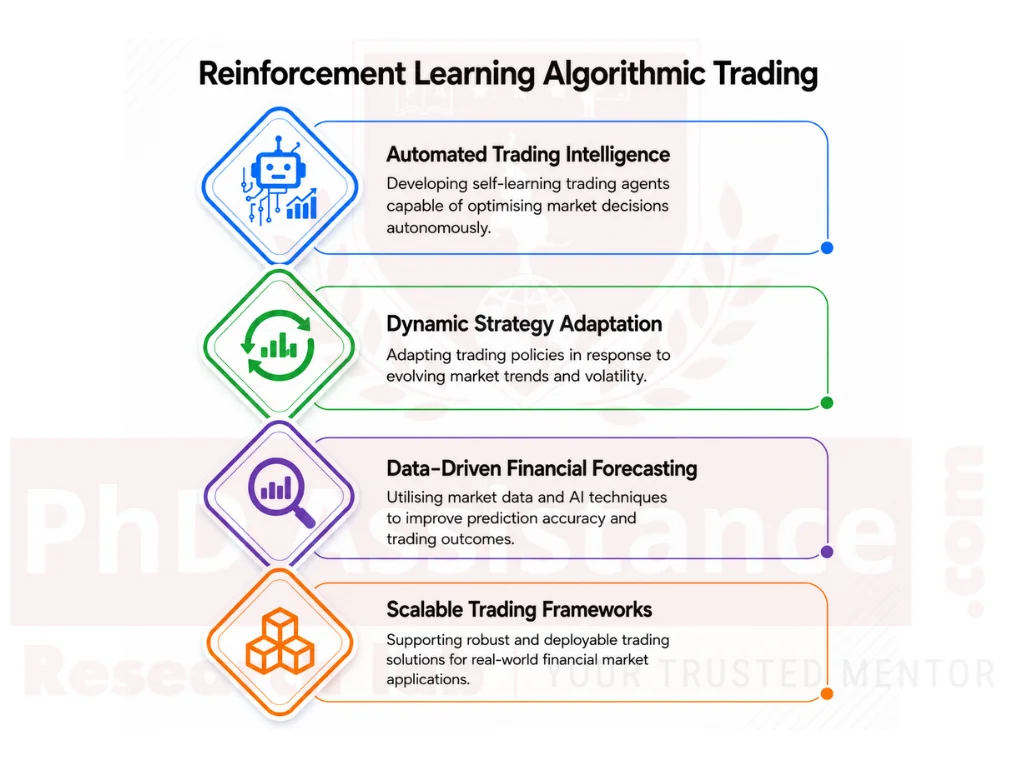
RL frames trading as sequential decision-making: an agent observes the market, acts, and learns from rewards. Hambly et al. (2023) survey its use in optimal execution, portfolio optimisation, option pricing and hedging, market making, smart order routing and robo-advising, noting that RL can exploit large datasets with fewer model assumptions than classical stochastic control. Two cautions shape every title below. Deep RL results are sensitive to random seeds, hyperparameters and implementation details (Henderson et al., 2018), and financial data are time-ordered, so standard cross-validation can leak future information into training (Bergmeir & Benítez, 2012).
Theme 1: Adapting to changing market regimes
Markets switch between calm and turbulent periods, and an agent trained in one regime can fail in another. A good title in this theme defines regimes in advance and tests the agent on periods it has not seen.
| Dissertation title | Possible research question | Likely design and data | Why it matters now |
|---|---|---|---|
| Deep reinforcement learning for equity index futures trading across volatility regimes: out-of-sample evaluation after transaction costs | Does a deep RL agent outperform buy-and-hold and a rule-based trend strategy, after costs, in volatility regimes not seen during training? | Daily or intraday futures data; regimes defined before testing; walk-forward evaluation; several random seeds with results spread reported | Out-of-sample, multi-seed evaluation is the main weakness of published deep RL work (Henderson et al., 2018; Bergmeir & Benítez, 2012) |
An illustrative evaluation plan shows what "out of sample" means in practice. Suppose the data run for twelve years. The first six are used for training, the next two for choosing hyperparameters, and the final four are opened only once, after every design decision has been frozen. Within the final period, results are reported separately for calm and turbulent regimes defined in advance, for example by a volatility threshold. Costs are charged on every trade at a stated rate, and the agent is trained with at least five random seeds so that the spread of outcomes can be shown alongside the mean. A walk-forward variant rolls this window forward year by year. This illustration is hypothetical, but each step answers a question an examiner is likely to ask.
Theme 2: Risk-aware agents and portfolios
An agent rewarded only for profit learns to take risk. Risk-aware RL changes the objective, for example by penalising drawdowns or constraining volatility. Portfolio optimisation is one of the main application areas reviewed by Hambly et al. (2023).
| Dissertation title | Possible research question | Likely design and data | Why it matters now |
|---|---|---|---|
| Risk-constrained reinforcement learning for multi-asset portfolio allocation: drawdown and tail risk compared with mean-variance benchmarks | Does adding a drawdown or tail-risk constraint to the reward reduce losses in stress periods without sacrificing after-cost returns relative to mean-variance and equal-weight portfolios? | Monthly or daily returns for a fixed asset universe; rolling re-estimation; stress periods held out | Portfolio choice is a core RL application in finance (Hambly et al., 2023) |
| Market impact and execution in limit order book simulation: closing the gap between simulated and realistic trading for RL agents | How much of a simulated RL agent's advantage survives when market impact and queue position are modelled? | Agent-based or historical-replay limit order book simulator; agents trained with and without impact models | Optimal execution and order routing are active RL problems (Hambly et al., 2023) |
Theme 3: Alternative data and explainability
News and sentiment are attractive inputs, but adding them also adds many design choices, and each extra trial raises the chance of a lucky result. Treat each tested variant as a hypothesis and control for multiple comparisons (Benjamini & Hochberg, 1995). Explainability matters because traders, risk managers and supervisors need to understand why a model acts; Bracke et al. (2019) illustrate explanation methods on a financial model, and Rudin (2019) argues that interpretable models should be preferred for high-stakes decisions where they perform comparably.
| Dissertation title | Possible research question | Likely design and data | Why it matters now |
|---|---|---|---|
| News sentiment as state information for reinforcement learning trading agents: an ablation study in large-cap equities | Does adding news sentiment features to the agent's state improve after-cost, out-of-sample returns compared with price-only features? | Licensed or public news archive aligned by timestamp to avoid look-ahead; ablation with and without text features; correction for multiple variants | Every added data source multiplies the variants tested (Benjamini & Hochberg, 1995) |
| Explaining reinforcement learning trading decisions to practitioners: feature attribution versus interpretable policies | Do practitioners understand and trust explanations of an RL agent's trades, and does an interpretable policy lose performance compared with a deep one? | Comparison of a deep agent with an interpretable policy; explanation study with traders or risk analysts | Explainability supports oversight of model-driven decisions (Bracke et al., 2019; Rudin, 2019) |
How to test a title before you commit
Use the FINER criteria: feasible, interesting, novel, ethical and relevant (Hulley et al., 2013). In this area, feasibility depends on data licences (intraday and order book data can be expensive), on computing for repeated training runs, and on fixing the test period before you start tuning. Write down your benchmarks, cost assumptions and evaluation windows in the proposal so that later choices cannot drift towards a flattering result.
For the wider process, see how to choose a PhD topic, how to select a PhD topic and PhD topic selection support. Decentralised markets are covered on the decentralised finance analytics topics page.
Common mistakes
- Reporting backtest returns before transaction costs, slippage and market impact.
- Using shuffled cross-validation on time-ordered data.
- Showing one training run instead of the spread across random seeds.
- Testing many variants and reporting only the best.
- Promising live deployment that the project cannot carry out.
Key takeaways
- RL is applied across execution, portfolio choice, hedging and market making (Hambly et al., 2023).
- Report several seeds and settings, because deep RL results are fragile (Henderson et al., 2018).
- Evaluate in time order and out of sample (Bergmeir & Benítez, 2012).
- Control for the number of variants tested (Benjamini & Hochberg, 1995).
- Explainability and interpretable alternatives support oversight (Bracke et al., 2019; Rudin, 2019).