
Who this list is for
This list is for doctoral and master's researchers in finance, economics, computer science or law who want a topic on the ethics and explainability of AI in trading. Two of them asked the same question, one borrowed fairness ideas from consumer lending without adapting them, and two cited a paper about manufacturing.
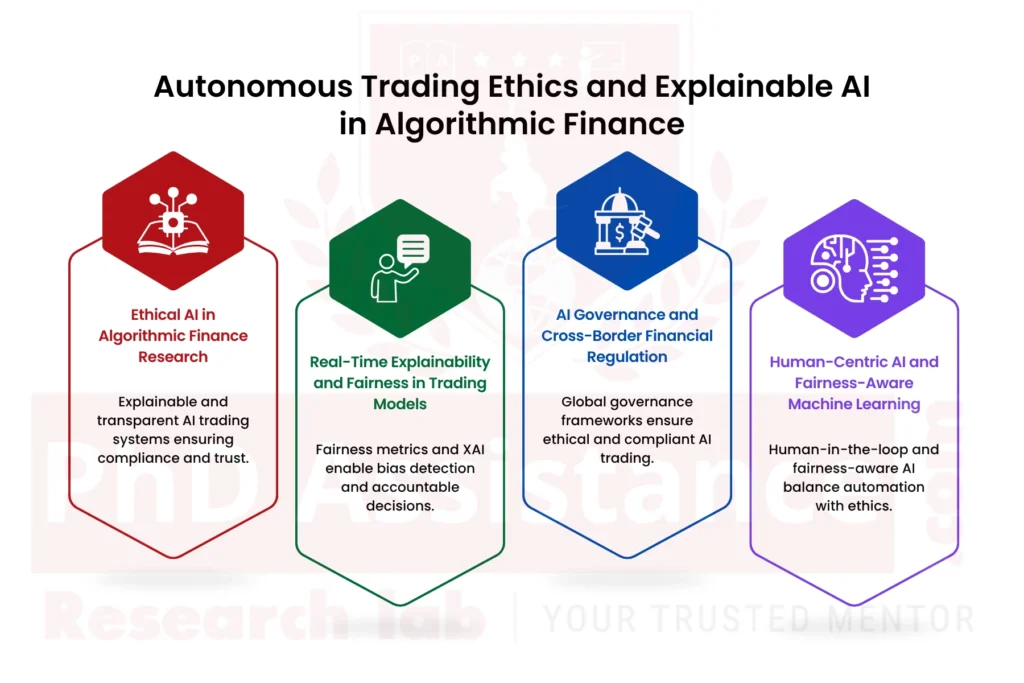
How to use this list
Machine learning in finance is a large and fast-growing field (Goodell et al., 2021; Aziz et al., 2022), so a topic needs a sharp boundary. Decide first which kind of question you are asking: a technical one about explaining a model, an institutional one about rules and accountability, or an ethical one about effects on markets or people. Each table row then gives a possible research question, the design and data it would need, and why it matters now. For broader lists see finance dissertation topics and decentralised finance analytics topics.
Theme 1: Explaining trading models under time constraints
Post hoc methods such as LIME (Ribeiro et al., 2016) and SHAP (Lundberg & Lee, 2017) explain individual predictions of complex models. Their cost varies: LIME and model-agnostic SHAP estimators rely on many model evaluations, while exact SHAP values can be computed efficiently for tree ensembles (Lundberg et al., 2020). For trading, the question is therefore not whether explanation is possible but which explanation, produced when and for whom: in real time for a trader, after the event for a risk committee, or periodically for a supervisor.
| Topic | Possible research question | Likely design and data | Why it matters now |
|---|---|---|---|
| Explaining AI trading models within a latency budget | Which combination of model class and explanation method gives stable, faithful explanations of trading signals within a defined time limit, and how much predictive performance is lost? | Computational experiment on historical market data; compare intrinsic models and post hoc methods on speed, fidelity and stability; back-test performance | Explanation cost depends heavily on model class (Lundberg et al., 2020), which few trading studies test directly |
| Explanations for whom? Matching explanation types to trading roles | What explanations do traders, risk managers and compliance staff need from an AI trading system, and do current tools provide them? | Qualitative interviews or a vignette experiment with practitioners, using explanations generated from a test model | Explainability is often evaluated technically, not by the people who use it (Bracke et al., 2019) |
Illustrative example. A candidate begins with "explainable AI for high-frequency trading". Because tick-level data for many venues are beyond her budget, she narrows the study to one liquid futures contract with minute-level data her university already licenses. She compares a gradient-boosted tree model explained with exact tree SHAP against a neural network explained with a sampling method, measuring explanation time, stability across similar inputs and the loss in back-tested returns. The result is a clear, testable contribution rather than a promised "framework for all trading systems".
Theme 2: Governance and market integrity
AI-driven trading crosses borders while rules remain national or regional. The EU Artificial Intelligence Act sets general obligations for AI systems and lists specific high-risk uses (European Parliament & Council of the European Union, 2024); trading itself is governed mainly by financial-markets regulation, which is why comparative governance is a useful doctoral topic. A second concern is collective behaviour: if many firms use similar models and data, their strategies may move together and amplify market stress, which is a question of market integrity rather than of fairness to individuals.
| Topic | Possible research question | Likely design and data | Why it matters now |
|---|---|---|---|
| Comparing supervisory expectations for AI-driven trading across jurisdictions | How do two or three jurisdictions expect firms to document, explain, test and control AI-driven trading algorithms, and where do the expectations conflict? | Comparative documentary and legal analysis of regulations, guidance and enforcement notices; optional expert interviews | New horizontal AI rules now sit alongside sector rules (European Parliament & Council of the European Union, 2024), creating overlaps firms must navigate |
| Similarity of AI trading strategies and market stability | Do strategies built with similar machine learning methods and data produce more correlated trading, and does that correlation rise in periods of stress? | Empirical study using public fund or trade-level data, or an agent-based simulation calibrated to market data | Machine learning adoption in finance is widespread (Goodell et al., 2021), making system-wide effects a live question |
Theme 3: Fairness and explainability in decisions about people
Fairness metrics and duties to explain are clearest where a model makes decisions about individuals. Bracke et al. (2019) showed how explanation methods can be applied to a default risk model, and the EU AI Act lists creditworthiness assessment of natural persons among high-risk uses (European Parliament & Council of the European Union, 2024).
| Topic | Possible research question | Likely design and data | Why it matters now |
|---|---|---|---|
| Fairness-aware and explainable credit risk models | Can a credit risk model meet defined group-fairness criteria and provide reasons an applicant can understand, at an acceptable cost in accuracy? | Computational study on a public or lender-provided credit dataset; fairness metrics, explanation quality tests and accuracy trade-off curves | Credit scoring of individuals is classed as high-risk under the EU AI Act (European Parliament & Council of the European Union, 2024) |
Keep this topic separate from the trading themes. It needs data on applicants, attention to protected characteristics and an ethics review that trading studies usually do not, and its contribution is judged by different readers.
How to test a topic before you commit
Apply the FINER criteria: is the topic feasible, interesting, novel, ethical and relevant (Hulley et al., 2013)? In AI finance, check data first: trade-level and order-book data are expensive, so confirm what your institution can license. Pre-specify back-test periods to avoid overfitting, and for regulatory topics fix a cut-off date because rules change quickly.
See how to choose a PhD topic, how to select a PhD topic and PhD topic selection.
Common mistakes
- Assuming explanation methods are too slow without measuring them for your model.
- Applying fairness metrics designed for decisions about people to market strategies.
- Promising a universal standard or a global governance model.
- Back-testing on the same period used to design the strategy.
- Citing sources that do not address trading or finance.
Key takeaways
- Explanation cost depends on model class and method, so test it rather than assume it (Lundberg et al., 2020; Ribeiro et al., 2016; Lundberg & Lee, 2017).
- Machine learning in finance is a broad field; a good topic picks one question type (Goodell et al., 2021; Aziz et al., 2022).
- Trading raises market-integrity questions; group fairness belongs to decisions about people such as credit (Bracke et al., 2019).
- AI-specific and sector rules now overlap, which suits comparative governance topics (European Parliament & Council of the European Union, 2024).
- Test each topic with FINER before committing (Hulley et al., 2013).