
Who this list is for
This list is for doctoral and master's researchers in pharmacology, clinical pharmacy, pharmaceutical sciences and pharmacometrics. Pharmacokinetics (PK) describes what the body does to a drug over time; pharmacodynamics (PD) describes what the drug does to the body; PK-PD models link the two so that dose, concentration and effect can be studied together (Holford & Sheiner, 1981).
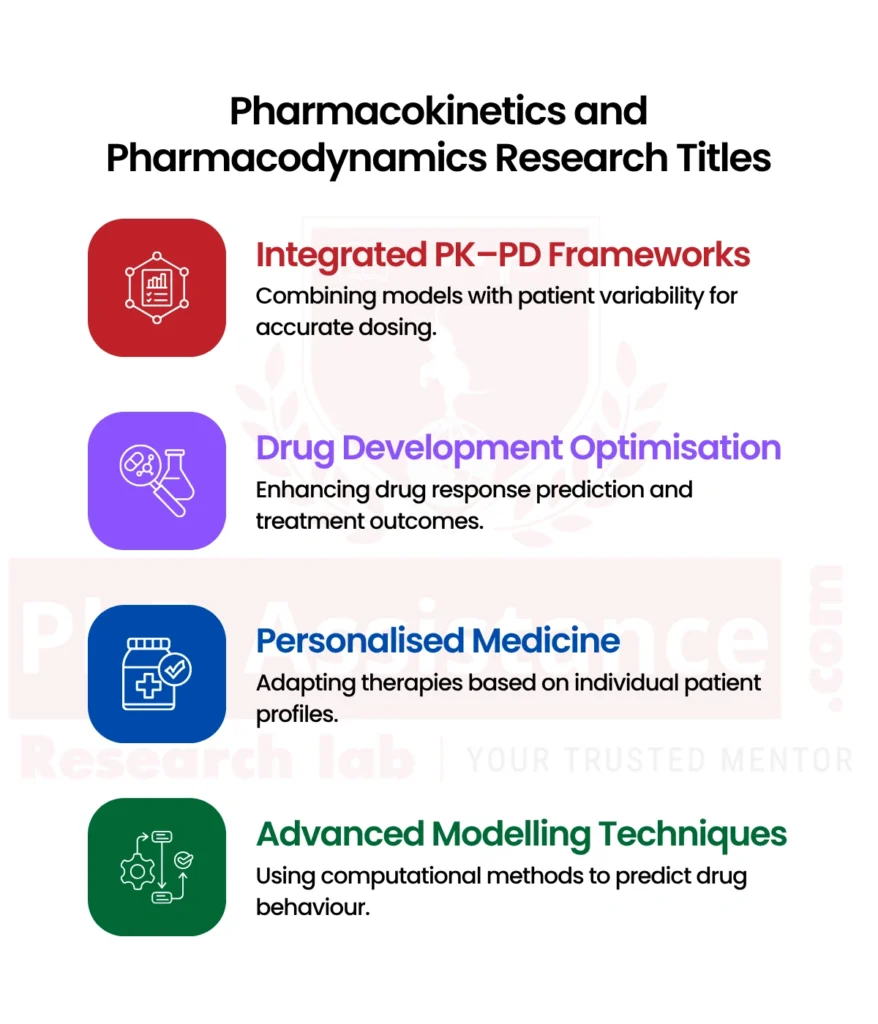
How to use this list
Read each row as a draft. Replace the example drug or population with one for which you can obtain concentration and response data, whether from a trial, a therapeutic drug monitoring service or published summary data. Each table gives a title, a research question, the likely design and data, and why it matters now. If you are planning the structure of the dissertation itself, read how to structure a pharmacology PhD dissertation that uses PK-PD modelling; for related lists see computational medicinal chemistry titles and the topics hub.
Theme 1: Modelling the concentration-response relationship
Effects often lag behind plasma concentrations. Sheiner et al. (1979) handled this by modelling PK and PD simultaneously with a hypothetical effect compartment, and Dayneka et al. (1993) compared four basic indirect-response models in which a drug stimulates or inhibits the production or loss of a response. Choosing among these structures, and justifying the choice with data, is a well-defined doctoral task. Comparing such models with newer data-driven approaches is a second, increasingly common one; the anaesthesia literature shows how PK-PD models have developed over several decades (Tulbah & Aljamaan, 2026).
| Dissertation title | Possible research question | Likely design and data | Why it matters now |
|---|---|---|---|
| Direct, effect-compartment and indirect-response models for an established drug: which structure best describes the time course of effect? | For a chosen drug and biomarker, which structural PK-PD model best describes the delay between concentration and effect, and how much do dosing predictions differ between models? | Secondary analysis of rich concentration and response data; nonlinear mixed-effects modelling; model comparison and simulation | Model structure changes dosing predictions (Sheiner et al., 1979; Dayneka et al., 1993), yet it is often chosen by habit |
| Machine learning and population pharmacokinetic models compared: predictive performance on external patient data | Does a machine learning model predict drug concentrations in a new patient cohort more accurately than an established population PK model, and where does each fail? | Model development on one dataset and external validation on another; prediction error metrics and graphical evaluation | Data-driven methods are spreading, but comparisons need standard evaluation metrics (Nguyen et al., 2017) |
Theme 2: Special populations and precision dosing
Population PK models estimate typical parameter values and the variability between and within patients, and covariates such as body size or renal function explain part of that variability (Mould & Upton, 2012). Special populations (critically ill, older, obese or paediatric patients, or those with organ impairment) are often under-represented in development studies, which is why dosing in these groups remains a practical research need. Regulators publish guidance on how population PK analyses should be conducted and reported (FDA, 2022; EMA, 2007).
| Dissertation title | Possible research question | Likely design and data | Why it matters now |
|---|---|---|---|
| Population PK-PD modelling of beta-lactam antibiotics in critically ill adults with altered renal function | How do renal function and illness severity affect beta-lactam exposure, and which dosing regimens give a high probability of reaching the PD target? | Observational PK study or secondary analysis of therapeutic drug monitoring data; population model with covariates; Monte Carlo dosing simulation | Covariate models explain variability that standard doses ignore (Mould & Upton, 2012) |
| Model-informed precision dosing from routine therapeutic drug monitoring data: development and prospective evaluation | Does Bayesian dose individualisation using a population model and routine drug levels improve target attainment compared with standard dosing? | Model development on retrospective data, then a prospective pilot evaluation with pre-specified outcomes | Precision dosing needs evidence from prospective evaluation, not only retrospective fit (Nguyen et al., 2017) |
Theme 3: Model-informed drug development
Model-informed drug development uses quantitative models to support decisions such as dose selection and trial design. The ICH M15 guideline sets out general principles for planning, assessing and documenting these models (EMA, 2026), which gives a doctoral study a clear standard to work to.
| Dissertation title | Possible research question | Likely design and data | Why it matters now |
|---|---|---|---|
| Exposure-response modelling to support dose selection between phase 2 and phase 3: a retrospective case study | Would an exposure-response analysis of phase 2 efficacy and safety data have supported the dose taken into phase 3, and what uncertainty remained? | Secondary analysis of trial data (sponsor collaboration or shared data); exposure-response models; simulation of alternative doses | Model-informed approaches are now addressed in harmonised international guidance (EMA, 2026) |
Illustrative example. A candidate begins with "PK-PD modelling for personalised medicine". Her hospital's laboratory holds several years of vancomycin levels with dosing records. She narrows the title to a population PK model with renal function and body weight as candidate covariates, evaluated with visual predictive checks and prediction errors, followed by a small prospective pilot. The contribution is now specific and testable.
How to test a title before you commit
Apply the FINER criteria: is the study feasible, interesting, novel, ethical and relevant (Hulley et al., 2013)? In PK-PD work, feasibility usually depends on data: confirm sampling times, assay details and dosing records before you choose a model, and agree data-sharing terms early if a sponsor holds the data. Plan the evaluation and reporting at the proposal stage (Nguyen et al., 2017; EMA, 2007).
See how to choose a PhD topic, how to select a PhD topic, PhD topic selection and how to identify research gaps in receptor pharmacology.
Common mistakes
- Promising an "integrated framework" without naming the drug, population or model.
- Choosing a model structure before looking at the time course of the data.
- Reporting goodness of fit without simulation-based or external evaluation.
- Comparing machine learning and population models on the data used to build them.
- Assuming access to trial data that a sponsor has not agreed to share.
Key takeaways
- PK-PD models link dose, concentration and effect; they describe the relationship rather than change it (Holford & Sheiner, 1981).
- Choosing between direct, effect-compartment and indirect-response models is a well-defined thesis task (Sheiner et al., 1979; Dayneka et al., 1993).
- Population models with covariates are the core tool for special populations (Mould & Upton, 2012; FDA, 2022).
- Plan model evaluation and reporting from the start (Nguyen et al., 2017; EMA, 2007).
- Model-informed development now has harmonised guidance, and the field keeps evolving (EMA, 2026; Tulbah & Aljamaan, 2026).
- Test each title with FINER, starting with data access (Hulley et al., 2013).