
Introduction
As diseases of the nervous system are still major causes of health ailments and death worldwide, a significant need exists for new methods to treat central and peripheral nervous system diseases. New opportunities for treatment are emerging in the field of regenerative medicine, stem cell biology, exosome engineering and neuropharmacology.
Stem cells and exosome-derived therapies are promising tools to modulate neuroinflammation, facilitate neurodegeneration and recovery of neuronal function, as well as target drugs through biological barriers like the blood-brain barrier.
Given the rising interest in papers related to Stem cell therapy and research on the therapeutic potential of exosome-based therapies, the pharmacological aspects and translational perspectives are emerging as key research priorities. This Call for Paper Stem Cell Research invites the best manuscripts to provide mechanistic insight into these processes and their translation for neurological diseases.
Why publish in this issue?
This Special Issue presents an excellent opportunity for researchers, clinicians and pharmaceutical scientists to get involved in one of the fastest-moving areas of regenerative medicine and neuropharmacology. All articles will be disseminated globally to a community of scientists working within neuroscience therapy, stem cell science and translational medicine.
Key advantages:
Scope
We welcome original research articles, review articles, short communications and translational research about stem cells, stem cells-derived exosomes, extracellular vesicles and their therapeutic applications in neurological disorders.
- Stem cells and exosomes, their mechanism and therapy.
- Emerging opportunities for Translational medicine research journals
- Neural inflammation control and neurodegeneration technologies.
- Stem cell, exosome and extracellular vesicles bioengineering.
- Drug delivery and targeting strategies of the blood-brain barrier.
- Safety, dosing and therapeutic evaluation studies.
- Translation studies linking lab and clinic.
- New technologies for regenerative medicine and nanomedicine. Novel research in the mechanism of action in neurological therapy.
The Special Issue has a strong preference for articles on Alzheimer’s disease, Parkinson’s disease, stroke, spinal cord injury, traumatic brain injury, multiple sclerosis, epilepsy, amyotrophic lateral sclerosis, and peripheral neuropathies. Submissions relevant for Neurological disease research publications, as well as for Translational medicine journals, are most welcome.
Contact PhD Assistance research lab today to publish your research papers in Scopus and PubMed-indexed journals!
Know More About This Issue
The growing problem of neurological disease is a perpetual strain on the healthcare sector, and few neuroinflammatory and neurodegenerative diseases have effective treatments. That said, enormous strides have been made in neuroscience and pharmacology. Both stem cell therapy and exosome-based therapy are considered potential approaches; stem cells and exosomes can be a delivery vehicle for bioactive factors, facilitate repair and regeneration of injured tissues, modulate immunity and promote neuronal restoration.
In this Special Issue, we will bring together researchers who utilise combined and novel approaches from regenerative medicine, neuropharmacology, molecular neuroscience and translational therapeutics. We hope to publish work detailing mechanistic discoveries, novel delivery strategies, bioengineering advancements and early clinical results towards new classes of neurologically relevant therapies.
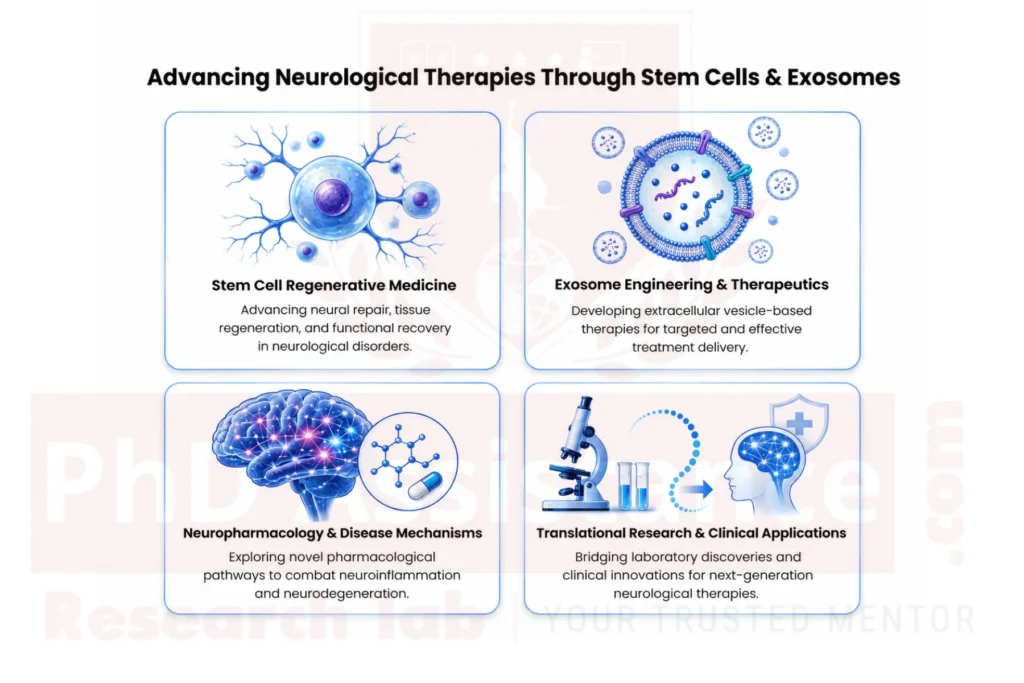
Key factors
How We Support Your Submission
We offer extensive support to assist researchers in producing publishable papers, compliant with top scientific journals and special issues. We focus on improving the quality, clarity and impact of your research presentation until final submission.
Our experts provide support for:
- Scientific manuscript development and content refinement.
- Journal guideline compliance and manuscript structuring.
- Reference organisation and citation management.
- Academic language enhancement and originality screening.
- Research design, methodology, and analytical support.
- Statistical validation and results interpretation.
- Preparation of figures, tables, and visual research elements.
- End-to-end submission guidance and documentation support.
- Our experts help to make sure that your manuscript complies with the Special Issue on Stem Cells, Exosomes, and Neurological Diseases
Journal Guidelines
- Submit unpublished and original work
- Submit with a structured abstract and keywords.
- Submission article type may be: research article, review, conceptual paper, case report, translational research.
- The topic will cover any area of stem cell biology, exosome therapy, neuropharmacology, regenerative medicine and neurotreatment.
- Both clinical and experimental studies are considered.
- Authors should highlight the article type as ’VSI: Stem Cells and EVs in CNS’ when submitting the manuscript on Editorial Manager
If you are a researcher who wants to publish research work in Stem Cells, Exosomes, and Neurological Diseases: Novel Pharmacological mechanisms studies, PhD Assistance Research Lab can offer guidance and assist you in successfully publishing the manuscript.
Free Guide: How to Write the Journal Manuscript
Book a free consultation to get guidance from the PhD assistance research lab for writing a credible research manuscript and submitting it in the high-quality journal.
Reference
Stem Cells, Exosomes, and Neurological Diseases: Novel Pharmacological Mechanisms and Translational Therapeutics. (2026). Special Issue Call for Papers. Pharmacological Research. Elsevier.