
Critical review of Artificial Intelligence in personalised medicine: transforming diagnosis and treatment
Introduction
The article demonstrates how current computational advancements in medicine enable doctors to create patient-specific diagnostic and treatment approaches. The authors position AI as a transformative force that bridges the gap between large-scale biomedical data and clinical decision-making. The study links its research to the current trend of personalised healthcare, which uses artificial intelligence to create precision medicine practices based on patient data.
The study on artificial intelligence in personalised medicine investigates that machine learning advancements in personalised medicine allow doctors to use complex genetic, clinical, and imaging data to improve their diagnostic and treatment results. The study identifies multiple continuing issues, which include ethical challenges, data security problems and infrastructure constraints.
Summary of the article
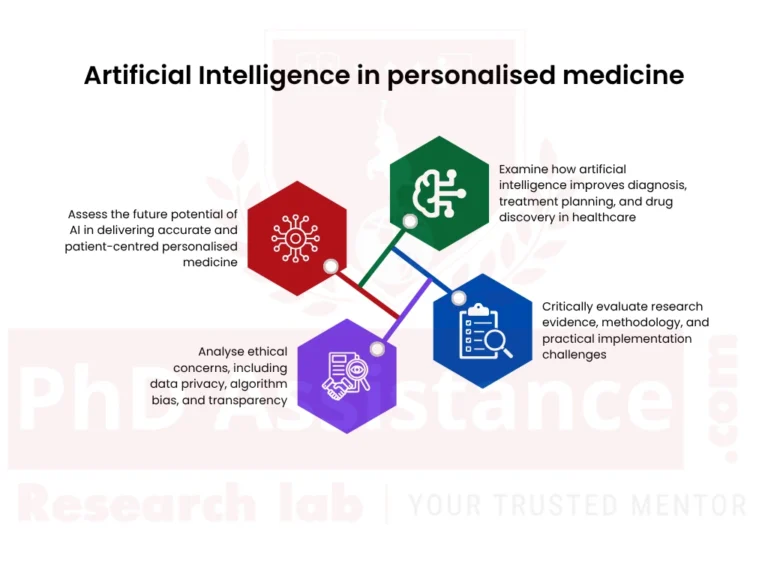
The article provides a compact summary that explains how AI for medical diagnosis and treatment is transforming healthcare systems. The article shows three main areas of focus.
The diagnosis process benefits from AI methods which use deep learning together with neural networks to discover diseases through their analysis of medical imaging and clinical data. The systems achieve better diagnostic accuracy than conventional methods which are used in oncology and cardiology and neurology medical fields.
The treatment process uses AI technology to create customized treatment plans which analyze both genetic information and clinical data that belongs to individual patients while it helps healthcare professionals to use AI for diagnosing medical conditions and choosing the best treatment methods.
The article demonstrates how AI technology helps pharmaceutical companies to develop drugs at a faster pace by its ability to predict drug effectiveness and discover potential targets and create clinical trial designs.
Critique
Significance and contribution of the field
The article demonstrates the transformative impact of precision medicine through its application of artificial intelligence to present its findings. The research establishes a link between technological progress and its use in medical settings by demonstrating how AI improves healthcare systems through increased operational productivity and enhanced treatment results.
The study achieves its principal objective through its integration of three different functions which include diagnosis and treatment and drug discovery into one comprehensive story. The complete system view shows how AI functions in personalized healthcare through its combined operation of multiple components, which work together to create personalised treatment solutions.
The article presents its actual scientific value through its findings, which describe basic information about the studied topic. The study presents AI potential, but it fails to analyze real world implementation issues, which include healthcare access gaps and complex regulatory frameworks.
Methodology and research design
The article functions as a commentary instead of an empirical study because its structure prevents it from conducting detailed research methods. The study depends mostly on secondary sources and example cases, while it lacks any original research or dedicated analysis.
The method provides a comprehensive view of machine learning in personalized medicine yet it decreases the research standard that academic studies usually require. The study lacks a defined evaluation system and research methods, which makes it impossible to verify its claims about validity and general applicability.
Argumentation and Use of Evidence
The authors demonstrate their case by showing how artificial intelligence improves both diagnostic procedures and medical treatment methods. The presentation of imaging diagnosis and genomic data integration shows that AI-driven diagnosis in healthcare systems can perform efficiently.
The use of literature references strengthens the argument, which shows how diagnostic accuracy and treatment results improved. The article needs additional comparative analysis, which should include comparisons between AI-based methods and traditional clinical approaches across various healthcare systems.
The discussion shows only positive results because it does not evaluate the complete range of dangers, which includes algorithmic bias and the overreliance on automated systems.
Ethical considerations and omissions
The article recognises important ethical issues, which include data privacy and algorithm reliability, and the unexplainable operation of AI systems. The issues mentioned here hold particular importance because they affect AI systems that doctors use to diagnose and treat patients, and need to establish transparency and accountability.
The treatment of ethics in this work only reaches shallow levels of examination. The study fails to examine existing regulatory frameworks, patient consent processes, and the social and economic consequences that result from using AI systems. The article requires an extensive ethical assessment, which will improve its capacity to convey vital information.
Writing Style and Structure
The article presents its content through organised sections which explain diagnosis and treatment, drug discovery and ethical concerns. The language is generally accessible, making complex concepts in AI in personalized healthcare understandable to a broad audience.
The sections use excessive technical terms that lack proper explanation, which creates difficulty for readers who do not know AI concepts. The text would become easier to read through the implementation of additional examples combined with basic explanation methods.
Conclusion
The article provides a comprehensive description of how artificial intelligence is transforming personalised medicine and reshaping contemporary healthcare systems. The research demonstrates how artificial intelligence technology enables better diagnostic results, creates individualised treatment plans, and accelerates the discovery of new medications.
The article presents its strengths through descriptive content, yet suffers from its failure to provide a complete methodological understanding. Future research should focus on empirical validation, ethical frameworks, and real-world implementation challenges to fully realise the potential of precision medicine with artificial intelligence.
The study demonstrates that AI technology presents significant potential; however, its implementation in healthcare systems needs thorough evaluation of ethical issues together with technical requirements and organisational aspects.
Reference
Alum, E. U., & Ugwu, O. P.-C. (2025). Artificial intelligence in personalised medicine: Transforming diagnosis and treatment. Discover Applied Sciences, 7, 193. https://doi.org/10.1007/s42452-025-06625-x