
What thematic analysis is, and which kind you are doing
Thematic analysis is a method for identifying, analysing and reporting patterns of meaning across a dataset (Braun & Clarke, 2006). It is flexible: it is not tied to one theory of knowledge, works with interviews, focus groups, open survey responses and documents, and is used across psychology, health, education, management and design research. In applied fields such as user experience research it helps teams turn interview data into insight about needs and problems.
Flexibility has a cost. Braun and Clarke now describe thematic analysis as a family of approaches rather than one method, and warn that many studies mix incompatible procedures (Braun & Clarke, 2021). Decide which kind you are doing before you code.
| Approach | How themes are developed | Quality is shown by |
|---|---|---|
| Coding reliability | A structured codebook applied by several coders; themes often defined early | Agreement between coders |
| Codebook (for example template or framework analysis) | A codebook developed and refined, often with some themes set in advance | Systematic, transparent application of the codebook |
| Reflexive thematic analysis | Codes and themes developed through the researcher's active interpretation | Reflexivity, depth of engagement and coherence of the analysis |
Before you start: is thematic analysis the right method?
Thematic analysis suits research questions about people's experiences, views, perceptions and practices, and about how a topic is represented or constructed in texts. It is a good choice when you want patterns across a dataset rather than a detailed account of each case, and when you are not committed to building a new theory from the data. If your aim is to develop an explanatory theory of a social process, grounded theory may fit better; if you want an idiographic account of how a few individuals make sense of an experience, interpretative phenomenological analysis may fit better.
Whatever you choose, make the link explicit in your methodology chapter: state your research question, your philosophical assumptions, the kind of thematic analysis you will use and why its procedures match those assumptions (Braun & Clarke, 2021). Examiners look for this coherence more than for any particular software or number of codes. Plan your data collection with the analysis in mind, too: interview guides with open questions and prompts for examples give richer material to code than lists of short factual questions.
The six phases
The six phases are not a linear recipe; analysts move back and forth between them (Braun & Clarke, 2006). Byrne (2022) gives a detailed worked example of the phases in a reflexive analysis.
- 1Familiarise with the data
- 2Generate codes
- 3Construct initial themes
- 4Review themes
- 5Define and name themes
- 6Write the report
Phase 1: Familiarise yourself with the data
Transcribe or check transcripts, then read and re-read the whole dataset actively. Listen to recordings again where tone matters. Note first impressions and questions in a reflexive journal, recording what surprised you and what you expected to find (Finlay, 2002).
Phase 2: Generate codes
Work systematically through every data item, labelling segments that are relevant to the research question. Codes can be semantic, staying close to what participants said, or latent, capturing underlying assumptions. Coding can be inductive, driven by the data, or deductive, informed by theory; state which you used. Keep enough context around each coded extract to understand it later. Code labels should be short analytic phrases, such as "hiding uncertainty from managers", rather than single words such as "uncertainty", because phrases carry the meaning you will later build into themes. Expect your codes to change during a second pass through the data, and record why you merged or renamed them.
Phase 3: Construct initial themes
Cluster codes that share a central idea into candidate themes and sub-themes. A thematic map helps. Keep a "miscellaneous" holding area for codes that do not yet fit. The 2006 paper called this phase "searching for themes"; Braun and Clarke have since stressed that themes are built, not found (Braun & Clarke, 2021).
Phase 4: Review themes
Check each theme against its coded extracts and then against the whole dataset. Ask whether each theme has a clear central organising concept, whether themes overlap or contradict each other, and whether together they tell a coherent story. Split, merge or discard themes as needed. A useful test is to try stating each theme's central idea in one sentence; if you cannot, the theme is probably still a topic. Revisit your research question at this point, because a strong theme that does not help to answer it may belong in a different paper.
Phase 5: Define and name themes
Write a short definition of each theme stating what it is about and what it is not. Choose names that convey the interpretation, not just the topic: "keeping up appearances" says more than "workload".
Phase 6: Write the report
Weave analytic narrative and data extracts into an argument that answers the research question. Extracts should illustrate claims, not replace them. Quote participants only as their consent allows, and remove identifying details.
Reflexivity and quality
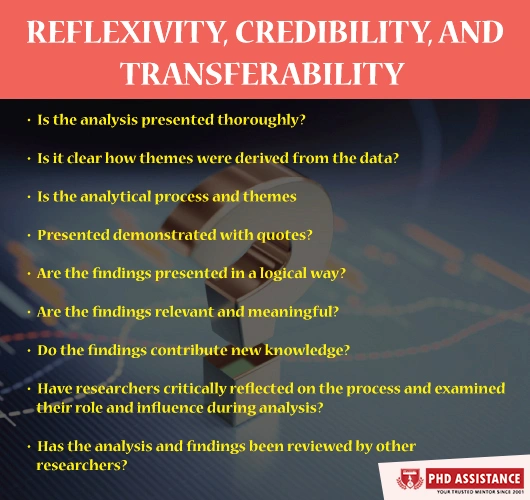
In reflexive thematic analysis the researcher's perspective is a resource, not a bias to be eliminated, but it must be examined and made visible (Braun & Clarke, 2021; Finlay, 2002). Keep a journal of analytic decisions, and discuss your interpretations with a supervisor or peer to challenge them rather than to reach agreement scores.
Trustworthiness is commonly judged by credibility, transferability, dependability and confirmability (Lincoln & Guba, 1985). Nowell et al. (2017) show how each phase of thematic analysis can address these criteria, for example through an audit trail of coding decisions, and Tracy (2010) offers broader markers of quality such as sincerity and meaningful coherence.
Using AI tools responsibly
Since 2023, researchers have tested large language models for qualitative coding. De Paoli (2024) found that a model could reproduce some themes from interview data but argued that the approach has clear limits for interpretive analysis. Morgan (2023) reported that ChatGPT handled descriptive themes better than subtle, interpretive ones, and Wachinger et al. (2025) found that a human researcher produced richer, more contextual analysis than the model.
If you use such tools, treat their output as one more prompt for your own thinking, check every suggested code against the data, protect participant confidentiality by not uploading identifiable transcripts to services that store them, and disclose the use in your methods section as your university and ethics approval require.
Worked example (illustrative)
A hypothetical doctoral researcher interviews 14 early-career teachers about their first year. After familiarisation, she codes extracts such as "staying late to look prepared" and "not asking for help in front of colleagues". A topic-based grouping would produce a weak theme called "workload". Instead, she constructs a theme, "performing competence", organised around the idea that new teachers manage how capable they appear, and checks it against the whole dataset. Extracts that do not fit, such as teachers who asked for help openly, are reported as a contrasting pattern rather than discarded.
Her reflexive journal records that she was herself a teacher who found the first year difficult, and that she was initially drawn to extracts describing struggle. Noticing this, she rereads the transcripts for accounts of confidence and support, which become a second theme about informal mentoring. In the write-up, each theme is introduced with its central idea, illustrated with two or three extracts from different participants, and interpreted in relation to the literature on professional identity. The methods section explains the approach, the coding orientation, the reflexive position and the audit trail, so that examiners can follow how the themes were developed (Byrne, 2022; Nowell et al., 2017).
What to report
| Item | What to state |
|---|---|
| Approach | Which kind of thematic analysis, and why it suits the question (Braun & Clarke, 2021) |
| Orientation | Inductive or deductive, semantic or latent coding |
| Process | How each phase was carried out, with software if used |
| Reflexivity | Your position and how it shaped the analysis |
| Quality | Audit trail, peer debriefing and other trustworthiness strategies (Nowell et al., 2017) |
| Reporting checklist | COREQ for interviews and focus groups or SRQR for qualitative studies generally (Tong et al., 2007; O'Brien et al., 2014) |
Common mistakes
- Presenting topic summaries ("participants discussed training") as themes.
- Mixing reflexive thematic analysis with inter-coder agreement statistics without explaining why.
- Writing that themes "emerged" instead of describing how they were developed.
- Using the interview questions as the themes.
- Listing quotations without analytic commentary.
For related reading, see qualitative research in medicine and health care, using AI in qualitative analysis ethically and reflexivity in quantitative research.
Key takeaways
- Thematic analysis is a family of approaches; decide whether yours is reflexive, codebook or coding-reliability before you start (Braun & Clarke, 2021).
- The six phases are recursive, and themes are constructed around a central organising concept rather than found (Braun & Clarke, 2006).
- Reflexivity and an audit trail, not agreement scores, underpin quality in reflexive thematic analysis (Finlay, 2002; Nowell et al., 2017).
- AI tools can support coding but cannot replace interpretive analysis (De Paoli, 2024; Wachinger et al., 2025).
- Report the approach, process and reflexivity using a recognised checklist (Tong et al., 2007; O'Brien et al., 2014).