
Why qualitative research matters in health care
Clinical trials and cohort studies tell us whether an intervention works and for whom, on average. They are less able to explain why patients stop taking a medicine, how teams keep a ward safe, or what a diagnosis means to a family. Qualitative research addresses such questions by studying people's accounts and actions in context. A synthesis of qualitative studies of medicine taking, for example, showed that many patients weigh medicines against their own concerns and adapt how they take them, an insight that adherence figures alone could not provide (Pound et al., 2005).
Qualitative work is now an established part of health research rather than a rarity, with its own reporting standards (Tong et al., 2007; O'Brien et al., 2014). Its claims are of a different kind from those of a trial: it explains meanings and processes and generates theory that can be tested or transferred, rather than estimating effects for a population.
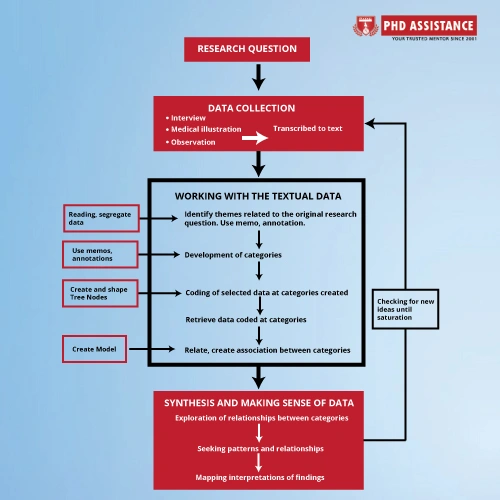
Choosing an approach
The approach follows from the question. Creswell and Poth (2018) describe five common traditions; two of them, phenomenology and ethnography, are especially frequent in health research, and qualitative description with thematic or content analysis is often used where a lighter theoretical commitment fits the aim.
| Approach | Typical question | Main data | Health example |
|---|---|---|---|
| Phenomenology | What is it like to live through this experience? | In-depth interviews with people who share the experience | Living with a new diagnosis of a chronic condition |
| Ethnography | How do people in this setting organise their work and meanings? | Observation, conversations, documents | How a maternity unit sustains safe practice (Liberati et al., 2019) |
| Grounded theory | What process explains how people handle this situation? | Interviews and observation, sampled theoretically | How patients decide whether to seek care |
| Qualitative description with thematic or content analysis | What are the views or experiences of this group? | Interviews or focus groups | Staff views of a new triage system (Graneheim & Lundman, 2004) |
Phenomenology seeks the essential structure of an experience as participants live it. Variants differ on whether the researcher can set aside prior assumptions or should interpret through them, so state which variant you follow. Ethnography studies a group or setting over time, often through observation, and is suited to questions about culture, routines and the gap between policy and practice (Liberati et al., 2019).
Collecting data: interviews, focus groups and observation
Semi-structured interviews are the most common method. A topic guide lists areas to cover while leaving room for participants to raise what matters to them. Focus groups add interaction, which helps when the aim is to understand shared norms or to compare views, but they suit sensitive topics less well because participants may not disclose in front of others. Observation shows what people do, which can differ from what they say they do.
Plan practical and ethical details as part of the design: where interviews take place, whether clinicians interview their own patients (which can affect what patients say), how recordings are stored, and how consent covers quotations. Reflect on ethically important moments that arise during fieldwork, not only on formal approval (Guillemin & Gillam, 2004).
Sampling and sample size
Qualitative samples are purposive: participants are chosen because they can inform the question, not to represent a population statistically. Strategies include maximum variation (to capture a range of experience), typical or critical cases, and theoretical sampling in grounded theory.
There is no single correct number. Malterud et al. (2016) propose information power: the more relevant information a sample holds, the fewer participants are needed. A narrow aim, highly specific participants, an established theory and strong interview dialogue all reduce the sample needed. Saturation is still widely used, and a systematic review of empirical tests found that saturation was typically reached within 9 to 17 interviews or 4 to 8 focus groups in studies with fairly homogeneous samples and narrow aims (Hennink & Kaiser, 2022). Report how you judged sufficiency rather than simply asserting that saturation occurred.
Analysing qualitative data
Most health studies begin by transcribing recordings and reading them repeatedly. Analysis then moves from description to interpretation. In thematic analysis, the researcher codes features of the data, develops candidate themes, reviews them against the data set and defines them before writing up (Braun & Clarke, 2006). Braun and Clarke later stressed that reflexive thematic analysis treats themes as patterns of shared meaning that the researcher constructs, not as objects that "emerge", and that quality depends on coherent, reflexive practice rather than counting coder agreement (Braun & Clarke, 2021). Qualitative content analysis offers a more structured alternative, moving from meaning units to codes, categories and themes (Graneheim & Lundman, 2004).
Software such as computer-assisted qualitative data analysis packages helps to store, code and retrieve data and to keep an audit trail. Large language models can now suggest codes. In one exploratory test, a model inferred most of the main themes reported in earlier human analyses of two open interview data sets, but the author stressed the limits of the approach and the need for human oversight (De Paoli, 2024). If you use such tools, check your institution's policy and ethics approval, describe exactly how you used them, and keep interpretation under your control.
Rigour: reflexivity, triangulation and trustworthiness
Qualitative rigour is usually discussed as trustworthiness, with criteria of credibility, transferability, dependability and confirmability (Lincoln & Guba, 1985). Several practices support these:
- Reflexivity. Record how your background, role and assumptions shape data collection and interpretation. For a clinician-researcher this is especially important (Finlay, 2002).
- Triangulation. Compare data from different methods, sources, researchers or theories to see where they converge and where they differ.
- Audit trail. Keep memos, code books and decision notes so that another researcher could follow your reasoning.
- Member reflection. Returning findings to participants can enrich them, but it is not proof of validity, because participants and researchers may legitimately interpret data differently (Birt et al., 2016).
Reporting against current standards
Health journals and examiners expect qualitative studies to be reported against a recognised checklist. COREQ sets out 32 items for interview and focus group studies, grouped into research team and reflexivity, study design, and analysis and findings (Tong et al., 2007). The Standards for Reporting Qualitative Research (SRQR) cover qualitative studies more broadly, including other approaches (O'Brien et al., 2014). Use the checklist while you write, not only at submission, and include the completed checklist as an appendix to your thesis or paper.
Where qualitative findings are used
Qualitative studies inform several areas of health care. In quality improvement and patient safety, they show how teams actually work, which formal indicators miss (Liberati et al., 2019). In communication research, they examine how clinicians and patients share information and make decisions. In service evaluation, they explain patient experience and satisfaction in terms that survey scores cannot, and they identify barriers to changing practice when a new guideline or technology is introduced. In trials, qualitative process work helps explain why an intervention did or did not work in a particular setting.
In each case, the value lies in explanation and transfer. Readers judge whether findings apply to their own setting from the description you give of participants, context and analysis, so thick description is part of rigour, not decoration (Lincoln & Guba, 1985).
Worked example (illustrative)
A hypothetical doctoral study asks how older adults with heart failure decide whether to contact services when symptoms worsen. The researcher chooses qualitative description with reflexive thematic analysis, because the aim is to understand reasoning rather than to build formal theory. Participants are sampled purposively for variation in age, living arrangements and time since diagnosis, recruited through two outpatient clinics by staff who do not treat them. The sample size is justified by information power: a focused aim and specific participants suggest that around fifteen to twenty interviews may suffice, with the final number judged against the richness of the data (Malterud et al., 2016).
Interviews are transcribed and coded by the researcher, with a second researcher discussing codes to widen interpretation rather than to compute agreement (Braun & Clarke, 2021). A reflexive journal records the researcher's nursing background and how it shaped questions. The thesis reports the study against COREQ (Tong et al., 2007).
Common mistakes
- Choosing an approach by name without matching it to the question and data.
- Claiming saturation without saying how it was judged (Hennink & Kaiser, 2022).
- Presenting themes as topics ("barriers", "facilitators") with no interpretation.
- Treating software output, including AI suggestions, as the analysis.
- Omitting reflexivity when the researcher is also a clinician in the setting.
- Reporting without a checklist such as COREQ or SRQR.
For a step-by-step treatment of analysis, see thematic analysis step by step; for another health example, see qualitative research methodology in otolaryngology; and for an observational approach, ethnographic research.
Key takeaways
- Qualitative research explains meanings and processes in health care that trials and cohorts cannot (Pound et al., 2005).
- Match the approach to the question, and state which variant you follow (Creswell & Poth, 2018).
- Justify sample size with information power and transparent judgement (Malterud et al., 2016; Hennink & Kaiser, 2022).
- Treat analysis as interpretation, supported but not done by software (Braun & Clarke, 2021; De Paoli, 2024).
- Show rigour through reflexivity and report against COREQ or SRQR (Finlay, 2002; Tong et al., 2007; O'Brien et al., 2014).