
Why section-specific phrases help
Most research articles in the sciences, and many in the social sciences, follow the introduction, methods, results and discussion (IMRaD) structure, which became the dominant format over the twentieth century (Sollaci & Pereira, 2004). Each section has a different job. The introduction argues that a question matters and has not been answered; the methods let a reader judge and repeat what was done; the results report findings; the discussion interprets them. Genre research describes these jobs as rhetorical moves, such as establishing a research territory, identifying a niche and occupying it (Swales, 1990).
Conventional phrases are signals that a move is being made. Used well, they help readers, including reviewers reading quickly, follow the argument. Used badly, they become filler: a sentence that announces a gap without naming it, or a conclusion that praises the method without saying what it achieved. The aim of a phrase list is therefore not to sound academic but to make each move explicit and then complete it with your own content.
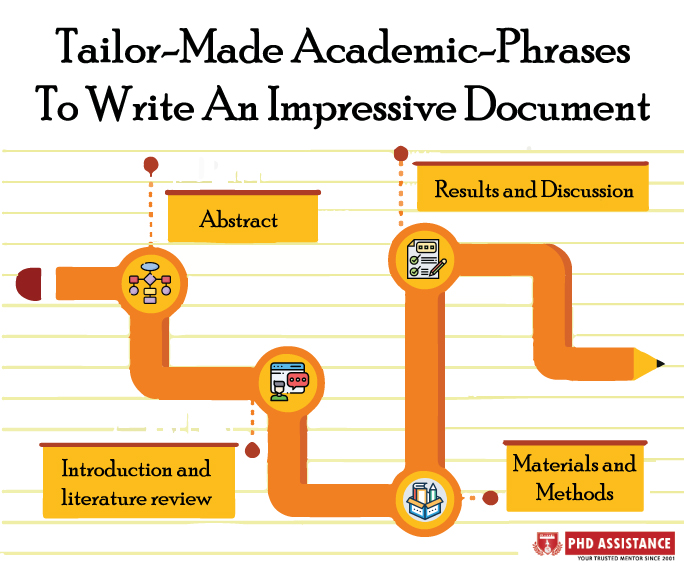
Phrases by section, and the job each does
The table collects common phrases and adds the function of each. Square brackets mark what you must supply.
| Section and move | Model phrase | What you must add |
|---|---|---|
| Abstract: background | [X] is a leading cause of [Y] ... | A specific, citable fact |
| Abstract: aim | The overall objective of this study was to ... | One precise aim, matching the paper |
| Introduction: territory | A growing body of literature shows that ... | Two or three citations that show it |
| Introduction: territory | Recent evidence shows that ... | The evidence, with dates and sources |
| Introduction: trend | The past [n] years have seen rapid growth in ... | The period and a measure of growth |
| Introduction: niche | Although many studies have examined [X], none has yet examined [Y] ... | Why [Y] matters and how you checked |
| Introduction: occupying the niche | To address this gap, we asked ... | The research question or hypothesis |
| Methods: procedure | In preliminary experiments, we found that ... | What the pilot showed and how it shaped the design |
| Methods: analysis | Statistical analysis was performed using [software, version] ... | Software, version, tests and settings |
| Results: finding | There was a positive correlation between [X] and [Y] (r = ..., 95% CI ...) | Effect size and uncertainty |
| Discussion: interpretation | The results indicate that ... | The interpretation and its limits |
| Discussion: comparison | These findings are consistent with ... | Which studies, and where they differ |
| Discussion: limitation | The limitations of this study include ... | Each limitation and its likely effect |
| Conclusion: implication | These findings may provide insights into ... | Which insight, for whom |
| Conclusion: future work | Further research should test whether ... | A testable next step tied to a limitation |
Tense, voice and perspective
Each section has its own tense and voice, but the choice follows the function of the sentence rather than the section as such. APA style advises consistency: past tense or present perfect to describe earlier studies and your own procedures and results, and present tense to discuss what results mean and to state conclusions (American Psychological Association, 2020). Many journals now accept, and APA style recommends, the first person ("we measured") where it avoids ambiguity, rather than long passive chains in which the reader cannot tell who did what (American Psychological Association, 2020). Check the author guidelines of your target journal, because conventions vary by discipline.
- Describing a study: "Smith (2022) found that ..." (past).
- Describing a body of work: "Several studies have reported ..." (present perfect).
- Describing your method: "Participants completed ..." (past).
- Interpreting: "This suggests that ..." (present).
Calibrate your claims
"It is obvious that" asserts what the reader should be allowed to judge; "our results confirmed" treats one study as settling a question; "could be a great tool" is promotional. Academic writers manage the strength of claims with hedges (may, suggests, appears to) and boosters (clearly, demonstrates), and reviewers notice when the two are out of line with the evidence.
| Overclaiming or vague | Calibrated alternative |
|---|---|
| From the results, it is obvious that ... | The results indicate that ... |
| Our results confirmed that ... | Our results support / are consistent with ... |
| ... has shown promising results and could be a great tool for ... | ... reduced [X] by [amount] in [setting], and may be useful for [purpose] if [condition] |
| We believe that there should be further research ... | Further research should test whether [X] holds in [setting] |
| Nevertheless, there are still challenges regarding ... | Two problems remain: [first] and [second] |
A hedge is not a sign of weak writing. It is an accurate statement of how much the evidence can bear. The same applies to "no study has examined": write it only after a documented search, and preferably say what the closest studies did.
Adapt phrases so that they carry content
A phrase list is a starting point. Three habits stop borrowed wording from sounding templated.
- Complete every phrase with specifics. "A growing body of literature" must be followed by the literature. If you cannot fill the brackets, the sentence is not ready.
- Vary signals once the reader knows the structure. Repeating "In addition" or "Moreover" at the start of every paragraph draws attention to the scaffolding instead of the argument.
- Build your own list from your target journal. Collect phrases from ten recent articles in the journal you are aiming for. A small, well-chosen set of texts that matches your purpose is more useful than a general list, which is the logic of corpus design applied to your own reading (Egbert et al., 2022).
Short conventional phrases such as "the aim of this study was to" belong to the genre and do not need citing. Copying an author's sentences, or the structure of a paragraph with its argument, does. If you write in English as an additional language, model phrases are a legitimate scaffold; the debate about how far non-native writers are disadvantaged in publishing continues (Flowerdew, 2019; Hyland, 2016), but clarity and precision matter more to reviewers than idiomatic flourish.
Generative AI and phrasing
Many doctoral writers now ask chatbots to suggest phrasing, and research is beginning to describe how they do so (Wu et al., 2026; Krumsvik, 2025). AI-suggested phrases have the same risks as phrase lists, plus some of their own: they tend towards generic wording and confident claims, and they can introduce statements the evidence does not support. Publication ethics guidance holds that AI tools cannot be authors and that authors must disclose how such tools were used (Committee on Publication Ethics, 2023). Check your target journal's policy and your university's rules, record what you used, and read every suggested sentence against your data.
Worked example: from templated to specific (illustrative)
Templated draft: "The last few years has seen a huge development in mobile health. Recent evidences show that apps are effective. However, no study has so far examined this. From the results, it is obvious that our app could be a great tool for patients."
Revised: "Since 2020, randomised trials of smartphone self-management apps for type 2 diabetes have reported modest reductions in HbA1c [citations]. These trials recruited mainly urban, younger adults, and none, to our knowledge, has tested an app in rural primary care. In this pilot, HbA1c fell by [amount] more in the app group than in usual care, which suggests that the approach may be feasible in rural settings; a larger trial is needed to estimate the effect reliably."
The revision keeps the moves of the original (territory, niche, finding, implication) but replaces each empty phrase with content the reader can check, corrects the grammar, and scales the claim to a pilot. The clinical details are placeholders for illustration, not findings.
Common mistakes
- Announcing a gap ("few studies have examined") without naming the studies or the search.
- Using "prove", "confirm" or "obvious" for findings from a single study.
- Mixing tenses within one description of the same study.
- Stacking signposts ("Moreover", "Furthermore", "In addition") at the start of consecutive paragraphs.
- Ending with "further research is needed" without saying what research.
- Using chatbot phrasing without checking it or disclosing it (Committee on Publication Ethics, 2023).
Thesis chapters follow related but looser conventions than articles (Paltridge, 2002); if you are turning chapters into papers, expect to rewrite the framing for a new audience (Kamler, 2008). Conclusions in particular differ: thesis conclusions often restate and consolidate across chapters (Bunton, 2005), while an article's conclusion is short and specific. For editing your own draft, see editing and proofreading your own dissertation.
Key takeaways
- Each section of an IMRaD paper makes different rhetorical moves, and phrases are signals for those moves (Swales, 1990; Sollaci & Pereira, 2004).
- Choose tense by function and use the first person where it removes ambiguity (American Psychological Association, 2020).
- Scale every claim to the evidence; replace "obvious" and "confirmed" with calibrated wording.
- Complete every model phrase with specific, checkable content, and build your phrase list from your target journal (Egbert et al., 2022).
- Disclose generative AI use in writing and check every suggested sentence (Committee on Publication Ethics, 2023; Wu et al., 2026).