
About this example
This page is a short research proposal in computer science, on making autonomous robotics accessible to secondary school students through cloud-based robot services and visual programming. It is annotated to teach two lessons in particular: how to credit the prior work a proposal builds on, and how to update a proposal whose methods and technology have dated.
It is an illustrative teaching example, not a real student's proposal. The prior work it describes is real and cited. Read each passage, then the "What to notice" note beneath it. Do not submit any part of it as your own work.
The example: introduction, problem and aims
1. Introduction
Computing has moved from stand-alone desktop machines to networked services, and the Internet of Things now connects sensors, actuators and devices through common protocols (Al-Fuqaha et al., 2015). Robots can be treated in the same way. In a service-oriented approach, a robot's sensing and movement are exposed as services that software can call over a network (Chen & Bai, 2008). Building on this idea, Chen and colleagues proposed Robot as a Service, in which robots are accessed through cloud computing (Chen et al., 2010), extended it to an "Internet of intelligent things" (Chen & Hu, 2013), and used it in university computing courses (Chen & Zhou, 2015). This proposal asks whether the same approach can make autonomous robotics achievable for secondary school students.
2. Problem statement
Many school robotics activities rely on remotely controlled robots, and students may spend much of their time on mechanical construction rather than on programming. Building a robot that acts autonomously usually requires knowledge of hardware interfaces and low-level programming that most school students do not yet have. As a result, students may gain little experience of the computational thinking that autonomous systems demand. The extent of this problem in the schools to be studied will be established in the first phase of the project rather than assumed.
3. Aim and objectives
The aim is to design and evaluate a robotics platform that lets secondary school students program autonomous behaviour through visual programming and cloud-hosted robot services. The objectives are:
- To establish, through teacher interviews and a review of competition rules, how school robotics is currently taught and assessed.
- To adapt an existing Robot as a Service architecture for a school setting (Chen et al., 2010; Chen & Zhou, 2015).
- To build a starter kit and a sequence of progressively autonomous challenges.
- To evaluate students' learning, engagement and programming success in partner schools.
The example: literature and gap
4. Literature review
Three bodies of work frame the project. The first is service-oriented and cloud robotics, led for this application by Chen and colleagues (Chen & Bai, 2008; Chen et al., 2010; Chen & Hu, 2013). The second is the wider Internet of Things literature, which treats connected devices as systems of systems and now has a standard reference architecture (Fortino et al., 2021; ISO/IEC, 2024). The third is computing education. A systematic review of introductory programming identified the difficulties novices face (Luxton-Reilly et al., 2018), and generative AI is now changing how programming is taught and assessed (Denny et al., 2024). Research on STEM education has grown rapidly, but its focus has shifted over time (Abdi et al., 2024), so the place of robotics within it must be established rather than assumed.
4.1 Research gap
Robot as a Service has been used in university courses (Chen & Zhou, 2015), but its use with secondary school students, who have less programming experience, has not been evaluated in the studies reviewed here. In addition, the original visual programming environment belonged to a platform that is no longer developed, and the effect of current block-based tools and AI coding assistants on school robotics is unknown.
The example: methodology
5. Methodology
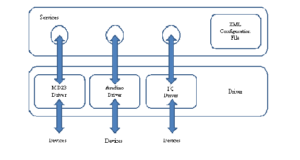
The project follows a design-and-evaluate approach in three phases. In Phase 1, teachers in partner schools are interviewed about current practice. In Phase 2, a platform is built that exposes the robot's sensors and motors as network services, following the published architecture (Chen et al., 2010), with a block-based visual programming front end. In Phase 3, the platform is used in classes and evaluated.
| Element | Weak version | Updated specification | Reason |
|---|---|---|---|
| Controller | Intel Core 2 Duo and Atom N270 boards | Any current low-cost single-board computer or microcontroller | Original boards obsolete; keeps the design platform-neutral |
| Operating system | Windows XP or Linux | A currently supported operating system | Windows XP support ended in 2014 |
| Programming environment | Microsoft Robotics Studio VPL | A current block-based visual language | Original platform no longer developed |
| Robot middleware | Custom C# and Java services | Services built on current open-source robot middleware | Maintainability and school IT support |
| Evaluation | Not specified | Pre and post tasks, completion of challenges, interviews | Needed to answer objective 4 |
Evaluation combines students' success on programming challenges, a short pre and post test of programming concepts, and interviews with teachers. Because participants are minors, the study will need ethics approval, school permission, parental consent and student assent, and will collect no personal data that the analysis does not need.
5.1 Risks and timeline
| Phase | Months | Main output | Main risk and response |
|---|---|---|---|
| 1. Teacher interviews and rules review | 1 to 6 | Account of current practice | Low response: recruit through school networks early |
| 2. Platform adaptation and starter kit | 7 to 18 | Working platform and challenge sequence | Network restrictions in schools: support an offline mode |
| 3. Classroom evaluation | 19 to 30 | Learning and engagement findings | Timetable disruption: agree dates with schools a term ahead |
| Writing up | 31 to 36 | Thesis and papers | Delays in earlier phases: keep chapters drafted as phases end |
6. Summary
The project adapts an established Robot as a Service architecture for secondary schools, updates its toolset and evaluates whether it lets students program autonomous robots. Its contribution is evidence on a new population and a reusable starter kit.
How to adapt this to your own proposal
- Name the prior work your design builds on in the sentence where you introduce it.
- State your contribution relative to that work: a new population, setting, method or extension.
- Write a problem statement that can be checked, and say how you will check it.
- Specify technology by requirement where products date quickly, and check that named tools are still supported.
- Link every objective to a method and an evaluation.
- Plan ethics early, especially with minors or schools.
Common mistakes in technical proposals
- Describing another researcher's system as your own design, even with a citation at the end of the list.
- Copying a published architecture diagram without a source line or permission.
- Specifying hardware or software that is obsolete or unsupported.
- Stating a problem in vague or garbled terms that cannot be tested.
- Listing objectives with no evaluation plan.
- Citing a reference that does not support the claim it is attached to.
Key takeaways
- Robot as a Service is Chen and colleagues' approach; a proposal that uses it must say so (Chen et al., 2010).
- A new population and updated tools can be a sound contribution (Chen & Zhou, 2015).
- Specify technology by requirement and check it is still supported.
- Ground the education side in computing education evidence (Luxton-Reilly et al., 2018; Denny et al., 2024).
- Link each objective to an evaluation and plan ethics early (Kivunja, 2016).