
Why qualitative methodology is hard for psychology PhD researchers
Qualitative research lets psychologists study how people experience and make sense of distress, care, relationships and change. Many psychology PhD researchers, however, arrive with training built mainly on experiments and questionnaires. They are then asked to choose an approach, justify a sample, analyse text systematically, account for their own influence and meet ethics requirements, often all in the first year.
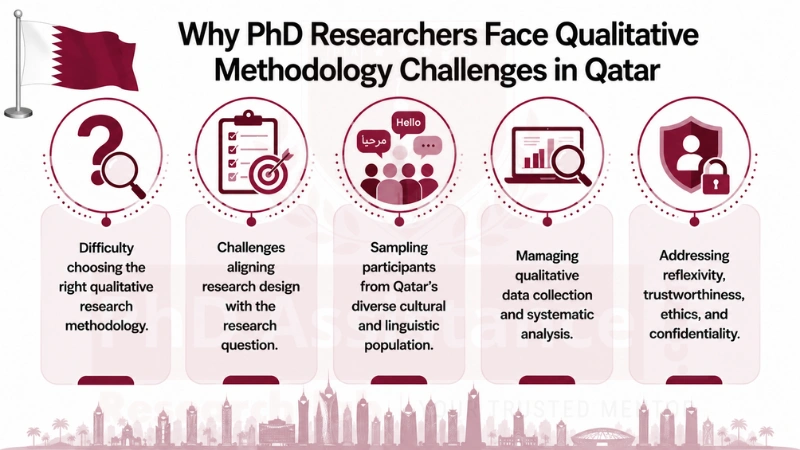
In Qatar these tasks have extra layers. Participants and professionals come from many nationalities; Arabic and English are both in daily use, and care is often delivered across language boundaries. Mental health remains a sensitive subject for many families. Each of these features affects who can be recruited, in which language interviews are held and how meaning is preserved when data are translated. The sections below look first at how researchers in Qatar have handled these issues, then turn that evidence into practical steps for your own design.
How researchers in Qatar have designed qualitative studies
Recent studies by authors at Qatar University, Hamad Bin Khalifa University (HBKU), Weill Cornell Medicine-Qatar and the Primary Health Care Corporation (PHCC) show a consistent set of design choices: focus groups or semi-structured interviews, purposive samples, an explicit theoretical model and a structured analytic method.
| Study | Participants and setting | Data collection | Analysis | Lesson for your design |
|---|---|---|---|---|
| El-Awaisi et al. (2024a) | 43 health profession students, Qatar University, during COVID-19 | Eight focus groups | Framework Analysis Approach guided by the Coping Reservoir Model | A named model can structure both the topic guide and the analysis |
| El-Awaisi et al. (2024b) | 58 primary care professionals in Qatar | 14 semi-structured focus groups, purposive sampling | Deductive thematic analysis using the "Gears" model | Deductive coding is defensible when the framework is stated in advance |
| Dixon et al. (2025) | Patients and staff of PHCC, about 70 nationalities | 18 focus groups, 11 in English and 7 in Arabic | Framework method, two independent coders | Plan language-specific groups and report the translation process |
| Al-Najdi et al. (2025) | 15 undergraduate healthcare students with mild to moderate depressive symptoms | Semi-structured interviews after screening a survey sample | Thematic analysis, inductive and deductive coding | Screening can identify information-rich participants for purposive sampling |
| Alkhatib (2026) | Mental Health Service, Hamad Medical Corporation | Theoretical chapter preparing empirical work | Practice theory (Schatzki) applied to interpreter-mediated encounters | Theory choice for language barriers is a methodological decision in itself |
Two points stand out. First, structured approaches dominate. El-Awaisi et al. (2024a) used the Coping Reservoir Model as a framework for their focus groups with students, and El-Awaisi et al. (2024b) coded deductively against the Gears model of interprofessional collaboration. A doctoral study can follow this route, but it must then explain why a pre-set framework suits the question better than an inductive analysis.
Second, language is handled explicitly when it is handled well. Dixon et al. (2025) ran some focus groups in Arabic, moderated by trained PHCC staff, and had the recordings translated by certified translators, with English transcripts checked against the original recordings. Participants also reported language barriers in clinical consultations, which is the problem Alkhatib (2026) addresses theoretically for the mental health service of Hamad Medical Corporation, where ad hoc interpreters are often used. For a psychology thesis on help-seeking, therapy or family decision-making, language is therefore part of the phenomenon, not only a practical obstacle.
Quantitative work supplies useful context. In an online survey of 812 Qatar University students, Al-Jayyousi et al. (2025) found that 45.5% reported a lifetime diagnosis of mental illness, and the sample was 84.6% female. That study was not qualitative, but its sample composition is a reminder that volunteer recruitment through university email can over-represent some groups, which a qualitative researcher should anticipate when planning purposive sampling.
Choosing an approach that follows from your question
The commonest early mistake is to choose a method first and then write a question to suit it. Start with what you want to know, then pick the approach whose purpose matches. The American Psychological Association reporting standards for qualitative research ask authors to explain this fit explicitly (Levitt et al., 2018).
| If your question asks... | A suitable approach | Typical data | What you must justify |
|---|---|---|---|
| How do people experience a specific situation? | Phenomenology or interpretative phenomenological analysis | In-depth interviews with a small, homogeneous sample | Homogeneity of the sample and depth of interviews |
| How does a social or psychological process unfold? | Grounded theory | Interviews with theoretical sampling | How sampling followed emerging categories |
| What patterns of meaning run across a data set? | Reflexive or codebook thematic analysis | Interviews or focus groups | Which version of thematic analysis and why (Braun & Clarke, 2006) |
| How does a case work in its context? | Case study | Interviews, documents, observation | Case boundaries and how sources were combined |
| How do people tell and organise their stories? | Narrative research | Life-story or episodic interviews | How narratives were analysed as wholes |
In the Qatar context, check feasibility at the same time. Can you reach the population in the language you plan to use? Will the setting allow audio recording? Does a gatekeeper such as a clinic, school or employer need to approve access? A design that is ideal in principle but impossible to recruit for will not survive the ethics stage. For wider guidance on fitting design to question, see Research Methodology and our article on narrative research.
Sampling and language in a multilingual setting
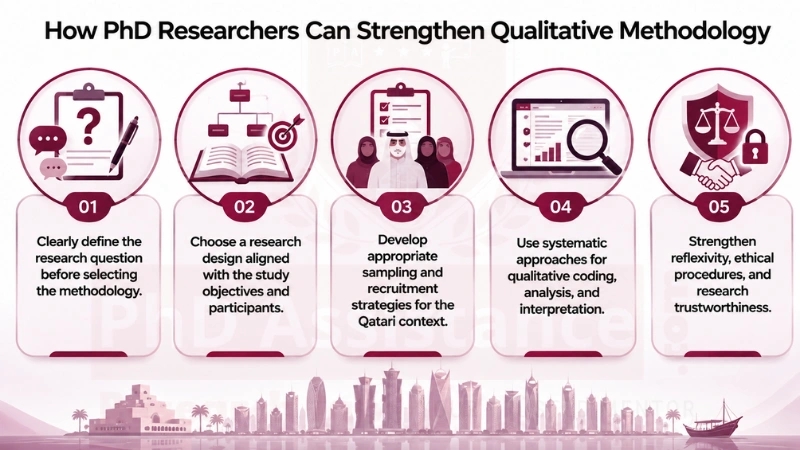
Qualitative samples are chosen for the information they can provide, not to represent a population statistically. Define inclusion and exclusion criteria, then explain how your strategy (purposive, snowball, maximum variation or criterion sampling) reaches people who can speak to the question (Robinson, 2014). Al-Najdi et al. (2025) illustrate one route: they surveyed students with validated screening scales and then invited those with mild to moderate symptoms to interview.
Justify the number of participants with the concept of information power: the narrower the aim, the more specific the sample, the stronger the theory, the richer the dialogue and the more focused the analysis, the fewer participants you need (Malterud et al., 2016). Avoid promising "saturation" as an automatic stopping rule; Braun and Clarke (2021) argue that it does not fit reflexive thematic analysis, where meaning is generated through interpretation rather than discovered as a finite set of codes.
For language, decide before fieldwork who will conduct interviews in Arabic, who will transcribe and translate, and whether analysis will be done on original-language or translated text. Temple and Young (2004) show that translators shape meaning and should be treated as part of the research process rather than as invisible technicians. Record these decisions; examiners will ask about them.
Analysis, reflexivity and trustworthiness
Choose an analytic method that matches your approach and describe it step by step. For thematic analysis, Braun and Clarke (2006) set out phases from familiarisation through coding to defining and naming themes; framework analysis, used by El-Awaisi et al. (2024a) and Dixon et al. (2025), adds a matrix that summarises data by case and theme. Keep an audit trail: the codebook or coding notes, how codes became themes and why some were merged or dropped.
Reflexivity matters especially when the researcher is a clinician, a lecturer or a member of the community studied. Keep a reflexive journal from the start, note how your role may affect what participants say, and explain in the thesis how you handled it. Quality criteria such as sincerity, credibility and resonance (Tracy, 2010) give you a vocabulary for this discussion, and the COREQ checklist (Tong et al., 2007) lists the interview and focus group details that should be reported.
Ethics and data protection
Psychological interviews often touch on confidential and distressing topics. Your protocol should cover informed consent in the participant's language, protection of identity in quotations, a plan for participants who become distressed (including referral information), secure storage of recordings and transcripts, and how long data will be kept. Qatar-based studies report approval from bodies such as the Qatar University Institutional Review Board (Al-Najdi et al., 2025); studies in health services also need the approval route of the host organisation, as Dixon et al. (2025) describe for PHCC. Confirm early which committees must approve your study and how long each takes.
Small, multinational communities raise a specific risk: a quotation that mentions a nationality, job title and workplace can identify someone even without a name. Decide in advance which details will be removed or generalised, and tell participants how quotations will be used.
Worked example (illustrative)
The following study is hypothetical and shows how the decisions above fit together.
- Question. How do Arabic-speaking parents in Qatar make sense of their adolescent's referral to mental health services?
- Approach. Interpretative phenomenological analysis, because the question concerns lived experience and meaning in a specific situation.
- Sample. Eight to twelve parents recruited through an outpatient service, purposive and fairly homogeneous; the number justified by a narrow aim and dense interviews (Malterud et al., 2016).
- Language. Interviews in Arabic by a trained bilingual interviewer; analysis on Arabic transcripts with translated extracts checked by a second bilingual researcher (Temple & Young, 2004).
- Rigour. Reflexive journal, audit trail, supervisor review of a sample of coded transcripts, and reporting against JARS-Qual (Levitt et al., 2018).
- Ethics. University and host-service approvals, distress protocol, and removal of nationality and workplace details from quotations.
What to report in your methodology chapter
| Element | What examiners look for |
|---|---|
| Research question and approach | A clear reason why this approach answers this question |
| Philosophical position | Assumptions about knowledge that are consistent with the analysis |
| Sampling and recruitment | Criteria, strategy, access route and a justified number |
| Language and translation | Who translated, at what stage, and how meaning was checked |
| Analysis | Named method, steps followed, and how themes were developed |
| Reflexivity and quality | Researcher position, journal, audit trail and quality criteria used |
| Ethics | Approving bodies, consent, distress protocol, anonymisation and data storage |
Common mistakes and a quick self-check
- Writing the research question after choosing the method.
- Mixing approaches (for example, phenomenology and grounded theory) without explaining why.
- Promising saturation or a fixed sample size without a rationale.
- Treating translation as a technical step and not reporting it.
- Describing analysis as "themes emerged" without showing how they were developed.
- Leaving reflexivity and ethics to the final draft.
Before you submit your proposal, check that you can answer yes to each of these: Is your Qatar-based target population clearly defined? Does your sample fit your question and approach? Have Arabic-English language and cultural factors been planned for? Are consent, confidentiality and data protection covered? Does the study address a clearly defined psychological, health or social need in Qatar? For help shaping the question itself, see choosing a psychology research topic.
Key takeaways
- Recent Qatar-based qualitative studies favour purposive samples, focus groups or interviews, explicit frameworks and structured analysis (El-Awaisi et al., 2024a; El-Awaisi et al., 2024b; Dixon et al., 2025).
- Language is often part of the phenomenon in Qatar, so translation decisions must be planned and reported (Temple & Young, 2004; Dixon et al., 2025).
- Justify sample size with information power, not a fixed number or an automatic appeal to saturation (Malterud et al., 2016; Braun & Clarke, 2021).
- Describe your analytic steps and keep an audit trail and reflexive journal throughout (Braun & Clarke, 2006; Tracy, 2010).
- Use JARS-Qual and COREQ to check that your methodology chapter reports what examiners expect (Levitt et al., 2018; Tong et al., 2007).