

Digital Therapeutics and Intelligent Patient Monitoring in Connected Healthcare Systems
July 10, 2026
Call for Papers: Global Capital Reallocation, Geoeconomic Fragmentation, and the Future of International Finance
July 13, 2026Stuck at Chapter 4? Why UK PhD Students Fail to Finish Their Dissertation on Time
- July 13, 2026
- Full Dissertation
Introduction
The PhD thesis writing process can be a daunting task for many students, but especially when it comes to writing Chapter 4, Results and Findings, many of them struggle in the UK. This chapter necessitates that researchers interpret their research data and show how they have met the goals of the research through these results. What sets Chapter 4 apart from other chapters is its demand on analytical and critical skills.
Several studies indicate that delay issues encountered by researchers during the advanced phases of research work are associated with problems encountered in dissertation writing and progress management. For instance, Dowle (2023) established that timely academic advice and proper progress checks contribute to successful dissertation completion.
Many UK-based PhD students face difficulties in terms of data analysis, interpretation of results, presentations, and implementation of supervision suggestions, leading to constant revision of work and delay in submission. Professional PhD Complete Dissertation Services in UK from PhD Assistance Research Lab assist researchers in overcoming such issues.
What you will learn from this blog?
- Why Chapter 4 delays dissertation completion.
- Common challenges faced by UK PhD students during data analysis.
- Practical strategies to prepare a high-quality Results chapter.
- How structured dissertation support improves research quality.
Understanding the importance of PhD Full Dissertation Services in UK
Writing a PhD dissertation is certainly among the most challenging aspects of PhD research, during which researchers must create an integral academic work by incorporating all parts of their research. Each step, from creating a research framework to concluding the study, should be consistent with the goals of the research and UK University requirements.
Some scholars find it difficult to maintain coherence across all the dissertation chapters while writing the complete chapters. They should keep in mind to balance uniformity when writing the dissertation. The research objective should be reflected in all the chapters. PhD Full Dissertation Services in UK can help you successfully go through all the stages of writing your dissertation in the UK.
Why are UK students stuck at Chapter 4?
1. Difficulty Analysing Research Data
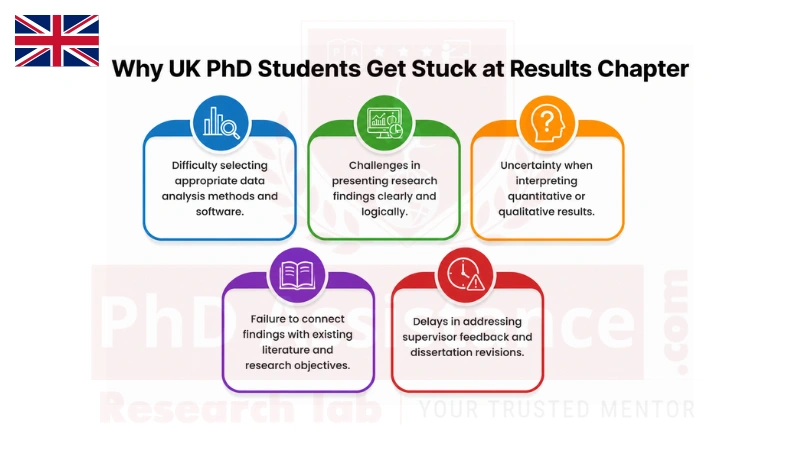
One of the main reasons why PhD students get stranded at Chapter 4 is the ambiguity in the analysis of research data. Deciding which statistical or qualitative analysis technique to use depends on a solid grasp of research methodologies and properties of research data. Many researchers have enough data but face difficulty in deciding which tools to use for its analysis, including SPSS, R, Stata, NVivo, and MAXQDA. Consequently, they end up spending a lot of time trying different approaches to data analysis.
As a result, much of their time is spent on testing various methods of data analysis. The mistakes in the analysis can create wrong results, which will force the students to repeat the analysis or use another research method. This problem not only delays the writing of the dissertations but also affects the credibility of the results of the study.
Example: According to Saunders, Lewis, and Thornhill (2019), any data analysis must correspond to the research aims, design, and measurements of variables. In addition, it should be noted that an inadequate choice of analysis methods may lead to a lack of research validity.
Tips
- Select analytical methods that align with your research objectives.
- Use validated statistical or qualitative software appropriately.
- Verify analytical assumptions before conducting the analysis.
- Justify your analytical approach within the methodology chapter.
2. Addressing Poor Presentation of Research Findings with AI Complete Dissertation Support in UK
A further major problem lies in communicating research findings logically. Often, many PhD students only move the output of their statistical analysis or the coded results into their dissertation, but do not clarify their significance. Others use too many tables, charts, and descriptive statistics without showing the connection between the results and the research question or objectives.
In UK universities, Chapter 4 should contain the findings logically and in an organised manner with appropriate use of subheadings, tables, figures, and concise explanation. Organised presentation allows the examiner to comprehend the significance of the findings. Researchers can get expert AI Complete Dissertation Support in UK to present their results appropriately.
Example: As explained by Field (2018), outputs from the statistics are not enough for communicating the findings of research. Results should be presented in an organised way where the connection of the findings to the research questions and the overall objectives of the research is made explicit.
Tips:
- Organise findings using logical themes and subheadings.
- Present tables and figures with concise explanations.
- Highlight findings that directly answer the research questions.
- Maintain consistency in formatting and reporting.
3. Difficulty Interpreting Research Findings
The generation of statistical and qualitative data is not the end of Chapter 4. A lot of PhD candidates face difficulties in explaining what their results mean and how their work fits into the existing scientific paradigm. Some researchers concentrate only on statistical significance without paying attention to the effect sizes, confidence intervals, or practical significance. Others do not connect qualitative themes to the research goals and theory.
In case of a lack of proper interpretation, the Results chapter becomes scientifically useless and gets numerous comments from a thesis supervisor. Proper interpretation shows that a researcher can analyse and interpret his or her results.
What research shows:
As stated by Wooldridge (2020), the results of any research must be interpreted taking into consideration both statistics and the area being studied, not just significance testing. To interpret the results meaningfully, the researcher should make clear what these mean for the objectives of the study.
Tips:
- Relate results directly to your research objectives.
- Explain unexpected findings with academic justification.
- Discuss the implications of your results objectively.
- Avoid drawing conclusions unsupported by the evidence.
4. Failing to Connect Findings with Existing Literature
Many students find it easy to analyse their data; however, they have a problem in linking their results with past research that has been done by other scholars as described in the literature review. This makes Chapter 4 look detached from the previous chapters of the dissertation. It is necessary for the examiners to get some information on how the results are related to previous research work done by others.
A good dissertation will be one that is able to critically compare its results to the literature and how it differs from previous studies.
What research shows:
Creswell & Creswell (2018) suggest that empirical evidence needs to be linked with prior literature to provide uniqueness and add value to the research work in general. Comparison between existing studies and new empirical results enables the research to become significant and contribute to the body of knowledge.
Tips:
- Compare findings with relevant previous studies.
- Identify agreements, contradictions, and research gaps.
- Explain theoretical and practical implications clearly.
- Demonstrate the originality of your research contribution.
Get the pricing details for the PhD full dissertation service at PhD Assistance Research Lab, designed to assist researchers in writing complete thesis chapters.
5. Managing Supervisor Feedback and Revisions
The importance of a supervisor’s comments cannot be overstated when it comes to enhancing the quality of a dissertation. Unfortunately, numerous issues emerge among students who find it difficult to deal with the number of changes and revise the text in a consistent manner. Delays, poor planning of changes, and constant corrections lead to an increased time for dissertation completion.
Those researchers who can organise the revision procedure and give prompt feedback will most likely succeed in writing their thesis. Besides, effective communication with the supervisor will help in minimising the number of revisions required and increase the quality of research performed.
Example: The work done by Lee (2018) emphasises the importance of constructive supervision and prompt feedback in increasing the completion of doctorate degrees and the quality of the work done. It helps in enhancing the quality of arguments in the research done.
Tips:
- Address supervisor feedback systematically.
- Prioritise revisions based on academic importance.
- Maintain version control throughout the writing process.
- Ensure consistency across all dissertation chapters.
Strategies to Complete Results Chapter Successfully
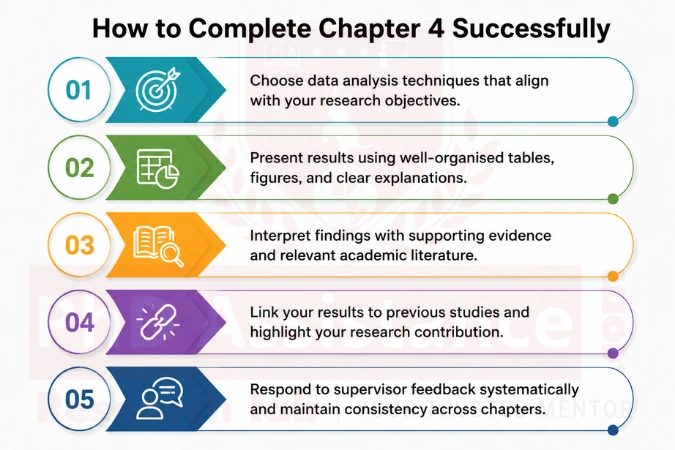
- Plan your analytical approach before writing.
- Select methods aligned with your research objectives.
- Present findings using logical headings and visuals.
- Interpret results with supporting academic evidence.
- Connect findings with existing literature.
- Seek professional PhD Full Dissertation Writing Help in UK for your dissertation analysis.
- Answer feedback from your supervisor immediately.
- Keep everything consistent throughout all the chapters of your dissertation.
Conclusion
Results and findings are usually the toughest part to complete when working on your PhD thesis, as it involves changing your research data into valuable scholarly results. The problems that one can face with data analysis, data results, data interpretation, literature review, and revision by the supervisor often slow down the process of finishing the dissertation of a UK PhD student. Nevertheless, proper preparation and the right approaches can help you a lot with Chapter 4.
Professional PhD Complete Dissertation Support in UK provides comprehensive assistance to researchers through the Results chapter by guiding them on how to analyse data and present results properly. With the proper help, scholars can cope with all issues related to the findings chapter.
Stuck at Chapter 4? Consult the experts at PhD Assistance for comprehensive dissertation writing support and complete your PhD on time.
Book a Free Expert Consultation to get clarity on how to present your results correctly.
References
- Creswell, J. W., & Creswell, J. D. (2018). Research Design: Qualitative, Quantitative, and Mixed Methods Approaches (5th ed.). Sage Publications. https://www.ucg.ac.me/skladiste/blog_609332/objava_105202/fajlovi/Creswell.pdf
- Field, A. (2018). Discovering Statistics Using IBM SPSS Statistics (5th ed.). Sage Publications. https://www.scirp.org/reference/referencespapers?referenceid=3504991
- Lee, A. (2018). Successful Research Supervision: Advising Students Doing Research (2nd ed.). Routledge. https://www.researchgate.net/publication/289309604_Successful_research_supervision
- Saunders, M., Lewis, P., & Thornhill, A. (2019). Research Methods for Business Students (8th ed.). Pearson. https://www.researchgate.net/publication/240218229_Research_Methods
- Wooldridge, J. M. (2020). Introductory Econometrics: A Modern Approach (7th ed.). Cengage Learning. https://www.scirp.org/reference/referencespapers?referenceid=4006544
