
Why statistical analysis is hard in UAE public health research
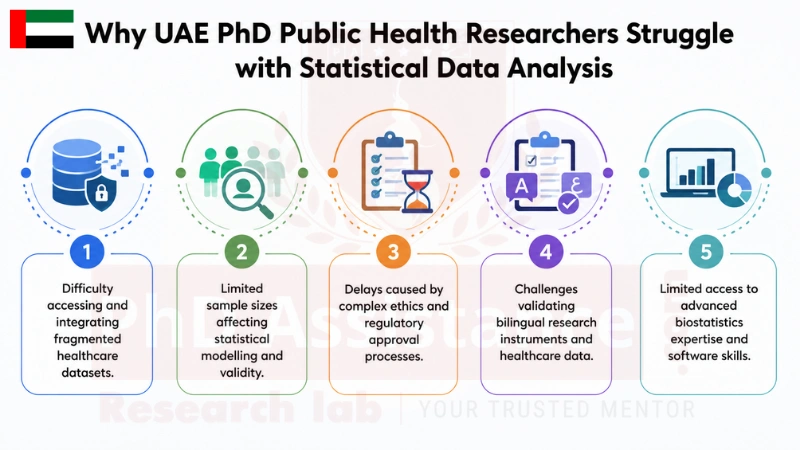
Public health doctoral research in the UAE sits on rich but awkward data. Health information exchange platforms such as Malaffi in Abu Dhabi, NABIDH in Dubai and the federal Riayati system have connected records across providers, but they were built to coordinate care, not to answer research questions. The population is diverse and mobile, Emirati nationals are a minority, and many studies need instruments in Arabic, English and other languages. Ethics approval can involve both a university and a health authority. Each of these features shapes the analysis, and examiners expect a thesis to show that the researcher anticipated them.
What UAE-based studies show
| Study | Data and design | Analytic problem and how it was handled |
|---|---|---|
| Aw et al. (2011) | Population-based cancer research experience at UAE University | Small national population, high mobility, incomplete registries and sampling frames; interviews in health settings, questionnaires in Arabic, English and Urdu, frames built with government agencies |
| AlKetbi et al. (2025) | Abu Dhabi cohort from screening programme records: 6,772 people without diabetes, mean follow-up 9.2 years, 643 new cases | Cox model with good discrimination (c-statistic 0.837); records with missing main variables excluded and no external validation reported |
| Swidan et al. (2022) | Records of 121,035 patients from 13 primary care centres in Dubai | Telemedicine rose from 0.2% to 14% of encounters; short comparison period and no data on education or digital literacy |
| Albahri et al. (2023) | Survey of medical students at the University of Sharjah | A single-institution sample; findings describe that group rather than all UAE students |
Researchers at UAE University described recurring obstacles to population studies: nationals are a small share of residents, people move often, registries and sampling frames are incomplete, and some questions are sensitive (Aw et al., 2011). Their responses, such as multilingual questionnaires and working with government agencies to build frames, remain good practice.
Recent work shows what routine records make possible. AlKetbi et al. (2025) used screening records from the Abu Dhabi Risk Study to model incident type 2 diabetes over about nine years. The study also shows two common gaps a doctoral project could close: participants were selected from records with complete main variables, and the model was not externally validated. Swidan et al. (2022) used large service records from Dubai but could not measure education or digital literacy, a reminder that routine data contain only what services record.
Working with fragmented health records
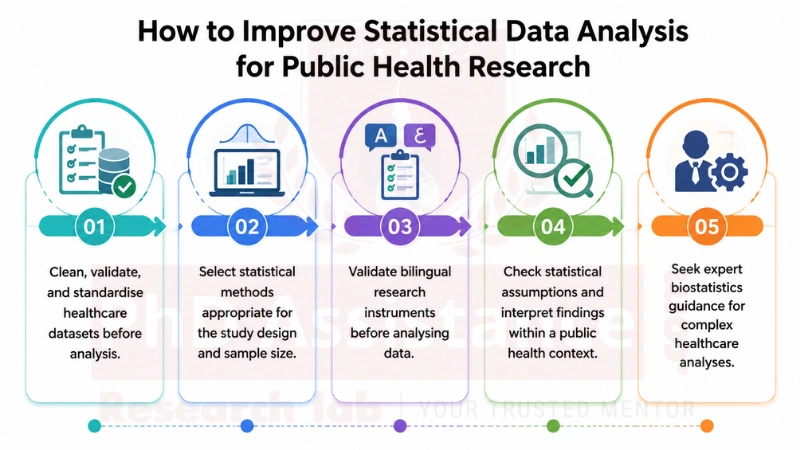
Before any model is fitted, map each variable to its source system, its coding scheme and the period it covers. Diagnoses may be coded differently across providers, laboratory units may differ, and a variable may be added or redefined part way through the study period. Write a data dictionary, harmonise codes with documented rules, and keep the raw extract unchanged so every step can be repeated.
Missing data deserve particular care, because in routine records they are rarely random: tests are ordered for patients who look unwell. Report the amount missing for each variable, consider why it is missing, and use multiple imputation under stated assumptions rather than dropping incomplete records by default (Sterne et al., 2009; van Buuren, 2018). A complete-case analysis can be a sensitivity check, not the main result.
Small samples and rare outcomes
Studies restricted to Emirati nationals, a single emirate or a specific condition often end up with modest samples. Start with a sample size justification tied to the analysis (Lakens, 2022). For prediction models, calculate the required sample size for your setting using the expected outcome rate, the number of candidate predictors and the anticipated model performance (Riley et al., 2020); this replaces the older rule of ten events per variable.
| Situation | Problem | Method to consider |
|---|---|---|
| Small cell counts in a 2 by 2 table | Chi-square approximation unreliable | Fisher's exact test |
| Rare outcome in logistic regression | Biased estimates or separation | Penalised (Firth) logistic regression (Firth, 1993) |
| Many candidate predictors, few events | Overfitting | Fewer pre-specified predictors; shrinkage; required sample size check (Riley et al., 2020) |
| Patients clustered in clinics | Standard errors too small | Multilevel models or cluster-robust errors |
| Prior evidence available | Imprecise estimates | Bayesian analysis with justified, reported priors |
Ethics and regulatory approval
Approvals take time, and delays squeeze the period available for cleaning and analysis. In Abu Dhabi, the Department of Health standard requires research ethics committee approval before work with human subjects and lists categories, such as multi-centre studies and processing of medical data outside the UAE, that need further review (Department of Health Abu Dhabi, 2020). In Dubai, the Dubai Scientific Research Ethics Committee reviews research in institutions under the Dubai Health Authority (Dubai Health Authority, 2019). Nationally, the Ministry of Health and Prevention's National Center for Health Research certifies research ethics committees (National Center for Health Research, n.d.). Health data also fall under sector-specific rules rather than only the general federal data protection law (UAE Government, n.d.), so confirm where data may be stored and analysed.
Write the approval route into your timeline and analysis plan, request only the variables you need, and agree in advance whether analysis must take place in a secure environment.
Bilingual and multilingual instruments
When a validated English questionnaire is used in Arabic, use forward translation, independent back-translation and reconciliation, then pretest with respondents (Brislin, 1970). Analytically, do not pool Arabic and English responses until you have checked that the scale works the same way in both: report reliability for each language version and, with enough data, test measurement invariance before comparing groups. If some respondents answered in a third language, as Aw et al. (2011) anticipated, record the language as a variable and examine it.
Interpreting results for UAE public health
Statistical results become public health evidence only when they are read against the population they describe. State clearly whom your data represent: residents using one provider network, nationals in one emirate, or attendees of particular clinics. Because nationals and expatriate residents differ in age structure, insurance and patterns of care, report results by these groups where numbers allow, and avoid generalising from one group to the whole country (Aw et al., 2011).
Prefer absolute measures, such as risk differences or numbers of cases, alongside relative ones, because planners need to know how many people a finding affects. Present uncertainty with confidence intervals and say what further data, such as linkage to another emirate or a longer follow-up, would strengthen the conclusion. That final step turns the limitations section into a research agenda.
Worked example (illustrative)
A hypothetical doctoral study aims to predict hospital readmission for heart failure among adults in two emirates using linked records. The researcher plans approvals from the university committee and both health authority committees and builds three months for them into the timeline (Department of Health Abu Dhabi, 2020; Dubai Health Authority, 2019). A sample size calculation for the expected readmission rate and eight pre-specified predictors shows the records available are sufficient (Riley et al., 2020). Diagnosis codes are harmonised across providers with written rules; missing laboratory values are imputed with multiple imputation, and a complete-case model is reported as a sensitivity analysis (Sterne et al., 2009). Because hospitals cluster patients, standard errors account for clustering. The model is developed in one emirate and validated in the other, the step that the Abu Dhabi diabetes model did not report (AlKetbi et al., 2025).
What to report, and common mistakes
| Element | What to state |
|---|---|
| Data sources | Systems, providers, period and linkage method |
| Preparation | Code harmonisation, exclusions and the data dictionary |
| Missing data | Amount per variable, assumed mechanism and method |
| Sample size | Calculation or justification linked to the analysis |
| Model | Pre-specified predictors, clustering, assumptions checked |
| Validation | Internal and, where possible, external validation and calibration |
| Approvals | Committees, approval numbers and data access conditions |
- Treating a single clinic or university sample as representative of the UAE (Albahri et al., 2023).
- Excluding incomplete records without saying how many or why.
- Fitting many predictors to few events.
- Pooling translated and original scale scores without checking equivalence.
- Starting extraction before every approval is in place.
For related guidance, see planning a UAE healthcare dissertation, reporting regression analyses and reporting survival analyses.
Key takeaways
- UAE studies report small national populations, mobility and incomplete frames as recurring constraints (Aw et al., 2011).
- Routine records support large cohorts but need code harmonisation, explicit missing-data methods and external validation (AlKetbi et al., 2025; Sterne et al., 2009).
- Calculate sample size for prediction models rather than relying on events-per-variable rules (Riley et al., 2020).
- Plan university and health authority approvals into the timeline (Department of Health Abu Dhabi, 2020; Dubai Health Authority, 2019; National Center for Health Research, n.d.).
- Translate instruments carefully and check equivalence before pooling languages (Brislin, 1970).