
How to Complete a PhD Dissertation in UAE Healthcare: Integrating AI Diagnostics, Telemedicine and Predictive Patient Care Models
Sustainable Practices in Environmental Science
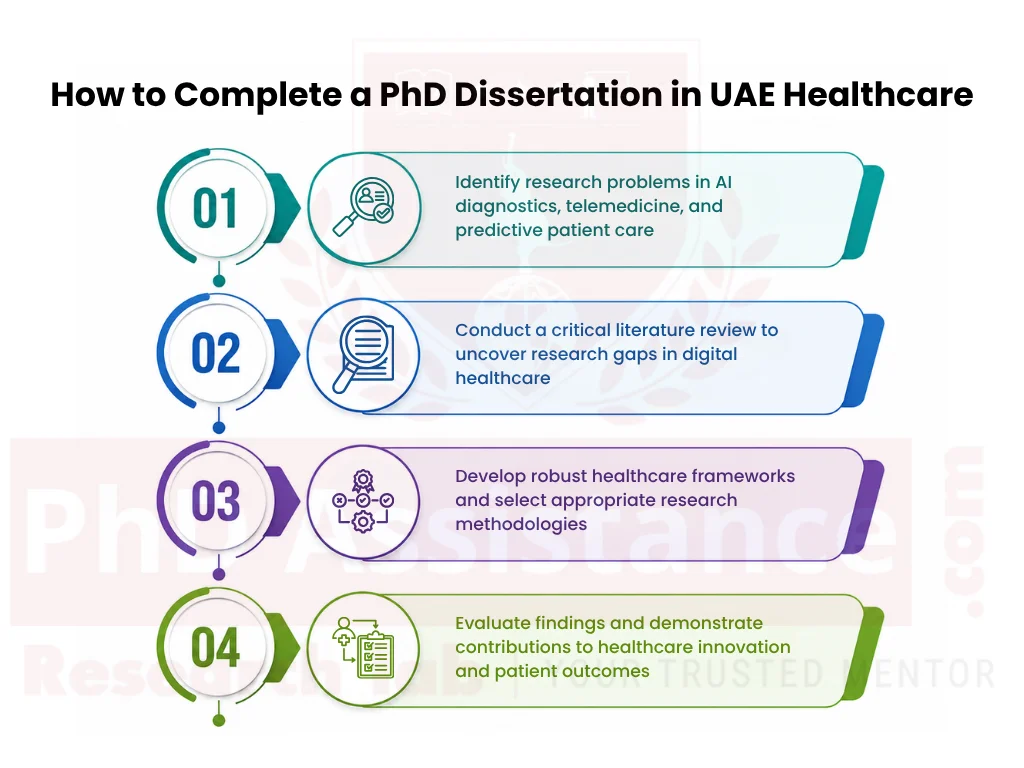
- Step 1: Identify Research Problems in AI Diagnostics, Telemedicine and Predictive Patient Care
- Step 2: Conduct Literature Review and Gap Analysis
- Step 3: Develop Healthcare Frameworks and Conceptual Models
- Step 4: Select Methodologies, Data Sources and Validation Techniques
- Step 5: Evaluate Results and Establish Dissertation Contributions
- Strategies for Writing a Strong Healthcare PhD Dissertation
- Conclusion

Recent Post
Introduction
Health authorities in the UAE have been proactively shifting to new-generation healthcare that involves using smart technologies like Artificial Intelligence, telemedicine, data-based disease forecasting, and patient outcomes analysis and forecasting. Smart health programmes and nationally-run healthcare programmes, including UAE Vision and Artificial Intelligence UAE 2031, are spurring the use of predictive analytics-based treatment patterns and remote monitoring technologies.
PhD students may explore diverse fields like AI Diagnostics, Telemedicine Research, Predictive Care Models, and Digital Health Research. It’s vital to choose a cutting-edge subject, but the pursuit of your PhD research will necessitate a thorough approach to finding important research gaps, well-researched concepts, sound methodology, and realistic healthcare impact.
This article guides you through completing a PhD in health care while incorporating new technologies that are helping reshape health care across the UAE. Further, it discusses how PhD Dissertation Writing Help in UAE can facilitate doctoral researchers in the accomplishment of their studies.
What you will learn?
Step 1: Identify Research Problems in AI Diagnostics, Telemedicine and Predictive Patient Care
The initial phase in crafting a high-performing research healthcare dissertation comprises of selecting a research problem that addresses a substantial healthcare concern. Students ought to choose problems aligned with actual contemporary concerns in healthcare services. Such problems can vary; for instance, accurate patient diagnosis, improving patient participation or healthcare spending, efficient decision-making in clinical practice.
Opportunities for a research doctor could lie in the following: the use of AI to process diagnostic images, remotely treating patients, digital health apps and telehealth visits, health status prediction or health risk analysis and smarter healthcare IT systems and solutions.
The research problem itself should have some scholarly importance as well as some direct impact on people or healthcare. Other national healthcare priorities of the UAE should also be researched, such as digitisation and the UAE healthcare innovation programs.
Example:
However, one review of the scientific literature, conducted by Mesk and Topol in January 2023, found AI to have value in increasing provider decision-making and diagnosis in such areas as the diagnosis of imaging or tissue (radiology and pathology) or managing long-term diseases (mesk and Topol, 2023).
Step 2: Conduct Literature Review and Gap Analysis
A literature review at a doctoral level should critically review research done previously instead of summarising it. Compare studies to identify inconsistencies, assess different research approaches, and pinpoint the research gap.
Researchers should organise a body of literature if they work on healthcare dissertations concerning AI diagnostic systems, telemedicine or predictive analytics is aimed at exploring various themes such as digital healthcare adoption, clinical effectiveness, patient outcomes, the performance of the algorithms or healthcare governance.
You will want to build a case for what knowledge you propose to add to the existing healthcare debates.
Example
After reviewing global digital health implementation approaches, Keesara et al. (2023) noted that increases in telemedicine use brought extensive positive changes to healthcare accessibility and patient engagement. However, they reported that there was insufficient evidence on the impact on long-term health outcomes, inequality of access and physician adoption of telemedicine in subspecialties.
Step 3: Develop Healthcare Frameworks and Conceptual Models
A healthcare dissertation can serve to form a conceptual framework illustrating connections among variables which are relevant to the sphere of healthcare; and these may serve to conduct the investigation. Theoretical assumptions, technological aspects, and client-focused results are to be included in such a framework.
Those who focus on AI Diagnostics might incorporate a Technology Acceptance Theory, or a Clinical Decision Support Systems model, or Digital Health Adoption models. Those who look into Telemedicine Research UAE, patient involvement, and quality in health models.
The research framework can also bolster analytical power and serve as a starting point to guide data collection and analysis toward a hypothesis.
Example: Based on an integration of the factors, Benda et al. (2024) develop a comprehensive Digital Health Research UAE adoption framework integrating factors: clinical effectiveness, user experience, healthcare access and user acceptance of technology. The framework shows organisations in the health service how to assess how well a piece of digital health technology is performing and demonstrate clinical and operational viability.
Step 4: Select Methodologies, Data Sources and Validation Techniques
One essential factor to consider during healthcare dissertation research is the selection of the appropriate methodology. There is a need for students to provide a convincing rationale for their selection of qualitative, quantitative, mixed-methods, predictive modelling, or experimental methodologies.
With an increase in health researchers using electronic health records (EHR), medical imaging datasets, data from wearable sensors, and telemedicine, the use of machine learning and deep learning, predictive modelling, or survival analysis is prevalent in health research, just as in any other research area.
The researcher should not only focus on applying the data science techniques but on validating them too.
Example: In a study led by Rajpurkar et al. (2024), the deep learning model for abnormal detection had a diagnostic accuracy like human clinical experts on two large medical image datasets. But the study pointed out that clinical validation and interpretation, and integration into workflows in clinical settings are essential before wider deployment.
Step 5: Evaluate Results and Establish Dissertation Contributions
The final section is the process of analysing research findings. This includes presenting theoretical, methodological, and practical implications of research in a clear and understandable format. Researchers are responsible for evaluating whether the research contributes to the established body of knowledge, and whether or not the solution provided in the findings answers the research problem stated in the earlier section.
An effective contribution could range from creating new AI diagnostic tools to devising new telemedicine adoption patterns or creating predictive patient treatment designs or producing guidelines based on evidence to politicians and clinicians, etc. A well-formulated contribution ensures innovation as well as the overall importance of the doctoral study.
Researchers should clearly explain how their proposed study contributes to:
Example: Using predictive patient care models that analyse multimodal healthcare data,Jiang et al. (2024) achieved a substantial improvement in the accuracy of early detection and forecasting of disease outcomes in patients. The researchers stated that these predictive approaches have the capacity to help with early intervention and treatment at the individual level when implemented in the health system.
Strategies for Writing a Strong Healthcare PhD Dissertation
Conclusion
AI Diagnostics in Healthcare, telemedicine platforms, and predictive models of patient care are revolutionising delivery within the UAE. Doctoral researchers can use this area as a springboard into the future of health.
Completing a healthcare PhD dissertation would entail defining the problem and conducting relevant and pertinent analytical evaluation of existing literature based on a strong, sound theoretical framework. Adopting such a method-based research strategy helps one in writing a significant dissertation that can bring substantial health benefits to mankind along with augmenting the knowledge base within the academic arena.
Get customised PhD Dissertation Writing Services in UAE support for your healthcare research from experts at PhD Assistance Research Lab.
References
- Benda, N. C., Veinot, T. C., Sieck, C. J., & Ancker, J. S. (2024). Digital health and patient engagement: Emerging frameworks for healthcare transformation. Journal of Medical Internet Research.
- Jiang, F., Jiang, Y., Zhi, H., Dong, Y., Li, H., Ma, S., Wang, Y., Dong, Q., Shen, H., & Wang, Y. (2024). Artificial intelligence in healthcare: Past, present and future applications. Stroke and Vascular Neurology.
- Keesara, S., Jonas, A., & Schulman, K. (2023). Telemedicine and the future of healthcare delivery. New England Journal of Medicine.
- Meskó, B., & Topol, E. J. (2023). The imperative for AI implementation in healthcare. npj Digital Medicine.
- Rajpurkar, P., Chen, E., Banerjee, O., & Topol, E. J. (2024). AI in health and medicine. Nature Medicine.