
Why topic selection is demanding in finance and law
Choosing a research topic is the first major challenge in a doctorate, and Lei (2009) describes it as probably one of the most important decisions a graduate student makes. In finance and law the difficulty has a particular shape. Both fields are large, fast-moving and closely tied to policy, so it is easy to pick a topic that is topical but not researchable, or one that has already been studied many times.
The two disciplines also ask questions differently. Finance is predominantly empirical and quantitative: researchers test hypotheses about prices, risk, firms and households with data. Legal scholarship has a strong doctrinal tradition that analyses and critiques legal rules, alongside a growing body of empirical and socio-legal work. A good topic in either field, and especially one that spans both, needs to be clear about which kind of question it asks. For general steps in testing a candidate topic, see How to choose a PhD topic; this guide concentrates on what is specific to finance and law.

Research areas in finance, law and where they meet
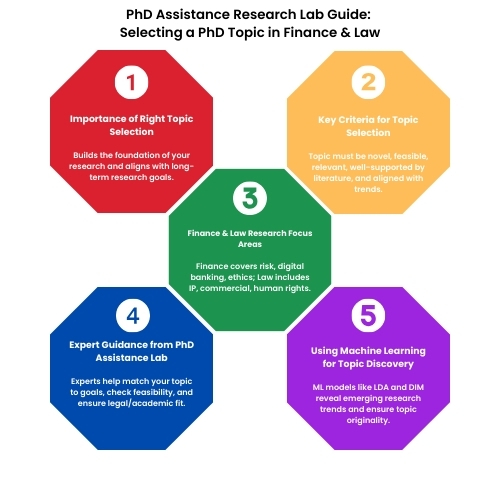
Each discipline has broad areas. Table 1 keeps those areas and shows how each can be narrowed towards a doctoral question. The example questions are illustrative starting points, not ready-made topics.
| Discipline | Broad area | Example of a narrower doctoral question |
|---|---|---|
| Finance | Microfinance | Does group liability still predict repayment once borrowers have access to mobile credit? |
| Finance | Retail and commercial banking | How did branch closures affect small-business lending in rural regions? |
| Finance | Cross-border financial investment | Do changes in investor protection law alter cross-border portfolio flows? |
| Finance | Liquidity risk management | How did banks adjust their holdings of liquid assets after liquidity rules were introduced? |
| Finance | Accounting control systems | Are stronger internal control disclosures associated with lower audit fees? |
| Finance | Financial ethics | How do conflicts of interest in financial advice affect the products clients buy? |
| Law | Family law | How do courts value pension rights when dividing assets on divorce? |
| Law | Employment and equity law | How effective are pay-transparency duties in narrowing gender pay gaps? |
| Law | Commercial law | How should insolvency law treat digital assets held by an intermediary? |
| Law | Intellectual property rights | Can patent law accommodate inventions generated with artificial intelligence? |
| Law | Human rights | How far do human rights due diligence duties reach into corporate supply chains? |
| Law | Immigration law | How consistently are discretionary decisions reviewed by tribunals? |
The richest ground for a combined finance and law topic lies where legal rules shape financial outcomes. The "law and finance" literature began with La Porta et al. (1998), who compared investor protection across 49 countries and related it to legal origin and to the development of capital markets. A later review by La Porta et al. (2008) summarised a decade of work on the economic consequences of legal origins and the debate it provoked. These studies show how a legal variable can be measured and tested, and their critics show how such measures can be challenged, which is itself a source of doctoral questions.
Other areas at the intersection include financial regulation and technology, where Arner et al. (2017) argue that regulatory technology could change how supervisors monitor markets; prudential regulation, where the Basel III liquidity standards set out the liquidity coverage ratio and monitoring tools that banks must apply (Basel Committee on Banking Supervision, 2013); and financial inclusion, where Morduch (1999) showed that the promise of microfinance ran ahead of the evidence on profitability and poverty impact. Each of these offers questions that need both a reading of the rules and an analysis of data.
Doctrinal, empirical and interdisciplinary approaches
The way a topic will be researched should be decided alongside the topic itself. Hutchinson and Duncan (2012) describe doctrinal legal research as the systematic analysis of legal rules, cases and statutes, the identification of their relationships and difficulties, and the prediction of their development. It is the core method of most law theses, and it produces original knowledge when it resolves an ambiguity, reconciles conflicting authorities or proposes a reform grounded in principle.
Empirical legal research asks what the law does in practice. Epstein and King (2002) argued that much empirical work in law reviews fell short of the standards of inference used in the social sciences, and set out rules for designing such studies: state the question and the theory, plan the data collection so that the inference can be tested, and report uncertainty. Their argument applies equally to a finance thesis that tests the effect of a regulation.
| Approach | Typical question | Main sources | What makes it original |
|---|---|---|---|
| Doctrinal | What is the law on X, and is it coherent? | Statutes, case law, regulatory texts, commentary | Resolving uncertainty, reconciling authorities, principled reform proposals |
| Empirical legal | How does the rule work in practice? | Court records, surveys, interviews, administrative data | New data on outcomes; testing claims made in doctrine |
| Empirical finance | What effect does X have on prices, risk or behaviour? | Market, accounting and household data | New identification strategy, data set or setting |
| Law and finance | Do legal rules change financial outcomes? | Coded legal indices combined with financial data | Better measurement of the legal variable; a credible causal design |
Criteria for testing a candidate topic
Seven questions help during topic selection. Table 3 keeps them and adds a practical way to check each one.
| Question | How to check it |
|---|---|
| Has prior research addressed this area sufficiently to build on? | Run a scoping search in Scopus, Web of Science, SSRN and the main legal databases |
| Does it allow in-depth investigation and new knowledge? | Write the gap in one sentence and name what is not yet known |
| Could it lead to peer-reviewed publications? | Identify two or three journals that publish similar work and read their recent issues |
| Does it reflect current research directions? | Check recent reviews and the topics trending in the literature (see the next section) |
| Does it warrant investigation? | State who would use the answer: courts, regulators, firms or other researchers |
| Is there adequate literature and data? | Confirm access to case law, regulatory texts or financial databases before committing |
| Can it be completed within the deadline? | Draft a timeline with data access, analysis and writing stages |
Novelty is the hardest criterion to judge. A gap is not simply something nobody has studied; it may be an assumption that the literature takes for granted. Alvesson and Sandberg (2011) argue that questioning such assumptions, rather than only spotting gaps, tends to produce more interesting research. In law and finance this often means testing a claim that doctrine treats as obvious, or applying a legal argument to a market practice that regulators have not yet considered.
Using text mining to map a field
Machine-learning tools can help you see the shape of a large literature before you choose a topic. The most common is topic modelling with latent Dirichlet allocation, a probabilistic model that represents each document as a mixture of topics and each topic as a distribution over words (Blei et al., 2003).
Aziz et al. (2022) applied this method to research on machine learning in finance. Analysing 5,942 studies from finance, economics, computer science and decision sciences, they extracted 15 coherent research topics and grouped them into four domains: price-forecasting techniques, financial markets analysis, risk forecasting and financial perspectives. They also reported the recent emergence of text-based machine learning, for example for sentiment analysis. A study of this kind tells a doctoral researcher which themes are crowded and which are growing.
A second line of work tries to detect emerging topics. Xu et al. (2019) combined a dynamic influence model, which extracts themes from publications over time, with a citation influence model and a forecasting model, and operationalised emergence through radical novelty, relatively fast growth, coherence and scientific impact. Their test case was gene editing literature rather than finance, so the method, not the result, is what transfers. Simpler bibliometric tools such as co-citation and keyword co-occurrence analysis are described step by step by Donthu et al. (2021).
These tools need careful use. A topic model groups words statistically; naming and interpreting each topic is a judgement, and results change with the corpus, the number of topics and the pre-processing. Treat the output as a map that tells you where to read closely, not as a list of gaps.
Worked example: from area to question
This illustrative example shows how the steps fit together. A researcher with a background in banking law is interested in "fintech regulation", which is an area, not a topic.
- Narrow the area. A scoping search shows a large literature on regulatory sandboxes and RegTech (Arner et al., 2017), but less on how consumer protection rules apply to lending by technology firms.
- Choose the approach. The researcher decides on a mixed design: a doctrinal analysis of the relevant consumer credit rules, followed by an empirical study of published complaint decisions.
- Write the question. "How do complaint bodies apply affordability rules to lending by technology firms, and are their decisions consistent?"
- Test it. Decisions are publicly available, two journals publish similar work and the timeline fits three years.
- Check the contribution. The study tests an assumption in the literature, that existing consumer rules apply unproblematically to new lenders, which strengthens its originality (Alvesson & Sandberg, 2011).
Common mistakes
- Choosing a news-driven topic without checking whether a precise, answerable question lies within it.
- Treating a description of the law as a contribution, without analysis, critique or new evidence.
- Using a legal index or financial variable without examining how it was constructed.
- Assuming that data from proprietary financial databases or court registries will be accessible.
- Combining finance and law without the methodological training to do both properly.
- Reading topic-model output as a list of gaps instead of a guide to where to read.
Key takeaways
- A broad area such as microfinance or commercial law becomes a doctoral topic only when narrowed to a specific question, setting and source of evidence (Lei, 2009).
- Decide early whether the topic calls for doctrinal, empirical or combined methods, and apply the standards of each (Hutchinson & Duncan, 2012; Epstein & King, 2002).
- The law and finance literature shows how legal variables can be measured and tested, and its critics show where such measures are weak (La Porta et al., 1998; La Porta et al., 2008).
- Topic modelling and bibliometrics can map a field quickly, but interpreting the output and judging the gap remain your task (Aziz et al., 2022; Donthu et al., 2021).
- Questioning an assumption in the literature often produces a stronger contribution than filling a narrow gap (Alvesson & Sandberg, 2011).