
Why publication matters for a UAE healthcare doctorate
For many doctoral researchers in the UAE, publication is part of the degree as well as the career. UAE University's PhD policy, for example, expects candidates to have papers considered for publication before the defence (United Arab Emirates University, 2018), so the choice of journal can affect when you can be examined. Health research output from the UAE has grown quickly: a bibliometric analysis by UAE-based authors counted 18,936 medical and health sciences publications between 2000 and 2022, an 18-fold increase, with about 55% published in the last five years of that period (Ganesan et al., 2026). More output means more competition for good journals and more targets for questionable ones.
There is also local evidence that early-career clinicians are exposed to predatory publishing. In a survey of 160 graduate medical trainees at two academic medical centres in Abu Dhabi, most recognised rapid publication and vague editorial boards as warning signs, yet 95% were unaware of resources to help them select a journal, and 15.2% of those who had received unsolicited publisher emails had submitted to an unfamiliar journal (Ibrahim et al., 2022). This guide therefore starts with checking journals before turning to the manuscript. If you have not yet finished the thesis itself, see completing a UAE healthcare dissertation; for general advice on cutting a thesis into papers, see from thesis to manuscript. Related guides cover reporting AI diagnostic studies, pharmacology dissertations in the UAE and the wider UAE research context.
Check Scopus coverage yourself
Scopus coverage is decided by an independent Content Selection and Advisory Board. To be considered, a journal must publish peer-reviewed content with a public description of its peer review process, have an ISSN, publish English titles and abstracts, and display a publication ethics and malpractice statement (Elsevier, n.d.). Indexed titles are re-evaluated when concerns about publication ethics are raised or when data models detect outlier patterns in publishing, citations or authorship; content flow is suspended during re-evaluation, and discontinued titles are marked in the Scopus source title list, while content already indexed normally remains (Elsevier, n.d.).
The practical consequence is simple: do not rely on a journal's own website or an email that says "Scopus indexed". Search the title or ISSN in the Scopus journals list (Sources) or the downloadable source title list, confirm that coverage is current rather than discontinued, and check that the publisher, ISSN and web address match. Remember also that metrics differ by database: CiteScore, SJR and SNIP are calculated from Scopus data, whereas the Journal Impact Factor comes from Clarivate's Web of Science.
Recognise predatory and hijacked journals
Predatory journals have no single agreed definition, but an international consensus describes them as prioritising self-interest at the expense of scholarship, with false or misleading information, deviation from best editorial practice, a lack of transparency and aggressive solicitation (Grudniewicz et al., 2019). Hijacked journals are a sharper danger for anyone targeting Scopus, because fraudsters build a clone website for a real, indexed journal or buy its expired domain, then copy its title and ISSN. Abalkina (2025) identified 67 hijacked journals that had penetrated Scopus since 2013, 33 of which had unauthorised content indexed. The Retraction Watch Hijacked Journal Checker, which she maintains, passed 400 entries in December 2025 (Retraction Watch, 2025).
| Check | How to do it | Warning sign |
|---|---|---|
| Scopus coverage | Search the Scopus journals list by title and ISSN (Elsevier, n.d.) | Not listed, or listed as discontinued |
| Website identity | Compare the URL with the one in Scopus or the ISSN Portal; look up domain registration (Abalkina, 2025) | Recently registered domain or a different URL from the indexed journal |
| Hijacked status | Search the Retraction Watch Hijacked Journal Checker (Retraction Watch, 2025) | Title appears in the checker |
| DOIs | Check that recent articles' DOIs resolve through Crossref (Abalkina, 2025) | DOIs that do not resolve or are malformed |
| Scope and content | Read recent issues (Think. Check. Submit., n.d.) | Papers far outside the journal's stated field |
| Peer review and fees | Read the peer review description and fee page (Think. Check. Submit., n.d.) | Promised acceptance within days; fees disclosed only after acceptance |
The Think. Check. Submit. checklist turns these points into questions about the publisher, the editorial board, peer review and fees (Think. Check. Submit., n.d.). Ask your university library too: most UAE universities subscribe to Scopus and can confirm coverage for you.
Choose the journal before you write
Choose two or three legitimate target journals before drafting, because scope, word limits, structure and reporting requirements differ. Read recent articles to see whether the journal publishes studies of your design and population, and check its author instructions for the reporting checklist it expects. Consider who you want to read the paper: a clinical specialty journal, a health informatics journal or a public health journal will frame the same study differently. Metrics are one input, but fit with scope and audience matters more for acceptance and for being read.
A single thesis usually yields several papers, each answering one question with its own data (Kamler, 2008). Decide which chapter or analysis answers a clear, self-contained question and plan the others as separate papers rather than compressing the whole thesis into one.
Write to IMRAD and the right reporting guideline
Most healthcare journals use the IMRAD structure: Introduction, Methods, Results and Discussion, which became the dominant format in medical journals during the twentieth century (Sollaci & Pereira, 2004). The introduction should move from the clinical problem to the specific gap and the aim; the methods should allow replication and name the ethics approval; the results should report what was found without interpretation; and the discussion should interpret, compare and state limitations.
| Study design | Reporting guideline | What reviewers check first |
|---|---|---|
| Clinical prediction model, including machine learning | TRIPOD+AI (Collins et al., 2024) | Data source, missing data, validation, calibration and discrimination |
| Systematic review | PRISMA 2020 (Page et al., 2021) | Search strategy, selection flow diagram, risk-of-bias assessment |
| Randomised trial | CONSORT, with CONSORT-AI for AI interventions | Randomisation, allocation concealment, outcomes |
| Observational study | STROBE | Selection of participants, confounding, missing data |
| Case report | CARE | Patient consent, timeline, diagnostic reasoning |
Reporting guidelines are not formalities. TRIPOD+AI, for instance, asks authors to describe how a prediction model was developed and evaluated, including how missing data were handled, how the model was validated and how both calibration and discrimination were assessed (Collins et al., 2024). A UAE example shows why this matters. AlKetbi et al. (2025) published a diabetes risk model from Abu Dhabi screening records in a Scopus-indexed journal with good discrimination, but reported no external validation and selected participants with complete data. If your own paper builds on such a model, these are the points reviewers will raise, so address them in the methods and limitations rather than waiting for the reports. More broadly, clinical AI papers are judged on whether they show clinical usefulness and validation in real settings, not only algorithmic performance (Topol, 2019).
Name the ethics committee and approval number in the methods. For studies in Abu Dhabi, the DoH standard requires research ethics committee approval before work with human subjects begins (Department of Health Abu Dhabi, 2020). Follow the ICMJE criteria for authorship and disclose all contributions (International Committee of Medical Journal Editors, 2024). If you used generative AI tools while writing, disclose how; such tools cannot be listed as authors (Committee on Publication Ethics, 2023).
Submit and respond to peer review
Before submitting, check the author instructions line by line: word count, abstract format, reference style, figure resolution, data availability statement, conflicts of interest and the reporting checklist. A short cover letter should state the question, the main finding and why the journal's readers need it.
Most papers come back with revisions. Treat reviewers as consultants rather than adversaries, and write a response that thanks them, summarises the main changes and then answers every comment point by point, showing exactly where the manuscript changed (Bahadoran et al., 2022). Where you disagree, explain why with evidence and politely (Noble, 2017; Bahadoran et al., 2022). A well-organised response can improve the chance of acceptance because it makes the revision easy to assess (Bahadoran et al., 2022), but it cannot rescue a study whose design does not answer its question.
| Part of the response | What to include |
|---|---|
| Opening | Thanks to the editor and reviewers; one paragraph summarising the main revisions |
| Each comment | The reviewer's comment quoted, your reply, and the change with page and line numbers |
| Disagreements | A reasoned, evidence-based explanation, with any partial change you did make |
| Additional analyses | Results shown in the letter and, where relevant, in the manuscript or supplement |
Worked example: from thesis chapter to submission (illustrative)
The following example is hypothetical and reports no real results. A candidate at a UAE university has a thesis chapter that externally validates a diabetes risk model in a second emirate.
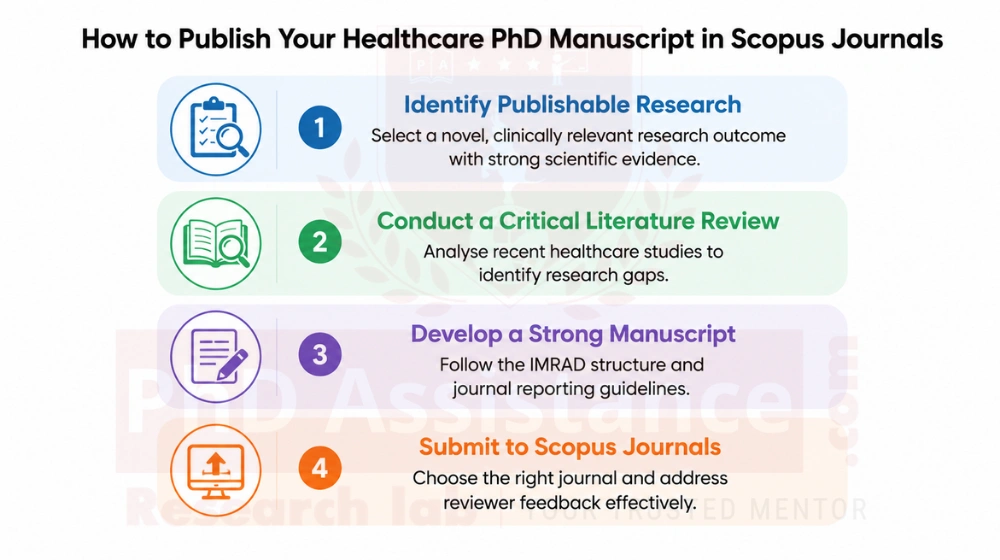
- 1Define one publishable question from the chapter
- 2Shortlist journals and verify Scopus coverage and legitimacy
- 3Draft in IMRAD with the TRIPOD+AI checklist
- 4Check authorship, ethics statement and AI disclosure
- 5Submit, then revise with a point-by-point response
- Question. "How well does a published Abu Dhabi model predict type 2 diabetes in another emirate?" One question, one dataset.
- Journals. Three candidates in diabetes and epidemiology; each checked in the Scopus journals list, against the hijacked-journal checker and for a matching URL (Elsevier, n.d.; Retraction Watch, 2025).
- Writing. Methods follow TRIPOD+AI, reporting missing-data handling, calibration and discrimination (Collins et al., 2024).
- Integrity. Authorship agreed with co-authors against ICMJE criteria; ethics approval reference given; any AI-tool use disclosed (International Committee of Medical Journal Editors, 2024; Committee on Publication Ethics, 2023).
- Revision. A reviewer asks for decision-curve analysis; the candidate adds it and points to the new table in the response (Bahadoran et al., 2022).
Common mistakes
- Trusting an email or website that claims Scopus indexing without checking the Scopus journals list.
- Submitting to a clone site of a real journal because the title and ISSN look right.
- Choosing a journal by impact factor alone, or confusing Clarivate and Scopus metrics.
- Compressing a whole thesis into one manuscript instead of one question per paper.
- Ignoring the reporting guideline until reviewers ask for it.
- Answering reviewers selectively or without saying where the manuscript changed.
- Citing quotations that do not appear in the source; check every quotation against the paper.
Key takeaways
- Verify Scopus coverage in the Scopus journals list and watch for discontinued titles (Elsevier, n.d.).
- Hijacked clones of indexed journals have reached Scopus, so check URLs, DOIs and the Retraction Watch checker (Abalkina, 2025; Retraction Watch, 2025).
- Local evidence shows trainees in Abu Dhabi are exposed to predatory publishing and need journal-selection skills (Ibrahim et al., 2022).
- Write in IMRAD and report to the guideline that fits the design, such as TRIPOD+AI or PRISMA 2020 (Sollaci & Pereira, 2004; Collins et al., 2024; Page et al., 2021).
- Answer reviewers point by point with evidence; this helps, but no response guarantees acceptance (Bahadoran et al., 2022; Noble, 2017).