
What a conceptual framework is
Every dissertation rests on an argument about what matters in the problem being studied and how those things relate. A conceptual framework makes that argument explicit. Jabareen (2009) defines it as a network, or "plane", of linked concepts that together provide a comprehensive understanding of a phenomenon, and sets out a procedure for building one from multidisciplinary literature. Ravitch and Riggan (2017) take a broader view, treating the conceptual framework as the overarching argument for why a study matters and why its methods are appropriate and rigorous.
Three terms are often confused. A theory is an established explanation of a phenomenon. A theoretical framework is the use of one or more such theories to frame a particular study. A conceptual framework is the researcher's own justification of the study: it draws on theory, prior empirical work and practical knowledge to explain what is being studied, why, and how. Varpio et al. (2020) show that how these terms are used also depends on whether the research proceeds deductively, from theory to data, or inductively, from data towards theory. For a broader introduction see conceptual framework support and theoretical framework support.

Why computer science dissertations need one
Much computer science research is design-oriented: the researcher builds an algorithm, system, model or method and then evaluates it. Design science research, as set out for information systems by Hevner et al. (2004), treats such artefacts as research contributions only when their design is grounded in the existing knowledge base and their utility is demonstrated through rigorous evaluation. Peffers et al. (2007) turned this into a process model running from problem identification and objectives, through design and demonstration, to evaluation and communication, and Wieringa (2014) adapted the approach for software engineering, distinguishing design problems from the knowledge questions used to investigate them.
In this tradition a conceptual framework does real work. It states which concepts define the problem, which properties the artefact must have, and which outcomes the evaluation must measure. Gregor (2006) distinguishes five types of theory in information systems, from theory for analysing to theory for design and action, which prescribes how to build something. Locating your framework in this typology helps you decide whether your study describes, explains, predicts or prescribes, and therefore what kind of evidence it must produce.
Examiners also expect computing research to meet the methodological norms of its community. The ACM SIGSOFT Empirical Standards describe, for each kind of study, what reviewers expect to see (Ralph et al., 2020). A conceptual framework that names its constructs and their measures makes it much easier to show that a study meets the relevant standard.
The form of the framework varies with the kind of computing research. In an empirical study of developers or users, it resembles a framework in the social sciences: constructs, expected relationships and the measures that operationalise them. In an algorithmic or systems study, it is closer to a structured design rationale: the problem characteristics that matter, the properties a solution must have and the conditions under which it should be compared with alternatives. In a theoretical study, the equivalent is the set of assumptions and definitions from which results are derived. In every case the purpose is the same: to make the reasoning behind the study visible so that an examiner can judge whether the questions, design and conclusions fit together.
How published frameworks guide design
Several published frameworks guide design. Read closely, each shows a different job a framework can do in a computer science dissertation.
| Framework | Domain | What the framework organises | What it shapes in the research |
|---|---|---|---|
| Arena et al. (2024) | Predictive maintenance | Machine learning characteristics, dataset characteristics and predictive maintenance characteristics, plus the accuracy versus interpretability trade-off | Algorithm selection and justification |
| Podo et al. (2024), EvaLLM | Generative AI visualisation | An evaluation stack that decomposes evaluation into atomic components | Evaluation design and metrics |
| Monshizada et al. (2023), 2PDT | AI system development | People, process, data and technology dimensions | Scope of an organisational study and interview themes |
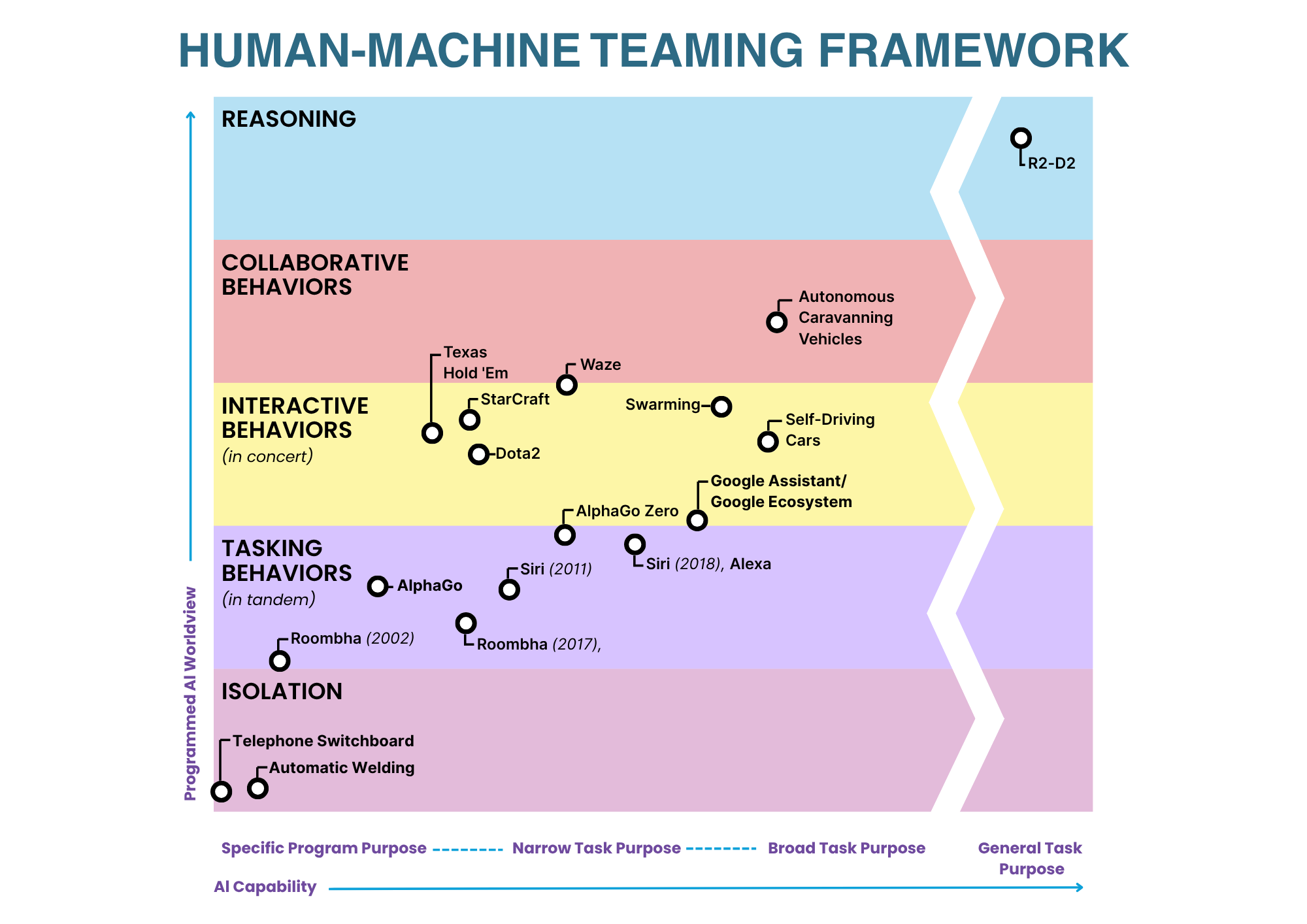
| Grosz (1996) | Collaborative systems | Characteristics of collaborative activity between people and systems | Requirements for human-machine teaming |
| Samuel (2020) | Big-data visualisation | Models, methods and AI for graphical representations of data | Positioning of visualisation research |
Choosing an algorithm: predictive maintenance
Arena et al. (2024) start from a practical difficulty: the literature on machine-learning-based predictive maintenance is large, yet practitioners struggle to choose an algorithm. Their framework classifies the decision by three groups of characteristics: those of the learning approach (type of learning, task and objective function), those of the dataset (response type, class balance, linearity, ratio of observations to features) and those of the maintenance problem (fault type, model objective such as remaining useful life estimation or fault detection, and number of system states). A dissertation built on such a framework does not simply report that one algorithm performed best; it explains why the candidates were chosen and under what conditions the result should hold.
Designing an evaluation: generative AI visualisation
Podo et al. (2024) address a newer problem: how to evaluate visualisations generated by large language models. Their EvaLLM framework decomposes evaluation into atomic components, so that issues such as the variety of possible instructions and model hallucination can be assessed separately, and they demonstrate it on Llama 2 70B. The lesson for a doctoral researcher is that, in a fast-moving area, a framework can be the contribution: it gives the field a structured way to compare systems.
Setting scope: AI system development in organisations
The People-Process-Data-Technology (2PDT) framework organises AI system development around four dimensions. Monshizada et al. (2023) investigated it through 12 case studies in Australian organisations and 39 expert interviews analysed thematically, and report that a lack of required skills was a key reason for unsuccessful delivery, alongside rapidly evolving technology, insufficient data quality and limited development frameworks. For a dissertation, a framework of this kind fixes the scope of inquiry and supplies the initial themes for data collection, while leaving room for new themes to emerge.
Human-machine teaming
Frameworks also carry older ideas forward. In her AAAI presidential address, Grosz (1996) argued that the ability to work collaboratively with people and other systems must be designed into systems from the start rather than added later, and set out the characteristics of collaborative activity that such systems require. Research on human-AI teaming still uses this framing to decide which capabilities a system must have before it is evaluated with users. Visualisation research has its own framing work, such as Samuel (2020) on conceptual frameworks for big-data visualisation and the role of artificial intelligence in graphical representations of data.
What the framework shapes in your dissertation
A conceptual framework is useful only if it changes decisions. The table below shows where a well-built framework should be visible in a computer science dissertation.
| Dissertation element | What the framework should supply | Question to ask yourself |
|---|---|---|
| Research questions | The constructs and relationships each question addresses | Does every question map to a part of the framework? |
| Scope and delimitations | The boundary of the system, data and setting studied | Which plausible factors are deliberately left out, and why? |
| Artefact design | The requirements and design principles the artefact must satisfy | Can each design choice be traced to a construct? |
| Variables and measures | Operational definitions of each construct | How will each construct be measured or observed? |
| Evaluation | The outcomes that define success and the baselines for comparison | Would a sceptical reader accept these outcomes as evidence? |
| Discussion | The lens for interpreting results and stating contribution | Which relationships did the results support, refine or contradict? |
The framework also links the literature review to the research gap. Rather than listing studies, the review should build the framework section by section, so that the gap appears as a missing or untested relationship in it. See research gap identification for methods of locating that gap.
Building your framework: a worked example
The following steps adapt Jabareen (2009)'s procedure and the design science process of Peffers et al. (2007) to a computing dissertation.
- Map the sources. Collect the literature on your problem across the fields it touches, including technical, organisational and human-factors work.
- Identify and name concepts. Extract the concepts that recur and give each a precise definition.
- Group and integrate. Merge overlapping concepts and group them into a small number of constructs.
- Specify relationships. State how the constructs are expected to relate, and the evidence for each link.
- Align with design. Map every construct to a research question, an artefact requirement or a measure.
- Represent and test. Draw the framework, discuss it with your supervisor and peers, and revise it after pilot work.
Illustrative example (hypothetical). A doctoral researcher proposes an anomaly detection method for industrial sensor networks. A first framework lists twenty factors drawn from the literature. Working through the steps, she groups them into four constructs: data characteristics (sampling rate, class imbalance, labelling), model properties (detection accuracy, interpretability, computational cost), deployment constraints (edge hardware, latency) and operator use (trust, alert fatigue). Following the logic of Arena et al. (2024), the data characteristics justify the candidate algorithms; the deployment constraints set the delimitations; and operator use, drawing on Grosz (1996), adds a small user evaluation. Each research question now maps to one or two constructs, and the evaluation reports both technical metrics and operator judgements.
Representation matters. Depending on the study, a framework may be shown as a concept map, a layered architecture, a causal loop diagram or a UML-style model. Choose the form that makes relationships, not only components, visible, and keep the text and the diagram consistent.
Common mistakes
- Borrowing a framework from another field without explaining why its concepts fit a computing problem.
- Describing concepts without stating how they relate, so the framework cannot generate expectations.
- Including constructs that are never measured, built or evaluated.
- Presenting no diagram, or a diagram that does not match the text.
- Leaving the link between constructs and variables or metrics unstated.
- Treating the first version as final instead of revising it after the literature review and pilot work.
- Calling the framework "theoretical" when it is the researcher's own synthesis, or the reverse.
For related guidance on defining the problem itself, see problem identification in computer science, and for formal and mathematical research designs see how to construct theorems from axioms.
Key takeaways
- A conceptual framework is the researcher's own argument linking concepts, questions and design, distinct from a theoretical framework (Varpio et al., 2020; Ravitch & Riggan, 2017).
- In design-oriented computing research, the framework grounds the artefact in the knowledge base and defines how its utility is evaluated (Hevner et al., 2004; Peffers et al., 2007).
- Published frameworks show the jobs a framework can do: justify algorithm choice, structure evaluation and fix scope (Arena et al., 2024; Podo et al., 2024; Monshizada et al., 2023).
- Build the framework early from linked concepts and revise it as the study develops (Jabareen, 2009).
- Every construct should map to a research question, a design requirement or a measure; anything that does not should be removed.