
Using a trend list to choose a topic
Digital technology has changed how financial services are designed, delivered and regulated. Banks now compete and cooperate with technology firms, credit decisions increasingly draw on machine learning, and new payment systems run alongside card networks. For a doctoral researcher this creates many possible topics, but also a risk: a topic chosen because it is fashionable may be outdated before the thesis is submitted, or may rest on industry claims that have not been tested.
This guide therefore treats each of five directions as a research area supported by peer-reviewed evidence or by regulation in force, not as a forecast. For each one it outlines what is known, what remains open and what kind of data could answer a doctoral question. For a general method of testing a candidate topic, see How to choose a PhD topic, and for the overlap between finance and law see Developing a PhD research topic in finance and law.
Three checks help separate a durable research direction from a passing trend. First, ask whether the claim rests on observed data in a peer-reviewed study or on a forecast by a vendor or consultancy. Second, ask whether the rules that shape the area are in force, proposed or about to be replaced, because a thesis built on a draft law can lose its footing. Third, ask whether the underlying question will still matter in four or five years, when you submit and publish. Questions about competition, fairness, inclusion and stability usually pass this test even when the technology changes.

The technologies and rules behind the topics
Five technologies are commonly named as enablers (cloud computing, open banking, application programming interfaces, artificial intelligence and cyber security) and a set of objectives for financial firms. Table 1 keeps those objectives and adds the regulatory context that a researcher would need to take into account. Thakor (2020) provides a useful overview of what research has established about fintech and banking, and is a good first reading for any of the directions below.
| Objective | Relevant rules or evidence | Research angle |
|---|---|---|
| Offer value-added digital services | Fintech and big tech competition with banks (Stulz, 2019) | Which customers switch, and why? |
| Gain cloud efficiencies in core operations | ICT risk and third-party provider rules under DORA (European Parliament & Council of the European Union, 2022) | Concentration risk in cloud provision |
| Move from digital to open banking | Third-party account access under PSD2 (European Parliament & Council of the European Union, 2015) | Effects of data sharing on competition |
| Grow revenue through API ecosystems | Common and secure open standards of communication (European Commission, 2018) | Design and uptake of bank interfaces |
| Meet PSD2 standards | Strong customer authentication rules applying from 14 September 2019 (European Commission, 2018) | Fraud and abandonment after authentication changes |
| Automate routine tasks with AI | Credit scoring classed as high-risk AI in the EU (European Parliament & Council of the European Union, 2024) | Accuracy, fairness and explainability |
| Address blockchain for smart contracts and KYC | Crypto-asset regulation under MiCA (European Parliament & Council of the European Union, 2023) | How regulation shapes token markets |
Directions 1 and 2: big tech and artificial intelligence
1. Big tech in finance
Some describe a "GAFA approach", learning from Google, Amazon, Facebook and Apple. The research literature studies this as big tech in finance. The Bank for International Settlements described big tech business models as resting on three mutually reinforcing elements, data analytics, network externalities and interwoven activities, and argued that financial services both benefit from and fuel this loop (Bank for International Settlements, 2019). Frost et al. (2019) examined how big techs enter lending and other financial services and how this changes the structure of financial intermediation, and Stulz (2019) assessed what fintech and big tech competition means for the future of banks.
Open questions include whether big tech lending widens access for small firms without credit histories, how competition and data protection rules should apply to platforms that combine commerce and finance, and whether banks respond by partnering, competing or retreating from particular products.
2. Predictive banking with artificial intelligence
AI is often said to make banking proactive, profiling customers in real time and recommending a "next best action". The research base is large: Goodell et al. (2021) used bibliometric analysis to map AI and machine learning in finance into distinct research clusters. Some of the most useful findings for a doctoral researcher concern consequences rather than technology. Berg et al. (2020) showed that simple digital footprint variables, such as the device used to place an online order, predicted default and complemented credit bureau scores. Fuster et al. (2022) found that more flexible machine-learning credit models could change the distribution of outcomes across racial and ethnic groups, so better prediction did not mean equal gains. D'Acunto et al. (2019) found that a robo-advising tool improved diversification for previously under-diversified investors but offered little benefit to those already diversified.
Regulation now frames this area. The EU Artificial Intelligence Act lists AI systems intended to evaluate the creditworthiness of natural persons or establish their credit score as high-risk, with an exception for systems used to detect financial fraud (European Parliament & Council of the European Union, 2024). Check the current application dates for the high-risk obligations before building a thesis around compliance.
Directions 3 and 4: payments and open banking
3. Payment innovation
Payment innovation draws on the Internet of Things, point-of-sale systems, mobile wallets, cryptocurrencies and blockchain. Since then, public payment infrastructures have become a major research theme. Brazil's instant payment system Pix, launched in November 2020, had signed up 67% of adults in Brazil within about 13 months; Duarte et al. (2022) attributed its uptake to mandatory participation by large banks and to the central bank's dual role as operator and regulator. Auer et al. (2023) found that central bank digital currency projects were concentrated in economies with high mobile phone use and innovation capacity, and that retail projects were more advanced where the informal economy was larger. In the EU, crypto-assets, including stablecoins issued as asset-referenced or e-money tokens, are now regulated under MiCA (European Parliament & Council of the European Union, 2023).
Researchable questions include how instant payments affect bank deposits and card revenues, whether digital payments support financial inclusion, and how regulation changes the behaviour of stablecoin issuers and users.
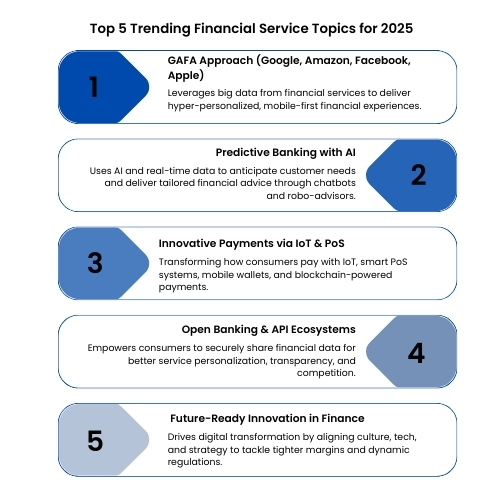
4. Open banking
Open banking lets customers share their payment account data with authorised third parties. In the EU, the legal basis is the second Payment Services Directive (European Parliament & Council of the European Union, 2015), applied from January 2018, with detailed standards on strong customer authentication and secure communication applying from 14 September 2019 (European Commission, 2018). Data protection law governs how the personal data involved are processed, but it did not itself create the access right. The Commission proposed a replacement framework in 2023 (European Commission, 2023); check its current legislative status before relying on either text.
The best evidence so far comes from Babina et al. (2025), who, drawing on evidence from 49 countries, found that privacy preferences predicted open banking adoption and that adoption spurred fintech entry, and, using UK microdata, that open banking helped consumers access advice and credit and helped small firms form new lending relationships. Their model also suggested that costlier or privacy-conscious consumers could face higher prices, which points to questions about who benefits from data sharing.
Direction 5: innovation, resilience and regulation
Broad calls for "future innovation" in the face of narrowing margins, competition and regulatory change. A sharper research direction is how firms and supervisors manage the risks that digital innovation creates. The EU Digital Operational Resilience Act, which applies from 17 January 2025, sets common requirements for ICT risk management, incident reporting, resilience testing and the oversight of critical third-party ICT providers such as cloud services (European Parliament & Council of the European Union, 2022). At the same time, regulatory technology may change how supervisors collect data and monitor firms (Arner et al., 2017).
Doctoral questions here might examine how outages at shared cloud providers propagate across financial firms, whether incident reporting changes behaviour, or how supervisors use data-driven tools. Many of these questions need both legal analysis and empirical data, and they suit researchers with a background in risk, information systems or law.
From trend to doctoral topic
| Direction | Example doctoral question | Possible data | Starting sources |
|---|---|---|---|
| Big tech in finance | Does platform lending reach firms that banks do not serve? | Platform or credit registry data | Frost et al. (2019); BIS (2019) |
| AI in banking | How do machine-learning scores change approval rates across groups? | Loan-level data, model audits | Fuster et al. (2022); Berg et al. (2020) |
| Payment innovation | How did instant payments affect deposits at small banks? | Central bank statistics, bank reports | Duarte et al. (2022); Auer et al. (2023) |
| Open banking | Who shares data, and do they obtain better credit terms? | Surveys, consented transaction data | Babina et al. (2025) |
| Resilience and regulation | How do firms report and manage ICT incidents under DORA? | Regulatory filings, interviews | DORA (2022); Arner et al. (2017) |
An illustrative walkthrough: a researcher interested in "AI in banking" begins with the bibliometric map in Goodell et al. (2021) to see which clusters are crowded. Reading Fuster et al. (2022), whose evidence comes from the United States mortgage market, she asks whether similar effects arise elsewhere. She narrows the topic to the question of how machine-learning scores affect small-business credit approvals in one European market, confirms that a lender will share anonymised data under an agreement, and notes that the AI Act's high-risk rules give the study policy relevance (European Parliament & Council of the European Union, 2024). The topic now has a question, a data source and a clear contribution.
Common mistakes
- Treating a vendor report or industry forecast as evidence rather than as a claim to test.
- Choosing a topic tied to one regulation without checking whether it is about to be replaced.
- Assuming access to bank, platform or transaction data before any agreement is in place.
- Studying a technology in general terms instead of a specific use, market and outcome.
- Ignoring distributional effects, such as who gains and who loses from new credit models.
- Relying on figures from before a major change in rules or markets without saying so.
Key takeaways
- Big tech firms combine data, networks and interwoven activities in ways that change financial intermediation (Bank for International Settlements, 2019; Frost et al., 2019).
- Machine learning in credit can improve prediction while changing who gains, so fairness is a central research question (Fuster et al., 2022; Berg et al., 2020).
- Public instant payment systems and central bank digital currencies are active research areas with clear policy relevance (Duarte et al., 2022; Auer et al., 2023).
- Open banking rests on PSD2 in the EU, and early evidence shows it spurs fintech entry with uneven benefits (European Parliament & Council of the European Union, 2015; Babina et al., 2025).
- Operational resilience rules such as DORA open questions at the boundary of finance, technology and law (European Parliament & Council of the European Union, 2022).